
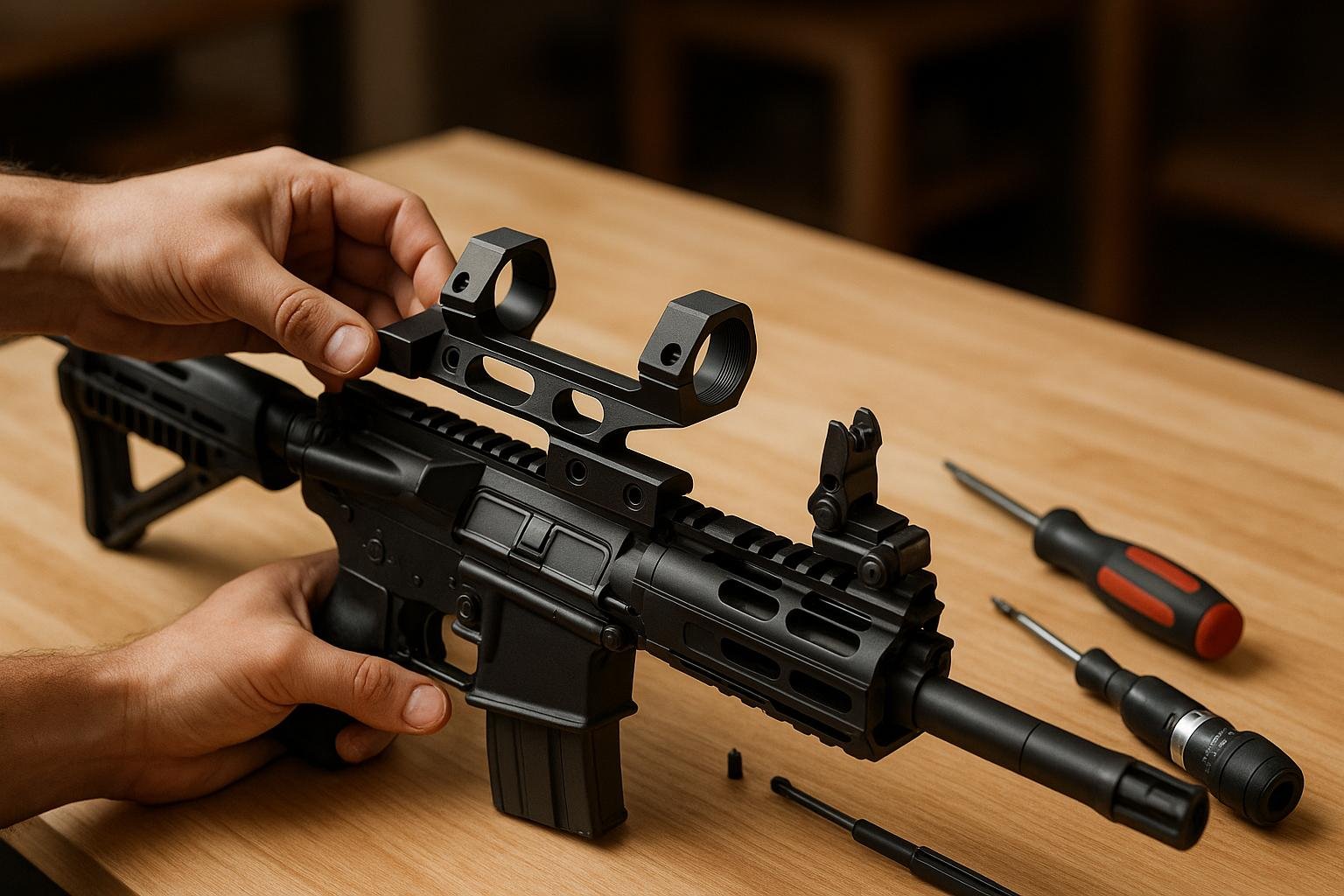
Installing a side scope mount can improve your rifle’s functionality, especially for firearms where top mounting isn’t an option. This guide breaks down the process into simple steps, from gathering tools to troubleshooting common issues. Here’s what you need to know:
- What is a Side Scope Mount?
It’s a mount that attaches to the side of a rifle’s receiver, allowing you to use both iron sights and a scope. Ideal for rifles with top ejection or specific designs. - Tools You Need:
A torque wrench, screwdrivers, thread adhesive (like Blue Loctite), a bubble level or reticle leveling system, and a gun vise are essential. Some firearms may require specialized tools. - Key Steps:
- Ensure the firearm is unloaded and secure it in a gun vise.
- Clean the mounting surface thoroughly.
- Align the base with pre-drilled holes, apply thread adhesive, and tighten screws to specifications.
- Position the scope, adjust eye relief, and level the reticle.
- Tighten all screws evenly and securely.
- Common Issues:
Loose mounts, misaligned optics, or stripped screws can impact accuracy. Regular maintenance and proper installation techniques help prevent these problems.
Side mounts are practical for certain rifle setups but may require extra care with windage adjustments and cheek position. Follow these steps carefully to ensure a stable and accurate installation.
What Are Side Scope Mounts
Side Scope Mount Basics
A side scope mount is a type of mount that attaches to the side of a rifle’s receiver, rather than sitting directly on top like traditional mounts. This design allows shooters to use both iron sights and a telescopic optic on the same firearm. The concept dates back to 1927 when Griffin & Howe introduced the detachable sidelever telescopic sight mount, setting the standard for rifles needing dual sighting systems.
Because the scope sits off to the side, some rifles may require stock modifications to ensure proper clearance. Side scope mounts are tailored to specific firearms, meaning they must match the rifle’s brand, model, and action length. Additionally, some manufacturers produce mounts specifically for AR-style rifles. These unique features define side mounts and contribute to their practical advantages.
Benefits of Side Scope Mounts
One of the standout benefits of side scope mounts is the ability to switch between iron sights and a telescopic optic, making them especially useful in changing lighting conditions where flexibility is key.
"The side scope mount was a matter of conflicting necessities. There is no one sight that’s good for all situations or purposes, so it’s a matter of providing sights for the most common situations." – Brett Nesin
Side mounts also allow for quick detachment, enabling shooters to transition to open or peep sights without losing zero.
From an ergonomic perspective, side mounts promote a more natural head position during long-range shooting, which can help reduce neck strain during extended sessions. They are particularly useful for rifles with top-loading magazines or those that eject casings upward. For instance, the Winchester 94 faced challenges with top ejection, making center-mounted scopes impractical until the 94 Angle Eject model redirected brass to the side.
These mounts also simplify tasks like clearing malfunctions and performing maintenance, which can be tricky on rifles like the Mosin-Nagant, where an unstable top cover complicates mounting. For hunters, having iron sights as a backup in low-light conditions or in case the telescopic optic fails can be a game-changer.
Type 81 Picatinny Side Mount Installation Guide
Required Tools and Materials
Before diving into the installation process, make sure you have everything you need. Being prepared with the right tools and materials will make the process much smoother and more efficient.
Basic Tools You Need
Start with reliable hand tools that match the fasteners on your mount. A calibrated inch-pound torque wrench is especially important to prevent over-tightening screws.
A good screwdriver set with interchangeable bits is essential for versatility. Additionally, thread adhesive like Blue Loctite will help secure screws while still allowing for future removal if necessary. Before applying it, lightly oil the screws and clean both the screws and holes to ensure proper adhesion.
For alignment, a bubble level works well for basic leveling, but if you want pinpoint precision, consider using a reticle leveling system. This tool is specifically designed to perfectly align the scope with your firearm.
Don’t forget cleaning supplies. A lens brush is ideal for removing dirt or debris from your scope lenses before mounting.
Lastly, use a gun vise to keep your firearm steady during the installation. This will help ensure accuracy and prevent any unnecessary movement.
If your firearm has unique features, double-check whether additional tools are needed before getting started.
Additional Tools for Specific Models
Some firearms, particularly older models, might require specialized tools. For instance, certain rifles may need specific drill bits for installation. Similarly, some mount systems use model-specific hardware or screws. Always review your mount’s documentation to identify any special tool requirements.
A laser bore sighter can also be a valuable addition. It helps align your bore and optic with precision, ensuring your firearm is sighted accurately.
With these tools and materials ready, you’ll be well-equipped to begin the installation process.
Installation Steps
Now that your tools and materials are ready, it’s time to dive into the installation process. Each step builds on the last, so take your time and follow the instructions closely.
Getting Ready
Safety first. Make sure your firearm is completely unloaded and double-check that no ammunition is anywhere near the action. Keep the safety engaged and always point the muzzle in a safe direction while working.
Set up your gun vise to hold the firearm securely in place. This prevents movement during the installation, ensuring precision and safety. Tighten the vise just enough to keep the rifle stable without causing any damage.
Clean the mounting surface thoroughly. Use a degreaser to remove any dirt, oil, or residue from the receiver where the mount will attach. A clean surface ensures a solid grip for the mount and prevents shifting over time. Make sure everything is completely dry before moving on.
Finally, organize your tools so they’re easy to access during the process.
Mounting the Base
Apply a light coat of oil to the underside of the rail, avoiding the screw holes to keep adhesive areas clean.
If your rifle has pre-drilled holes or grooves, align the base with these spots. Position the base carefully on the receiver and confirm that all screw holes line up perfectly.
Use Blue Loctite on the screws before threading them into place. This ensures the screws stay secure but can still be removed later if needed. Avoid using Loctite on the ring screws later, as it can lead to over-tightening.
Start threading the screws by hand to prevent cross-threading. Once they’re snug, use a calibrated torque wrench to tighten them to the manufacturer’s recommended specifications. This step is critical – over-tightening can damage threads or the receiver, while under-tightening can lead to a loose mount.
Check the base to ensure it’s firmly attached. Press gently to confirm there’s no movement. The mount should sit flush against the receiver with no gaps or wobble.
With the base securely in place, you’re ready to move on to aligning and adjusting your optic.
Installing and Adjusting the Optic
Place the scope into the rings, but don’t tighten them fully just yet. Adjust the eye relief distance, which is the space between your eye and the scope that allows you to see the full field of view. Proper eye relief is crucial to prevent recoil-related injuries, so take your time to get it right.
Assume your shooting position and adjust the scope until you achieve a full, clear field of view. Most scopes require about 3-4 inches of eye relief, but check the specific requirements for your model.
Level the scope using a bubble level or reticle leveling system. This step ensures your vertical and horizontal adjustments will be accurate. Place the level on the turret housing and adjust until the bubble is centered.
Once the scope is properly positioned, tighten all screws using your torque wrench to the manufacturer’s specifications. Tighten in a cross-pattern to distribute pressure evenly and avoid misalignment.
Focus the eyepiece by aiming at a light background and adjusting until the reticle appears sharp. This step ensures a clear reticle image while aiming.
Finally, mount the scope as low as possible without it touching the barrel or receiver. A lower mount provides a natural cheek weld and minimizes the height over bore, which can impact accuracy at varying distances.
Once everything is secure and aligned, the next step is to head to the range and zero your scope.
sbb-itb-31b92c7
Common Problems and Solutions
Once you’ve completed the installation, it’s crucial to double-check your work to ensure the mount is stable and secure. Even with careful preparation, issues can arise. Below, we’ll go over common mistakes and how to address them effectively.
Installation Mistakes to Avoid
Not cleaning surfaces properly can lead to debris or finish buildup interfering with the mount’s fit. Some Picatinny rails come with coatings like paint or ceramic finishes that may need to be trimmed or removed to ensure a secure connection.
Over-tightening or under-tightening screws is another frequent problem. Over-tightening can strip threads, while under-tightening may allow the mount to shift. A calibrated torque wrench, set to the manufacturer’s specifications, is essential for getting it just right.
Skipping thread adhesive on mounting screws is a common oversight. Without it, the recoil from repeated shots can loosen screws over time, compromising the mount’s stability.
Misaligned optics happen when the scope is not properly leveled or seated in the rings before tightening. This can result in a crooked reticle and accuracy issues.
Fixing Common Issues
If your mount feels loose even after tightening, the first step is to inspect for debris or finish buildup between the mount and rail. Clean both surfaces thoroughly with a solvent, remove any residue, and recheck the compatibility of the mount and rail. In most cases, proper cleaning followed by reinstallation with the correct torque and thread adhesive will solve the problem.
For a crooked reticle, loosen the ring screws and carefully reposition the scope until it’s level. Using a bubble level or a reticle leveling system can help ensure the optic is perfectly aligned before retightening. Proper leveling is especially important for maintaining accuracy at longer distances.
If you encounter issues like stripped threads or screws that won’t stay tight, stop immediately. Stripped threads often require professional repair, so consult a gunsmith. For screws that loosen repeatedly, inspect them for wear and consider upgrading to a stronger thread adhesive.
Sometimes, generic mounts may not fit certain firearm models perfectly. In such cases, you might need custom screws, shims, or adapters for a secure fit. Always refer to the manufacturer’s instructions and confirm compatibility before starting the installation.
To prevent recurring problems, inspect your mount and optic setup before each shooting session. Regular maintenance can help catch and address any issues before they impact your accuracy.
Side Mount Pros and Cons
After setting up your side mount, it’s important to weigh its benefits and challenges to fine-tune your shooting experience. Side mounts bring some clear advantages but also come with a few drawbacks worth considering. Let’s break them down before diving into how they compare to other mounting systems.
One major plus is that side mounts allow you to keep using your iron sights even while an optic is installed. This setup also avoids problems with ejection interference, making it a practical choice for certain firearms.
That said, the off-center placement of a side mount can introduce some issues. It tends to amplify vibrations, which can compromise accuracy. As Scorch, a Senior Member at TheFiringLine.com, explains:
"The primary one is that the scope is not as steady as a receiver-mounted scope, and the mount has vibration, reducing accuracy."
Another challenge is the added complexity of windage adjustments. Former competitive pistol shooter Bob Gray notes:
"Adjusting for elevation is the same as a conventionally mounted scope. ‘Windage’ requires exact adjustments at varying distances."
This difficulty stems from the scope’s offset position, which impacts the bullet’s trajectory both vertically and horizontally as the distance increases. For instance, a shooter observed that with a three-minute angle (MOA) offset, a scope zeroed at 100 yards caused bullet impacts to shift 6 inches to the right at 200 yards and 9 inches to the right at 300 yards. Such shifts demand precise adjustments and careful calculations, making side mounts more challenging to use compared to top-mounted scopes.
Another drawback is how side mounts can affect your cheek weld. The off-center position often forces shooters to adjust their head placement, which can feel awkward. This unnatural positioning may reduce comfort, make recoil absorption less effective, and lead to an inconsistent sight picture – ultimately impacting accuracy.
Mount Type Comparison
Here’s a quick overview of how different mount types stack up:
| Mount Type | Advantages | Disadvantages | Best For |
|---|---|---|---|
| Side Mount | Maintains access to iron sights; avoids ejection interference | Less stable; harder windage adjustments; awkward cheek weld | Rifles with ejection issues or backup sight needs |
| Top Mount | Highly stable; easy elevation adjustments; natural cheek weld | Blocks iron sights; unsuitable for some rifle designs | Precision shooting, hunting, general use |
| Rail System | Flexible positioning; supports multiple accessories; very stable | Adds weight; higher cost; may need gunsmithing | Tactical setups, multiple optics or accessory configurations |
Ultimately, the right mounting system depends on your rifle and shooting goals. Side mounts are a solid choice if your firearm ejects cases over the receiver or if you need to keep your iron sights accessible. However, for precision shooting, where stability is critical, top-mounted systems often deliver better results. If you’re shooting at shorter distances, where the offset effect is less noticeable, a side mount could still work well.
Conclusion
Installing a side scope mount involves careful preparation, precise adjustments, and ongoing upkeep. From selecting the right tools to making fine-tuned modifications, every step plays a role in ensuring your optics perform consistently. While the offset design requires extra care with windage and zeroing, it also keeps your iron sights ready for use – a practical balance for many shooters.
If you run into any issues during installation, don’t hesitate to reach out for help. Manufacturer support or online guides can be valuable resources. As Vortex Optics advises:
"If you have a unique mounting system, or if you have questions at any point in the process, just give us a call and we’ll get you dialed."
Regular checks are just as important – ensuring screws are properly torqued and the mount remains secure can save you from unexpected reliability problems. A loose mount can quickly compromise accuracy, so a little maintenance goes a long way.
FAQs
What can I do if my side scope mount is loose after installation?
If your side scope mount feels loose, the first step is to check that the screws are tightened correctly. The recommended torque is usually 20 inch-pounds, and using a torque wrench can help ensure precision. To keep the screws from loosening over time, consider applying a small amount of blue Loctite.
Additionally, double-check that the scope and rings are aligned properly and securely fastened. Avoid overtightening, as this can damage both the mount and the scope. If the problem continues, take a closer look at the mount for possible defects or misalignment – these issues might need professional attention or even a replacement.
How do I make sure my scope is properly aligned and leveled during installation?
To get your scope properly aligned and leveled, start by placing a bubble level on the rifle’s rail or scope base to check for horizontal alignment. For vertical alignment, use a plumb line or another bubble level positioned on the scope rings. This ensures there’s no tilt or cant in your setup.
While mounting the scope, secure the rifle firmly in a vice or use a scope leveling tool to keep it stable. Tighten the scope rings gradually in a criss-cross pattern to distribute pressure evenly and avoid misalignment. These steps are key to achieving precise alignment for more accurate shooting.
Are certain rifles better suited for side scope mounts instead of top mounts?
Some rifles are naturally better suited for side scope mounts because of their design or how they function. For instance, models like the M1 Garand or Winchester 1894 – with limited top rail space, unique bolt actions, or specific ejection port setups – often work well with side mounts. This arrangement prevents interference with the bolt or ejection system, ensuring smoother operation.
Ultimately, the decision to use a side mount comes down to the rifle’s design and the shooter’s preferences. Tactical or military-style rifles might also lean toward side mounts for added flexibility and ease of access. It’s important to match your mounting choice to your rifle’s setup and how you plan to use it.