
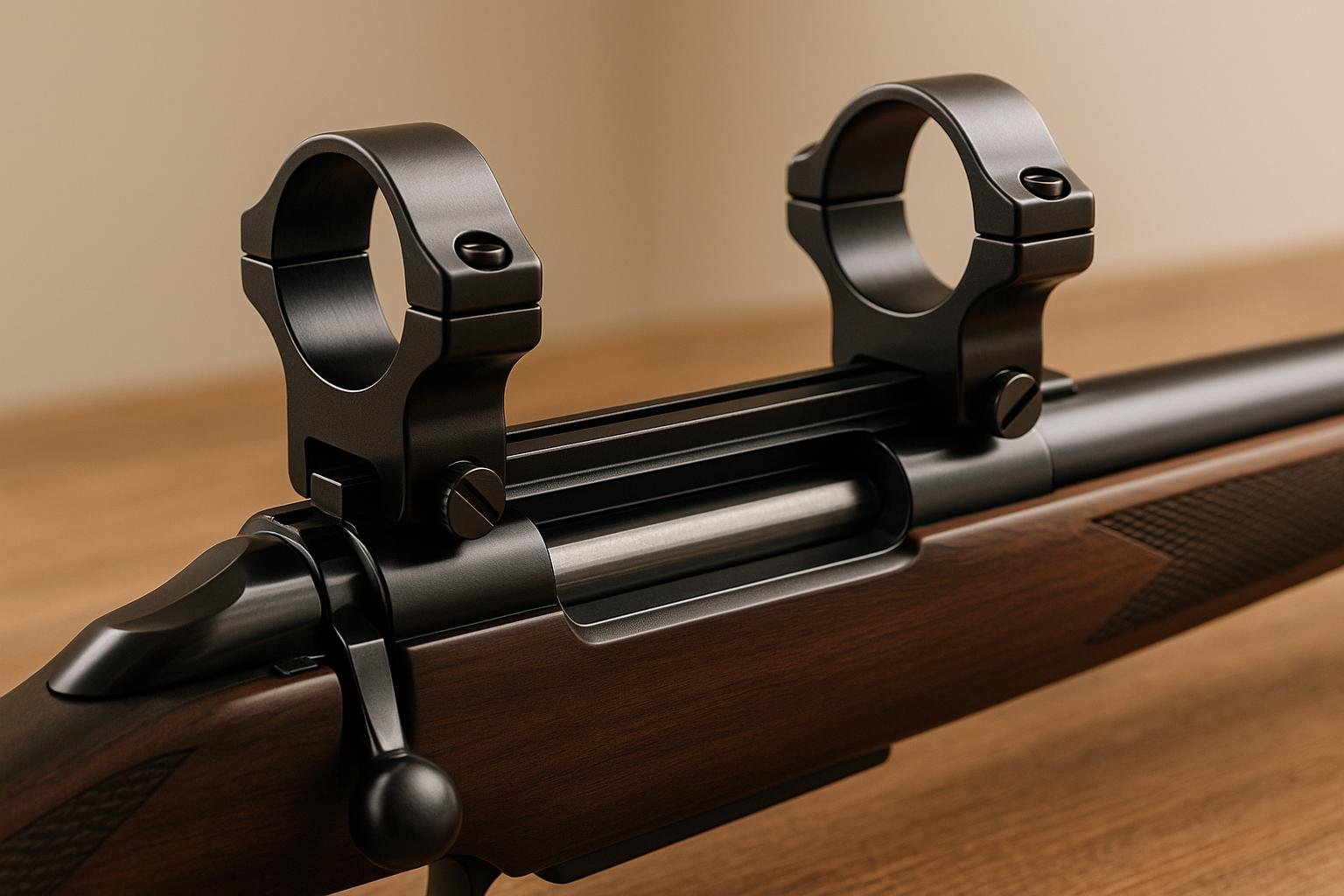
Dovetail scope mounts are a simple and affordable way to attach optics like scopes and red dot sights to firearms. Their unique dove-tail-shaped grooves provide a secure and adjustable fit, making them ideal for low-recoil firearms such as rimfire rifles and air guns. Here’s what you need to know:
- How They Work: Dovetail mounts use a wedge-like rail design (common sizes: 11 mm and 3/8 inch) to securely hold optics in place with clamping screws.
- Benefits: Affordable, lightweight, low-profile, easy to install, and great for quick optic changes.
- Drawbacks: Limited compatibility with modern firearms, struggles with high recoil, and less suitable for heavy optics.
- Best Use Cases: Perfect for rimfire rifles, air guns, vintage firearms, target shooting, and small game hunting.
If you’re using a low-recoil firearm and value simplicity, dovetail mounts are a solid choice. For heavier-duty setups, consider alternatives like Picatinny or Weaver mounts.
How-To Mount a Scope on an 11mm Dovetail Rail – Airgun Bootcamp
How Dovetail Scope Mounts Work
Dovetail scope mounts rely on a simple yet effective mechanical design to attach your optic securely to your firearm. By understanding how these mounts function, you’ll be better equipped to make decisions about installation and compatibility. Below, we’ll break down the rail design, common sizes, and how accessories are mounted.
The Dovetail Rail Design
At the heart of the dovetail mount is its inverted trapezoid-shaped rail. This design creates a wedge-like connection as the rail slides into a matching bracket. Once in place, clamping screws are tightened to ensure a firm and stable fit .
Common Sizes and Standards
Dovetail rails come in various sizes, with the 11–12 mm (or 3/8-inch) rail being the most common. Other sizes include 13, 14, 14.5, 16, 16.5, 17, and 19 mm . For instance, Warsaw Pact rails are typically around 14 mm.
| Dovetail Size | Example Firearms |
|---|---|
| 9.5 mm | Crosman Pumpmaster 760, CZ 452, Remington Model 552 |
| 11 mm | Accuracy International Arctic Warfare, CZ 455 and 511, Remington Model 597, Tikka T1x, Weihrauch HW 35 |
| 13 mm | Chiappa Firearms Double Badger |
| 17 mm | Sako TRG, Tikka T3 |
| 19 mm | CZ 550 |
Some manufacturers, like Sako, incorporate variable-width (or tapered) dovetails in models such as the Sako 75 and 85. These require specially designed mounts to fit properly.
Mounting and Securing Accessories
The trapezoidal shape of the dovetail rail guides the scope rings into the grooves, ensuring proper alignment. Once the scope is aligned with the rifle’s bore, tightening the clamping screws locks everything into place, delivering both accuracy and stability . Dovetail mounts are particularly popular for rimfire rifles and air guns , as their design helps maintain consistent stability shot after shot.
Benefits of Dovetail Scope Mounts
Dovetail mounts are a practical and reliable option for various shooting needs. Their design and functionality make them a popular choice in specific shooting scenarios.
Easy on the Wallet and Simple to Use
One of the biggest perks of dovetail mounts is their affordability. Thanks to their straightforward design – featuring a basic rail, rings, and clamping screws – they’re both cost-effective and easy to work with. Installation is a breeze and doesn’t require any special tools or complex setups, making them an accessible choice for shooters of all experience levels.
Sleek, Low-Profile Build
Dovetail mounts keep your scope positioned close to the bore, ensuring it stays properly aligned with the barrel. This low-profile setup not only supports accuracy but also helps maintain a consistent cheek weld for improved shooting comfort. Their compact and lightweight design makes them ideal for air rifles and rimfire rifles, where keeping the weight down is a priority.
Quick and Convenient Optic Changes
Often referred to as "tip off" mounts, dovetail rails allow for fast and easy removal of optics. This feature is especially handy when switching between sighting options or performing routine maintenance. Whether you’re swapping out a scope for iron sights or adjusting magnification levels, dovetail mounts let you make changes without altering your rifle permanently. Plus, when you reattach your optics, they typically return to their original position with little to no need for recalibration.
Drawbacks of Dovetail Scope Mounts
Dovetail mounts come with their fair share of benefits, but they aren’t without limitations. It’s important to weigh these drawbacks to determine if this mounting system aligns with your specific firearm and shooting needs. Below, we break down the key challenges tied to compatibility, recoil management, and accessory use.
Limited Compatibility
One of the main issues with dovetail mounts is their limited compatibility with modern firearms and optics. While they work well for low-recoil setups, they struggle with firearms outside this scope. Many modern optics and accessories are designed with Picatinny or Weaver systems in mind, which means dovetail mounts often fall short in accommodating them. Additionally, older Weaver mounts can have inconsistent slot widths, making them incompatible with contemporary rings and accessories.
Recoil Management Challenges
Dovetail mounts also show weaknesses when it comes to handling higher recoil forces. They’re simply not designed for the demands of centerfire rifles, where the recoil can cause the scope to shift. This movement can lead to a shifting zero, which directly impacts accuracy. The issue becomes even more pronounced with heavier scopes, as they are more prone to shifting under recoil . For shooters using firearms with significant recoil, this can result in ongoing frustration and the need for frequent adjustments.
Accessory Size and Weight Limitations
Another drawback is the restriction on accessory size and weight. Dovetail rails have less holding power compared to Picatinny or Weaver systems, limiting them to smaller, lighter optics. This reduced stability means you’re often confined to compact scopes that may lack advanced features. Additionally, screws on dovetail mounts need regular checking to prevent unwanted movement during use .
When compared to alternatives, these limitations stand out. Picatinny rails, for instance, offer better security and are commonly used on high-recoil firearms. Weaver rails provide greater stability for both rimfire and centerfire rifles. Ultimately, dovetail mounts are best suited for lighter firearms and low-recoil applications, making them less ideal for heavy-duty shooting scenarios.
sbb-itb-31b92c7
When to Use Dovetail Scope Mounts
Dovetail mounts may not be ideal for high-recoil firearms, but they shine in specific situations where their straightforward design and low-profile build are a plus. Knowing when to use these mounts can help you make the best choice for your firearm and shooting activities.
Rimfire and Air Rifles
Dovetail mounts are a natural fit for rimfire and air rifles, where low recoil eliminates concerns about their limitations. The standard 3/8" (around 11 mm) rail size makes it easy to find compatible accessories. With air rifles, minimal recoil prevents issues like scope creep, while the 30-degree rail angle provides a secure grip and allows for fine-tuning eye relief. Keep in mind, though, that some brands, like BSA, use 13 mm rails, so it’s important to double-check your rail width before purchasing.
Vintage Firearms
For vintage firearms, dovetail mounts are a great option to maintain the original look and feel of the weapon. Many older guns come with factory-installed dovetail rails, which preserve their historical style while still offering solid performance for firearms with low to moderate recoil.
Target Shooting and Small Game Hunting
Dovetail mounts are especially useful for target shooting and small game hunting. Their lightweight design allows for easy scope adjustments, and their low profile helps prevent snagging on brush. Plus, they’re budget-friendly, making them a practical choice for shooters looking to keep costs down.
Key Points About Dovetail Scope Mounts
Dovetail scope mounts offer a straightforward and dependable way to attach scopes, making them a favorite for shooters who appreciate a simple, low-profile design. These mounts are commonly used on rimfire rifles, air guns, and even some older firearms. Let’s break down the essentials.
One of the most critical factors is design and compatibility. Dovetail rails are characterized by their distinctive 30-degree angle, which makes them incompatible with Picatinny or Weaver systems. Before choosing a mount, it’s important to measure your rail width and ensure that the scope’s tube diameter aligns with the mount’s specifications.
What makes dovetail mounts appealing is their simplicity, affordability, and low-profile design. These features help reduce snagging and allow for precise, adjustable eye relief. However, they do have limitations. Dovetail mounts are less durable under heavy recoil, and lower-quality options may shift during firing, potentially causing your scope to lose its zero. Additionally, the wide variety of sizes and configurations can sometimes make selecting the right accessory a bit tricky.
Given these traits, dovetail mounts are best suited for low-recoil firearms and applications where precise adjustments are essential, such as target shooting or small game hunting. For modern firearms or setups involving high recoil, a sturdier mounting system might be a better fit.
Lastly, it’s worth noting that most night vision and thermal accessories require a dovetail-to-Picatinny adapter to be mounted.
FAQs
How can I check if my firearm works with dovetail scope mounts?
To determine if your firearm works with dovetail scope mounts, start by examining the rifle’s receiver. Look for a dovetail mounting surface, which is usually 11 mm or 3/8 inch wide. Pay attention to the grooves on your rifle to confirm they match the mount’s design.
Next, check whether your rifle has a flat-top or round-top dovetail, as mounts are often designed specifically for one of these shapes. If your rifle has pre-drilled holes, you might have the option to use either dovetail mounts or direct mounts. For precise details, always refer to your firearm’s user manual or specifications.
What makes dovetail scope mounts different from Picatinny or Weaver mounts?
Dovetail Scope Mounts: How They Compare to Picatinny and Weaver Systems
Dovetail scope mounts stand out from Picatinny and Weaver systems because of their distinct design and practical functionality. They feature a trapezoidal shape with parallel grooves, making it simple to install or remove optics without relying on screws. These mounts are especially popular with rimfire and air rifles and are typically available in two standard widths: 11mm or 3/8 inch. A significant benefit of dovetail mounts is the ability to make precise adjustments for eye relief by sliding the mount along the rail.
On the other hand, Picatinny and Weaver rails take a different approach with slots cut perpendicularly across the rail. Picatinny rails have uniform slot spacing, which allows them to accommodate a broader range of accessories. Weaver rails, however, feature narrower slots with variable spacing, limiting compatibility. While Picatinny mounts provide a more secure fit and are better equipped to handle recoil, they lack the adjustability that dovetail mounts offer. Ultimately, the choice between these systems depends on your firearm setup and shooting preferences.
Are dovetail mounts strong enough to handle the recoil of high-powered firearms?
Dovetail mounts work well for firearms with low to moderate recoil, such as rimfire rifles and air guns. These mounts are designed to securely hold lighter scopes, making them a reliable choice for less intense shooting setups. However, they may not perform as effectively when paired with high-powered or large-caliber firearms due to the stronger recoil forces.
While some dovetail mounts can handle moderate recoil to an extent, they aren’t the best option for heavy-duty use. For firearms with significant recoil, opting for a sturdier mounting system is a better way to ensure both stability and long-term reliability.