
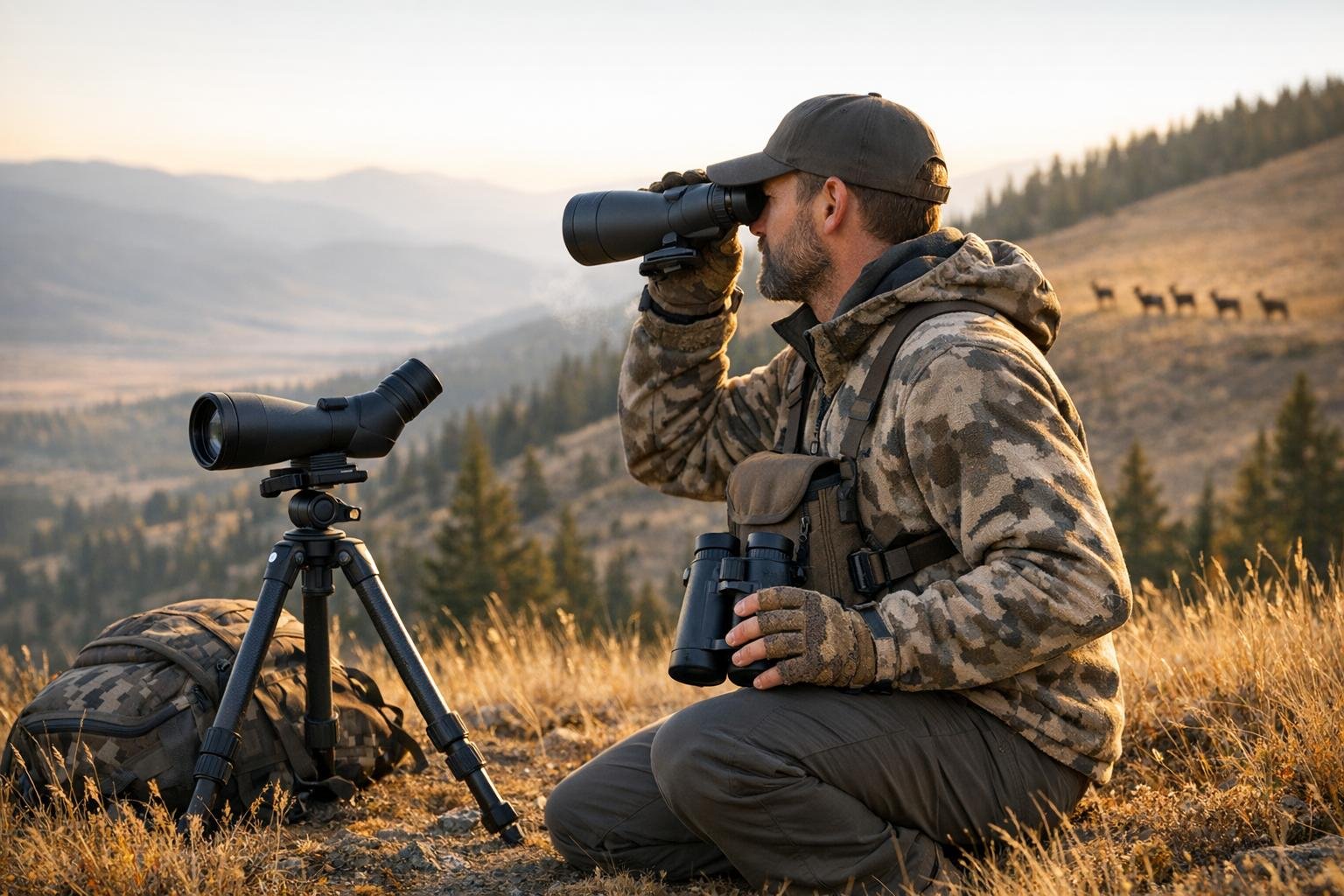
When choosing between spotting scopes and binoculars for hunting, it’s all about your needs in the field. Binoculars are lightweight, easy to use, and ideal for scanning large areas or tracking movement. They typically offer 8x–12x magnification and are perfect for ranges up to 600 yards. Spotting scopes, on the other hand, provide higher magnification (15x–60x), making them essential for detailed observation at distances beyond 1,000 yards. However, they require a tripod for stability and are bulkier to carry.
Key Takeaways:
- Binoculars: Best for dense woods, active stalking, and quick use. Affordable options start under $300.
- Spotting Scopes: Best for long-range detail, open terrain, and stationary setups. Quality models start around $1,000.
- Using Both: Scan with binoculars, then confirm details with a spotting scope for the perfect balance of speed and precision.
Quick Comparison:
| Feature | Binoculars | Spotting Scopes |
|---|---|---|
| Magnification | 8x–12x | 15x–60x |
| Field of View | Wide | Narrow |
| Portability | Lightweight, handheld | Heavy, tripod required |
| Best Use | Dense woods, mobile hunting | Open terrain, long-range glassing |
| Price Range | Under $300 for quality models | $1,000+ for quality models |
Binoculars handle 90% of observation needs, but spotting scopes excel in detail and precision. For most hunters, starting with binoculars is the smarter choice. Pairing both tools ensures efficiency and success in any terrain.
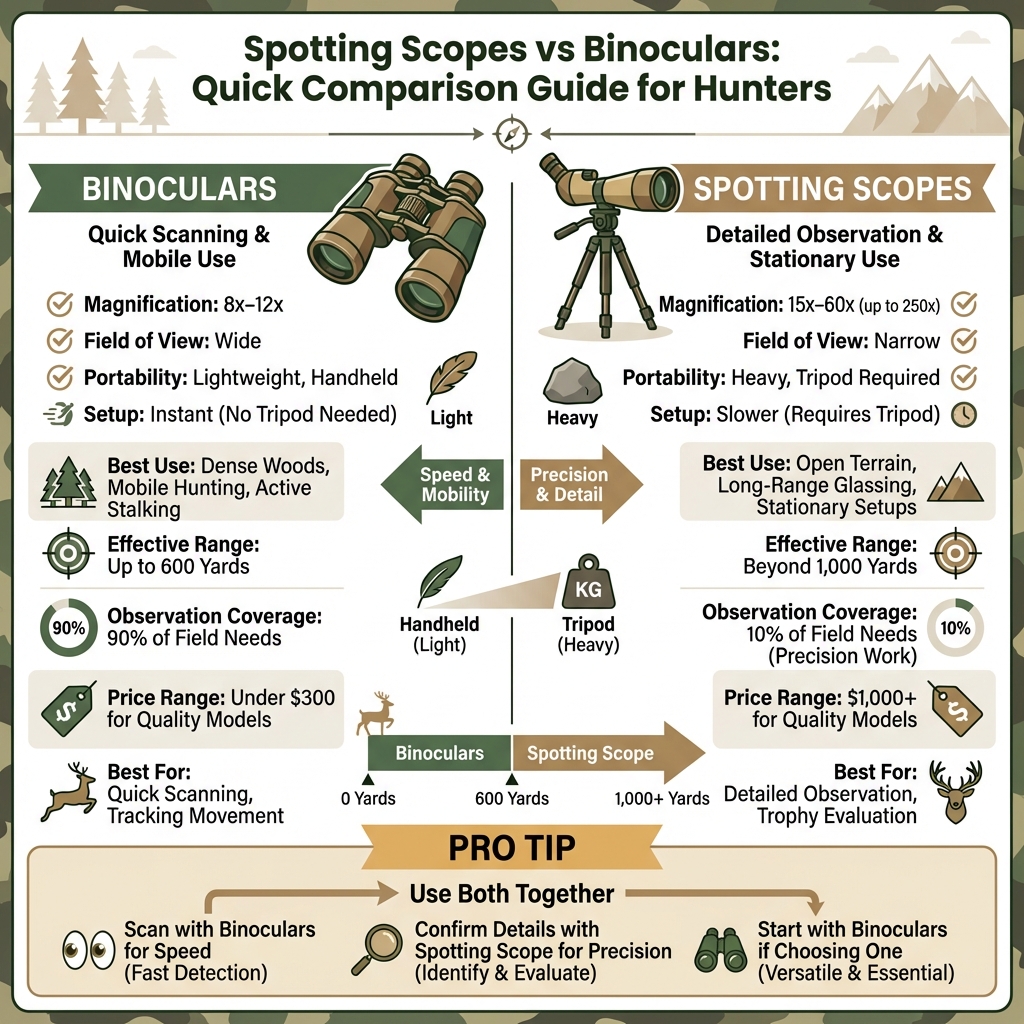
Spotting Scopes vs Binoculars Comparison Chart for Hunters
Main Differences Between Spotting Scopes and Binoculars
Magnification and Field of View
Binoculars generally provide 8x, 10x, or 12x magnification, offering a balance between zoom and ease of use. They are designed for a broad field of view, making them perfect for scanning wide areas. Spotting scopes, on the other hand, deliver much higher magnification – ranging from 15x to 60x, and in some cases, even up to 250x. However, this increased zoom comes with a trade-off: a narrower field of view, which is better suited for pinpointing details.
"If binoculars are your daily driver, spotting scopes are your scalpel." – TRACT Optics Team
Binoculars usually feature sub-50mm lenses, prioritizing portability, while spotting scopes rely on larger lenses (60mm or more) to gather enough light for high-magnification clarity. While binoculars are effective for identifying targets up to 500–600 yards, spotting scopes become indispensable for distances beyond 1,000 yards.
These differences in magnification and light-gathering ability shape how each tool is used in the field.
Portability and Setup
When it comes to portability, binoculars have the upper hand. Their lightweight design allows you to carry them around your neck with a strap or secure them in a chest harness, leaving your hands free for navigating rugged terrain.
"Just slap them around your neck and head on out – no tripod, no setup." – Optics Force
Spotting scopes, in contrast, are bulkier and require a tripod for stability, which adds to their weight and slows down their setup. This makes them less practical for active hunts but highly effective for stationary use. Because of this, many hunters prefer binoculars for ranges up to 1,000 yards, while spotting scopes dominate for longer distances.
| Feature | Binoculars | Spotting Scopes |
|---|---|---|
| Weight | Lightweight and compact | Heavy and bulky |
| Deployment | Instant (handheld) | Slower (tripod required) |
| Carrying Method | Neck strap or chest harness | Pack space + tripod |
| Best Terrain | Dense woods, active stalking | Open country, fixed vantage points |
Intended Use and Stability
The differences in magnification and portability naturally influence how and when each optic is used. Binoculars shine in fast-paced hunting scenarios where quick, handheld glassing is essential. Their lower magnification reduces the need for stabilization, although higher-powered models (like 12x) may still benefit from a rest in some cases. Plus, using both eyes minimizes fatigue during prolonged glassing sessions and offers better depth perception compared to the single-eye viewing of a spotting scope.
Spotting scopes, however, require steady support to perform well. At higher magnifications, even slight hand movements can cause significant image shake, making a tripod essential. This makes them ideal for stationary setups where detailed observation of distant targets is the priority. Many hunters use binoculars for scanning and then switch to a tripod-mounted spotting scope for closer inspection.
"The more you magnify an image the more you also magnify the movements in your hand caused when you try to hold something steady." – David James, Optics Expert
sbb-itb-31b92c7
Pros and Cons of Binoculars for Hunting
Benefits of Binoculars
Binoculars are compact, easy to carry, and ready to use at a moment’s notice. You can wear them on a neck strap or chest harness, keeping your hands free for navigating rugged terrain. Unlike spotting scopes, they don’t require a tripod – just lift them to your eyes and you’re good to go.
"Binoculars are by far the simplest optical device to use, the easiest to keep around, and probably the easiest to find." – John McCoy, Bear Creek Arsenal
One standout feature is their wide field of view, typically ranging from 130 ft. to 450 ft. at 1,000 yards. This makes them ideal for quickly scanning large areas and tracking moving game. According to 9-Hole Reviews, binoculars are used for observation tasks 90% of the time within ranges of 0 to 1,000 yards. In dense forests or brush, 8x binoculars excel by offering the widest field of view, allowing hunters to detect movement through foliage before the game becomes aware.
Another plus? Binoculars are often more budget-friendly than spotting scopes of similar optical quality. While their benefits are numerous, binoculars do come with a few trade-offs.
Drawbacks of Binoculars
Binoculars, while versatile, have some limitations. Their lower magnification can make it challenging to pick out fine details at long distances. For example, identifying antler points, age rings on sheep, or bullet impacts beyond 200 yards can be tough. This can limit their effectiveness for precise long-range spotting.
While 10x binoculars perform well for spotting targets up to 500 or 600 yards, they struggle beyond that range. The fixed magnification of binoculars stems from the technical difficulty of synchronizing dual zoom lenses. Additionally, their smaller objective lenses can’t maintain image brightness or clarity at higher magnifications. For instance, zooming a standard binocular lens to 80x would result in a dim and unclear image.
High-power binoculars (15x and above) often require a tripod to stabilize the image, which reduces their portability advantage. Furthermore, features like built-in reticles for ranging targets are far less common in binoculars compared to spotting scopes.
Comparison Table: Binoculars Features
The table below highlights how binoculars perform in various hunting scenarios, balancing their strengths and weaknesses.
| Hunting Situation | Advantage | Disadvantage |
|---|---|---|
| Timber / Dense Cover | Wide field of view helps spot movement through thick brush | Lower magnification makes it harder to detect stationary animals |
| Backcountry / Hiking | Lightweight design reduces fatigue during long treks | Can’t reliably assess trophy quality across a canyon |
| Open Plains / Long Range | Comfortable for prolonged scanning with both eyes | Lacks the power to distinguish fine details like antler points at 500+ yards |
| Vantage Point Glassing | Offers better depth perception and reduces eye strain | Requires tripod for stability at magnifications above 12x |
Pros and Cons of Spotting Scopes for Hunting
Benefits of Spotting Scopes
Spotting scopes offer impressive magnification, typically ranging from 15x to 60x, which unveils details that standard binoculars simply can’t. This level of clarity allows hunters to spot fine features like antler tines, age rings, or even bullet holes – critical for assessing game or shot accuracy.
The larger objective lenses, often between 65mm and 100mm, gather far more light compared to binoculars. This ensures bright, clear images even at higher magnifications, which is invaluable when judging trophy quality from across a canyon or verifying shot placement at long distances.
"A spotter helps me find game as far away as five miles. It’s almost a magic wand for scouting."
– Ron Spomer, Outdoors Writer
When combined with a tripod and angled eyepiece, spotting scopes provide a steady, comfortable viewing experience, ideal for extended use in seated or prone positions. Some models even include reticles for precise range estimation or shot correction, making them a versatile tool for hunters. As the TRACT Optics Team aptly describes, "If binoculars are your daily driver, spotting scopes are your scalpel".
However, these advantages don’t come without compromises.
Drawbacks of Spotting Scopes
While spotting scopes excel in detail, they do have limitations. One major drawback is their narrow field of view at high magnifications, which can make locating or tracking moving targets a challenge.
Their reliance on a sturdy tripod adds another layer of complexity. Carrying both the scope and a heavy-duty tripod can be cumbersome, especially for hunters who need to move quickly or navigate dense terrain. This setup also takes time to assemble, making it less practical for fast-paced hunting scenarios.
Extended use can strain the eyes, as keeping one eye closed for long periods often leads to fatigue, headaches, or dizziness. Additionally, when magnifications exceed 40x, environmental factors like heat mirage can distort the image, limiting their effectiveness in the field.
Comparison Table: Spotting Scopes Features
| Hunting Situation | Advantage | Disadvantage |
|---|---|---|
| Open Terrain / Western Hunt | Ideal for judging trophy quality across canyons at 500+ yards | Heavy tripod setup adds significant weight to backcountry gear |
| Mountain Glassing | Confirms if game is worth the climb, saving hours of effort | – |
| Target Range / Zeroing | Enables viewing of .22 caliber holes at 500 yards | Narrow field of view makes initial target acquisition difficult |
| Dense Timber / Woods | High magnification reveals stationary animals in shadows | Setup time and narrow view limit usefulness in thick brush |
When to Use Binoculars vs Spotting Scopes
When to Use Binoculars
Binoculars are the go-to choice for active hunters who need to move quickly and stay agile. Whether you’re tracking whitetail in dense timber, stalking turkeys through heavy cover, or following elk in thick brush, binoculars offer a wide field of view that makes spotting movement much easier. Since they don’t require a tripod, they’re perfect for a fast-paced, on-the-go hunting style.
For wooded areas, 8×42 binoculars are a standout option. Their lower magnification cuts through foliage more effectively than higher-powered models, making it easier to track animals weaving through tight spaces. This is especially important for species that are constantly on the move. Another major advantage of binoculars is their performance in low-light conditions, like dawn or dusk, where they often provide brighter images than a spotting scope with higher magnification.
"Lower power binoculars… are best at seeing through foliage in dense cover. Turkey hunters and whitetail hunters that hunt in timber need a larger field of view to be able to find game before the hunter is spotted."
– TRACT Optics
Experts estimate that binoculars handle about 90% of observation needs in the field. Using both eyes not only provides a natural view but also reduces fatigue during long periods of scanning.
However, when precision and detail at a distance become critical, that’s when a spotting scope steps in.
When to Use Spotting Scopes
Spotting scopes shine in situations where you need long-range detail while remaining stationary. Whether you’re glassing for mule deer in wide-open canyons, evaluating sheep on rugged alpine ridges, or judging antler points on a far-off buck, a spotting scope with 15x–60x magnification reveals details that binoculars simply can’t match. These tools are particularly valuable for distances beyond 1,000 yards, where they help hunters assess age, antler structure, and overall body condition before deciding on a stalk.
To get the most out of a spotting scope, find a stable vantage point and set up a tripod. This setup allows you to scan large, open areas efficiently. Spotting scopes are especially useful for locating bedded game that might be hidden in shaded areas during the heat of the day. For hunters targeting sheep or mountain goats in high-altitude environments, spotting scopes are often the only way to identify distant features clearly.
"Choosing between spotting scopes and binoculars is all about how you hunt and the terrain you’re working with."
– Optics Force
A smart approach is to use both tools together. Start by scanning the landscape with binoculars for quick coverage, then switch to a spotting scope for closer inspection and trophy evaluation. This "scan and confirm" method helps you balance speed with precision, ensuring you can make informed decisions about your next move.
Using Both Binoculars and Spotting Scopes Together
How to Use Both Tools Together
Pairing binoculars with a spotting scope can take your hunting efficiency to the next level. Many seasoned hunters start by scanning large areas with binoculars, typically in the 8× to 15× range, holding each view steady for about 30 seconds to catch subtle movements like the flick of an ear or the twitch of a tail.
Once something catches your eye, switch to a spotting scope with 20×–60× magnification. This allows you to zoom in on details like antler points or body condition to confirm your target. Big-game guide Buzz Brown explains it well:
"When you’re on a hill and looking for things, not trying to size them up but just find them, a 15× pair of HDs are best… I’ll switch to a spotting scope if I’m looking for stuff bedding under trees at a distance".
A handy tip is to attach a phone adapter to your spotting scope. This lets you take a reference photo of the animal and surrounding landmarks, which can be invaluable when planning your approach through tricky terrain. If you’re hunting with a partner, one person can scan the area with binoculars while the other uses the spotting scope to evaluate a specific target.
Tips for Carrying Both Optics
How you carry your binoculars and spotting scope can make a big difference in the field. Keep your 8× or 10× binoculars in a rigid chest harness for quick access during scans or when closing in on your target. Your spotting scope, on the other hand, should be mounted on a lightweight carbon-fiber tripod and secured to your pack for easy deployment.
The tripod is essential for getting the most out of your spotting scope. As Buzz Brown puts it:
"You can slap a $400 spotting scope on a good tripod, and see more than you can with a $2,800 scope on a cheap tripod".
For backcountry hunts, compact spotting scopes with 50–65 mm objective lenses work best when paired with lightweight tripods. To keep your optics in top shape, especially in dusty or windy conditions, carry a small can of compressed air to clean your lenses without scratching them.
Binoculars vs Spotting Scope | 9-Hole Reviews
Conclusion
Selecting the right optic depends on your hunting style and the terrain you navigate. Binoculars are perfect for dense forests and mobile hunts, offering a broad field of view that helps with quick target identification. On the other hand, spotting scopes shine in open landscapes, where a stationary setup allows for detailed observation of distant targets.
For wooded environments, binoculars in the 8×–10× range work well, providing the clarity and range needed without being cumbersome. If you’re tackling alpine terrain, a spotting scope becomes indispensable for assessing far-off ridgelines and avoiding unnecessary treks. Many seasoned hunters use both tools – binoculars for scanning and detecting movement, then a tripod-mounted spotting scope for closer inspection.
Your budget plays a key role, too. It’s wise to begin with a pair of quality binoculars that fit your price range before investing in a spotting scope. As Grafton Archery & Outdoors puts it:
"Binoculars represent the most versatile optic investment for hunters."
Keep in mind, a spotting scope under $200 often falls short in performance compared to well-made binoculars in the same price range.
FAQs
What binocular size is best for my hunting style?
When choosing binoculars for hunting, the right size largely depends on your terrain and how mobile you are. Binoculars with 8x or 10x magnification strike a good balance between image clarity, field of view, and ease of carrying. These magnifications are versatile enough to handle both stationary observation and active hunting scenarios.
What tripod should I use with a spotting scope?
The best tripod for a spotting scope largely depends on the size of your scope and how you plan to use it. If you have a heavier scope, a solid and reliable option like the Manfrotto 055 is a great pick. On the other hand, if portability is a priority, lightweight models such as the Leupold Pro Guide CF-436 are excellent choices. Many people gravitate toward carbon fiber tripods because they offer a combination of durability and light weight, which makes them especially handy for activities like hunting.
Is a spotting scope worth it if I hunt under 600 yards?
For distances under 600 yards, a spotting scope often isn’t needed. Binoculars are a more practical option – they’re lighter, easier to carry, and offer greater versatility for most hunting situations within this range.