
The choice between night vision clip-ons and dedicated scopes depends on your hunting style, budget, and specific needs. Here’s a quick breakdown:
- Clip-Ons: Attach to your existing day scope, retaining your zero. Ideal for versatility, occasional night use, and keeping your day scope intact. Best for magnifications up to 8x. Prices range from $300 to $10,000+, with portability and multi-rifle use as key advantages.
- Dedicated Scopes: Replace your day scope, offering sharper images and features like built-in reticles, rangefinders, and ballistic tools. Perfect for serious night hunters, with better balance and higher magnification options. Prices start at $1,000 and can exceed $8,000.
Quick Comparison
| Feature | Night Vision Clip-On | Dedicated Night Vision Scope |
|---|---|---|
| Image Quality | Good; depends on day scope | Superior; optimized for night use |
| Setup | Fast; no re-zeroing needed | Slower; requires re-zeroing |
| Weight Balance | Front-heavy | Better balance on the rail |
| Flexibility | High; works on multiple rifles | Low; rifle-specific |
| Magnification | Limited (1x–8x) | High; supports full zoom range |
| Price Range | $300–$10,000+ | $1,000–$8,000+ |
Key Takeaway: Clip-ons are great for flexibility and cost-effectiveness, while dedicated scopes excel in image quality and advanced features. Choose based on how often you hunt at night and your budget.
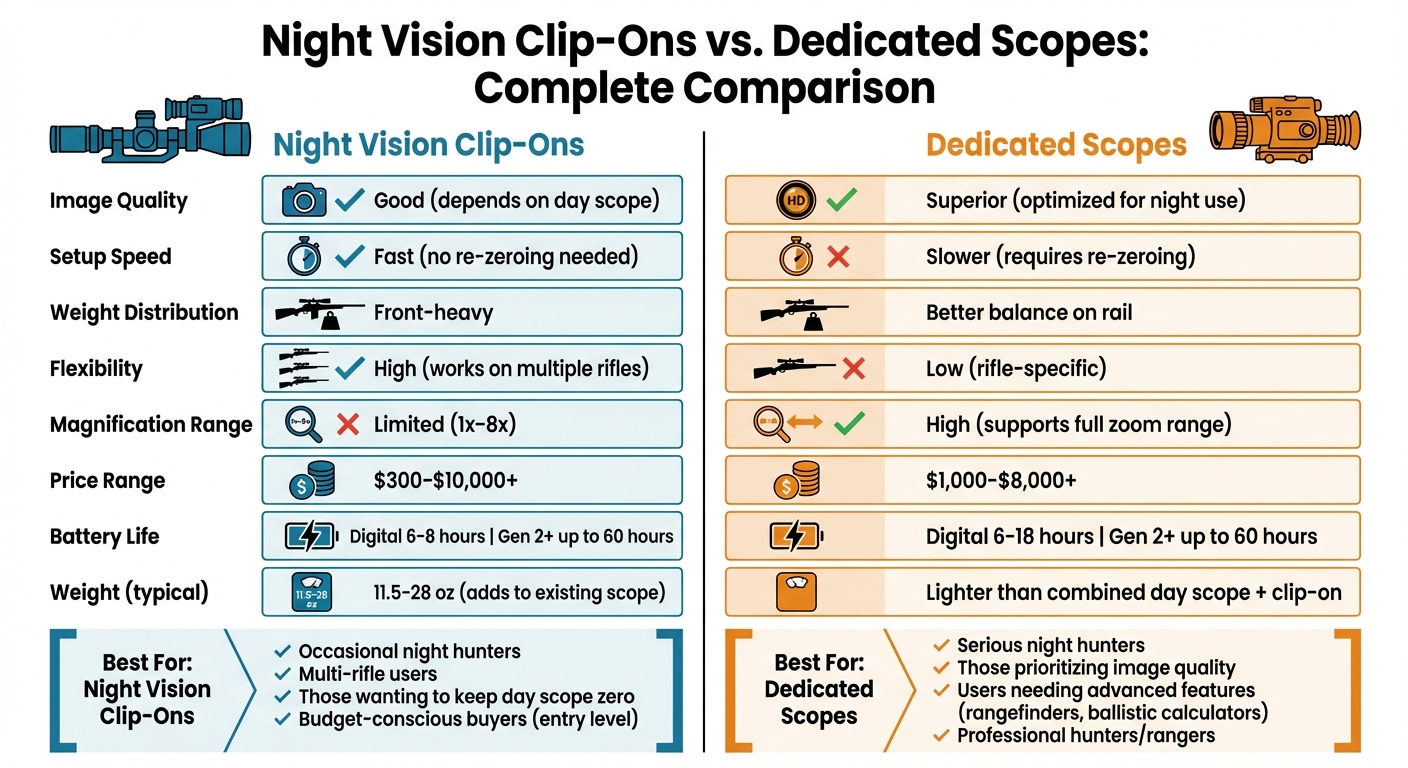
Night Vision Clip-Ons vs Dedicated Scopes Comparison Chart
How to Pick a Night vision NVD: Clip On Vs Dedicated Night Sights | Tactical Rifleman
sbb-itb-31b92c7
What Are Night Vision Clip-Ons?
Night vision clip-ons are devices designed to attach to your existing daytime scope, transforming it for use in low-light conditions while keeping your original zero intact. These add-ons can be mounted in front of – or sometimes behind – your day scope, making them versatile tools for nighttime use.
The core components of a clip-on include an objective lens, an image intensifier tube (or digital sensor), and a collimating lens. Together, these elements create a night-vision image that aligns with your daytime scope. This setup ensures you can maintain ballistic accuracy while using the same reticle and adjustment knobs, offering a seamless transition between day and night.
How Clip-Ons Work
The way clip-ons mount to your scope highlights their advantages. Most models attach either to a Picatinny rail in front of your scope or directly to the scope’s objective lens using an adapter.
One of the standout benefits is zero retention. Since the clip-on projects a 1x (unity) image that aligns perfectly with your existing optic, your point of impact remains unchanged from daytime use. As noted by the Tactical Life staff:
"The training and proficiency benefits that come with maintaining one day-scope system for 24-hour use is significant. The same zero is maintained, the same ballistic data and resulting aiming corrections are maintained."
Main Features of Clip-Ons
Resolution and Sensors: High-end digital clip-ons often feature 2K CMOS sensors (2,560 x 1,440 pixels), delivering exceptional image clarity. For comparison, a 640×512 sensor offers almost three times the resolution of a 384×288 sensor (327,680 vs. 110,592 pixels), making it an excellent choice for long-range visibility up to 1,000 yards.
Weight and Portability: Lightweight designs like the PARD FD1 weigh just 11.5 oz (328 grams). Battery life varies, with digital units lasting 6–8 hours, while Gen 2+ image-intensified models can run up to 60 hours.
Compatibility: Using the correct adapter is crucial for optimal performance and maintaining image quality. Most clip-ons perform best with magnifications between 1x and 8x, as image quality tends to degrade at higher magnifications. Additionally, many clip-ons double as handheld monoculars, making them useful for scouting before taking a shot.
What Are Dedicated Night Vision Scopes?
Dedicated night vision scopes are purpose-built devices designed exclusively for nighttime shooting. Unlike clip-ons, which modify your existing day scope for night use, these are standalone systems that completely replace your daytime scope. They come equipped with features like built-in digital displays or image intensifier tubes, integrated reticles, and electronic controls, making them self-contained and optimized for low-light conditions.
The main advantage of dedicated night vision scopes is their specialized design. Every component – from the objective lens to the sensor and display – is crafted specifically for nighttime use. This results in sharper, higher-resolution images compared to clip-ons. Some models can amplify ambient light by an astonishing 30,000 to 50,000 times, offering exceptional visibility in darkness.
How Dedicated Scopes Differ from Clip-Ons
One of the biggest differences between dedicated night vision scopes and clip-ons is how they operate. Dedicated scopes include internal reticles, eliminating the need to rely on the crosshairs of your day scope. As AGM Global Vision describes:
"Dedicated thermal scopes… are designed as standalone optic systems for rifles. They come equipped with a Quick Detach (QD) mount, an eyepiece, button layout, front focus ring, and software for zeroing profiles."
Because they function independently, dedicated scopes need to be zeroed directly on your rifle. Once calibrated, they avoid the alignment issues that can sometimes arise with clip-on systems. Additionally, these scopes are often lighter than the combined weight of a day scope and clip-on, which improves the balance and handling of your rifle.
Main Features of Dedicated Scopes
Dedicated night vision scopes come packed with advanced features that set them apart. Many models include tools like laser rangefinders, ballistic calculators, and "one-shot zero" systems, which allow you to zero your rifle by firing a single round and adjusting the digital reticle to match the point of impact. High-end options, such as the ATN X-Sight 5, even offer video recording capabilities in up to 4K resolution, with recoil-activated recording that captures moments before and after each shot.
Battery life depends on the technology used. Digital models typically last between 6 and 18 hours, while some Gen 2+ image-intensified scopes can run for up to 60 hours. Prices vary widely, starting at around $530 for entry-level digital models like the ATN X-Sight II HD and exceeding $5,000 for professional-grade Gen 3 units.
Performance, Cost, and Flexibility Comparison
When comparing night vision systems, several key aspects stand out. Image quality is one of the most noticeable differences. Dedicated scopes excel here, thanks to their direct sensor-to-eye design, which produces sharper and higher-resolution images. On the other hand, clip-ons rely on the optics of the day scope they’re attached to, which can lead to image degradation, especially at magnifications beyond 6×–8×.
Riccardo Tamburini from Pulsar highlights the complexity of clip-ons:
"Clip-on is absolutely more difficult to assemble, because they are smaller and also because they have to be calibrated with a day scope one by one before releasing them for sales."
Ease of installation is another area where these systems differ. Clip-ons are quick to attach and maintain zero, making them convenient to use. In contrast, dedicated scopes require you to remove your day scope and re-zero your rifle, which takes more time and effort.
Weight distribution also plays a role. Clip-ons tend to make the rifle front-heavy because they add weight to the objective end. Dedicated scopes, however, are usually mounted on the rail, resulting in a more balanced setup.
Flexibility is a strong suit for clip-ons. Many models can double as handheld monoculars for scanning before being mounted, and they allow you to keep your day scope’s zero intact. Dedicated scopes, while effective, are designed for use with a single rifle, limiting their versatility.
Finally, cost varies significantly between the two options. Clip-ons typically start around $300 and can go up to $5,000 or more, while dedicated scopes begin at $1,000 and can reach $8,000 or higher.
Comparison Table
| Feature | Night Vision Clip-On | Dedicated Night Vision Scope |
|---|---|---|
| Image Quality | Good; limited by day scope optics and passthrough loss | Superior; optimized sensor-to-eye path and high resolution |
| Setup Speed | Fast; clips onto existing day scope without re-zeroing | Slower; requires removing day scope and zeroing the rifle |
| Weight Distribution | Front-heavy; adds weight to the objective end | Balanced; weight is centered on the rail |
| Flexibility | High; can be used on multiple rifles and as a handheld monocular | Low; dedicated to one rifle/purpose |
| Magnification | Limited (typically 1×–8×) before pixelation | High; utilizes full digital and optical zoom range |
| Price Range | $300 – $5,000+ | $1,000 – $8,000+ |
Pros and Cons of Night Vision Clip-Ons
Night vision clip-ons bring several perks to the table for shooters. One of the biggest advantages is that they retain your zero, so you can switch from day to night shooting without needing to re-zero your rifle. As CoryT, a Gunsite Rangemaster, puts it:
A clip on system… works on any day scope with no changes to zero or eye relief and will provide excellent image quality.
Another plus? Clip-ons are incredibly versatile. You can easily swap them between rifles, and many models can double as handheld monoculars for scanning before you mount them. Plus, they let you keep using your trusted day scope with its familiar reticle and adjustment knobs. This means your muscle memory and ballistic data stay consistent, which can be a big deal for accuracy.
That said, clip-ons aren’t without their downsides.
Weight distribution is a frequent issue. Adding a clip-on shifts more weight to the front of your rifle, which can throw off its balance. This can make off-hand shooting more challenging, especially with heavier models. For instance, the PARD FD1 weighs 11.5 oz, but bulkier units can significantly affect handling.
Image quality can also take a hit. Clip-ons generally perform best at magnifications up to 5×–7×, but beyond that, resolution tends to drop noticeably. Digital models sometimes have refresh rates as low as 30 Hz, which can make tracking fast-moving targets feel jerky. Additionally, the extra layer of glass in front of your day scope can reduce light transmission, particularly at higher magnifications.
Another potential drawback is zero shift. If the clip-on isn’t properly mounted or if collimation is off, your zero might shift. Sean Kirk from Photonis Defense explains:
If you take it off and put it back on, your zero might be close, but will likely be off some.
Durability can also vary. Budget-friendly models might not handle heavy recoil well. For example, standard PVS-14 monoculars are often only rated for calibers like 5.56mm or smaller.
When weighing clip-ons against dedicated night vision scopes, it’s important to consider how they stack up in terms of performance, cost, and flexibility. Each option has its trade-offs, so finding the right fit depends on your shooting needs.
Pros and Cons of Dedicated Night Vision Scopes
Dedicated night vision scopes are built specifically for low-light environments, giving them a clear edge in performance. Their design focuses entirely on enhancing image clarity and resolution, unlike clip-on models that rely on integrating with existing day scopes. Firearms expert L.P. Brezny explains:
Dedicated thermal scopes often have better resolution and optics, which means you get crisper and clearer images of your target, making it easier to make a kill shot.
Another advantage is improved weight distribution. These scopes mount directly onto the rail of your rifle, which balances the weight better compared to clip-ons that add bulk to the front end. High-end models often come with advanced features like laser rangefinders and ballistic calculators – tools rarely found in clip-on devices. Additionally, dedicated scopes tend to handle high magnification levels more effectively, with some digital models offering up to 20× or even 40× zoom without the pixelation issues that clip-ons often face.
Ease of operation is another strong point. You won’t need to worry about aligning two separate optical systems or dealing with collimation drift. Many advanced models significantly amplify ambient light, providing exceptional visibility in the field. Some even boast battery runtimes of up to 60 hours. According to hunter and wildlife photographer Riccardo Tamburini:
A thermal riflescope is easier to build because the technicians have more "space" inside the device for all the circuits and the components it needs; furthermore, more space to use means larger sensors to mount.
However, daytime functionality is a major limitation. Traditional analog night vision scopes cannot be used during the day, as exposure to bright light can permanently damage them. While digital and thermal models can technically operate in daylight, their image quality is often described as "basic" and falls short compared to even budget-friendly daytime scopes.
Cost is another drawback. Entry-level digital models, like the ATN X-Sight II HD, start at around $530, while high-end Gen 3 analog units can exceed $5,000. Additionally, switching between day and night setups requires removing your day scope and re-zeroing, which can be inconvenient if you frequently alternate between the two.
These pros and cons make dedicated night vision scopes ideal for specific low-light shooting scenarios but less practical for users who need versatility across day and night conditions.
How to Choose the Right Night Vision System
When selecting a night vision system, it’s essential to consider how you’ll use it, the type of rifle you have, and your budget. If you only hunt at night occasionally but want to keep your daytime rifle ready for both conditions, a clip-on system is a practical choice. Clip-ons allow for easy transitions between day and night without affecting your rifle’s zero. As firearms expert L.P. Brezny explains:
"Clip-on scopes are the best option for most hunters who only plan on using thermals from time to time."
However, if nighttime shooting is your primary focus, a dedicated scope offers better image quality and is simpler to operate. Armasight highlights this advantage:
"If nighttime shooting is your primary activity, and you demand the utmost in image quality without concern for swapping optics, the Vulcan Gen 3 series is advisable."
Rifle Platform Considerations
Your choice of rifle also plays a role in determining the right system. Clip-ons work well with AR-15 and AR-10 rifles since their continuous Picatinny rails provide 6–8 inches of mounting space. To ensure proper optical alignment, your mount height should be at least 1.93 inches. On bolt-action rifles, the limited mounting space can make clip-on installation more challenging. Additionally, clip-ons typically add 14–28 oz to the front of your rifle, which can shift the balance forward.
Budget Considerations
Cost is another critical factor. Entry-level digital clip-ons, like the Oneleaf Commander NV100, start at around $300, making them a budget-friendly option. Mid-range thermal clip-ons generally cost between $3,000 and $4,500, while high-end systems can exceed $10,000. As 1trkyhntr, a respected member of the Predator Masters forum, notes:
"A clip-on that will do what you want it to do is not within your budget. With your budget you will be looking at a dedicated Gen 2 scope."
These factors can help narrow down your options for specific hunting needs.
Common Use Cases
When applying these considerations, think about the type of hunting you’ll be doing. For pest control around barns or fields within 150 yards, affordable digital clip-ons like the Oneleaf Commander or BESTSIGHT are effective choices. The AGM Rattler TC19-256 is another reliable option for detecting targets within 150–200 yards.
For hog hunting, a unit with an integrated laser rangefinder – such as the PARD NV007SPLRF – can help you accurately judge distances in complete darkness, ensuring ethical shot placement. For long-range predator hunting at distances of 500–800 yards, high-end thermal clip-ons like the Super Yoter-C or a dedicated Gen 3 scope are ideal for identifying targets like coyotes.
Lastly, if you’re using a high-recoil rifle, make sure the optic you choose is rated for your caliber. Some clip-ons are designed to handle powerful calibers, such as .375 H&H or .50 BMG.
Conclusion
Each system brings its own set of advantages and compromises, making the choice largely dependent on your specific needs. Clip-ons offer flexibility, allowing you to maintain your zero and use them as handheld monoculars. They work best at lower magnifications but can make your setup front-heavy. On the other hand, dedicated scopes are designed exclusively for nighttime use, delivering sharper images and higher magnification, while also offering a lighter and more balanced setup compared to combining a day scope with a clip-on.
Dedicated scopes shine for those who prioritize nighttime shooting. As Riccardo Tamburini from Pulsar explains:
The clip-on is the best choice for those who spend less time hunting during the night and want a versatile system… if you are a professional hunter or a ranger… the thermal riflescope is the best.
Your rifle platform and budget also play key roles. Clip-ons pair well with versatile setups like AR-15s or AR-10s, while dedicated scopes, though often more expensive, offer unparalleled clarity for serious night hunters. If your budget is under $3,000, a dedicated Gen 2 scope may outshine a budget clip-on when it comes to identifying targets.
Ultimately, there’s no one-size-fits-all solution. The best choice depends on your hunting habits, typical shooting range, and the species you target. Select the system that aligns with your priorities and enhances your overall experience.
FAQs
Will a clip-on work with my scope and mount height?
When using a clip-on night vision device with your scope, compatibility is crucial. The device’s mount height needs to align with your scope’s setup to ensure proper functionality. This includes considering factors like eye relief and clearance for any additional accessories, such as light suppressors. For instance, if your scope is mounted at a height of approximately 1.7 inches from the Picatinny rail to the center, the clip-on device should match this height for accurate aiming and a comfortable shooting experience.
Do I need an IR illuminator for night vision to work well?
Yes, an IR illuminator is often essential for achieving the best performance with night vision devices. It boosts visibility, enhances detail, and extends the range, particularly in low-light or pitch-dark settings. Without it, night vision devices may have difficulty producing clear images in extremely dark conditions.
What matters most for ID at longer range: sensor resolution or magnification?
For identifying objects from long distances, sensor resolution plays a crucial role. A higher resolution provides more detailed thermal images, which are essential for distinguishing targets at extended ranges. While magnification can enlarge the image and assist with detection, it doesn’t improve the level of detail in the image itself.