
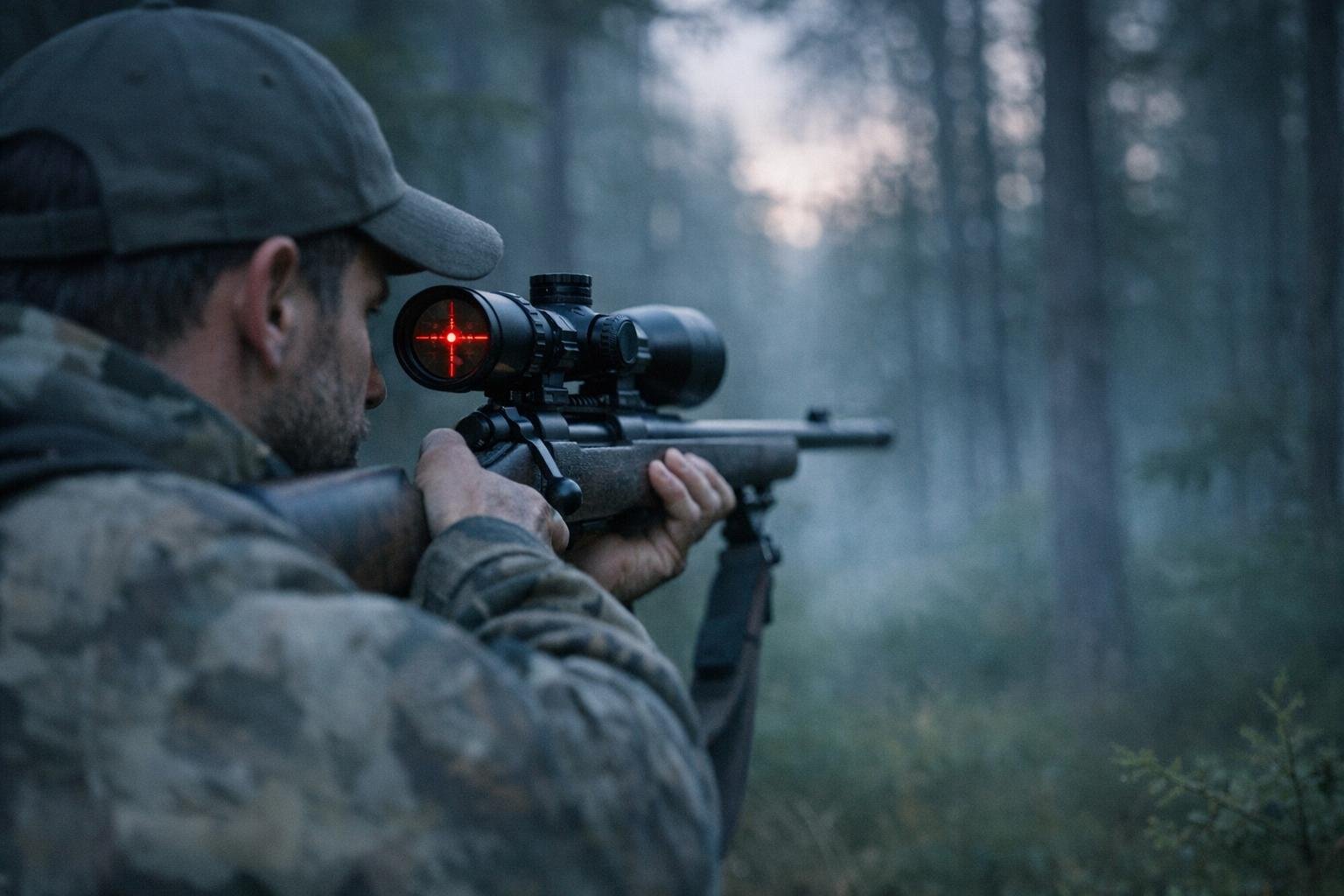
If you hunt in low-light conditions, track dark-coated animals, or need quick target acquisition, an illuminated reticle can make a big difference. These scopes use LED lighting to keep your aiming point visible when black crosshairs might disappear against shadows or dark fur. However, they come with added costs, battery reliance, and slight weight increases. For hunters in bright daylight or open fields, a non-illuminated scope might be a better choice.
Key Points:
- Best For: Low-light hunting (dawn/dusk), dark-coated game, dense cover.
- Pros: Extends visibility, improves contrast, helps in fast-moving situations.
- Cons: Higher cost, battery dependence, potential for brightness issues.
- Legal Note: Generally allowed, but check local regulations.
Bottom Line: If your hunting involves dim light or shaded environments, an illuminated reticle is worth considering. Otherwise, a non-illuminated scope with better glass quality may be more practical.
How Illuminated Reticles Work
Basic Components and Operation
An illuminated reticle uses a small LED – commonly red, green, or amber – to light up the crosshairs or aiming point inside the scope. This system is powered by a coin-cell battery, typically a CR2032, which is stored in a compartment on the scope’s turret or ocular bell. You can adjust the brightness using either a rotating dial (rheostat) or buttons, allowing you to adapt to different lighting conditions. These adjustments are especially useful during low-light hunting situations. Some scopes even include motion sensors that automatically turn off the illumination to conserve battery life. The added weight from this feature is minimal, usually around 1 ounce or less.
Red, green, and amber LEDs are popular because they’re easier for the human eye to detect in low light, and they don’t cause your pupils to contract as much as white light, which helps maintain your night vision. Modern etched glass reticles also let manufacturers illuminate specific areas, such as the center dot, instead of lighting the entire crosshair pattern.
What Illumination Does and Doesn’t Do
It’s essential to understand what illumination actually impacts. The light affects only the reticle, not the image of the target. As Team Bushnell clarifies:
An illuminated scope does not improve or alter the image of the target. Rather, an illuminated scope only alters the brightness of the reticle.
This means the light doesn’t project onto the target like a flashlight, nor does it use night-vision or infrared technology to enhance visibility. Its primary function is to create contrast between the reticle and the target, ensuring the black crosshairs don’t blend into dark fur or shadowy backgrounds. However, too much brightness can lead to blooming, where the reticle becomes overly bright and obscures the target. For this reason, experienced hunters typically use the lowest brightness setting that’s still visible.
Knowing these details can help you decide if an illuminated reticle fits your hunting requirements. It’s all about improving visibility without compromising your focus on the target.
Illuminated vs. Non-Illuminated Reticles – Which One Should You Choose?
When Illuminated Reticles Help
Illuminated reticles shine in specific hunting situations where visibility and precision are critical. Knowing when and why they’re useful can help you decide if this feature fits your hunting style.
Low-Light Hunting Conditions
Early morning and late evening are prime hunting hours, but they come with a challenge: poor visibility. Many states allow hunting up to 30 minutes before sunrise and after sunset, times when standard black crosshairs can all but disappear. In these dim conditions, an illuminated reticle can make the difference between a clear shot and no shot at all. It can extend your effective hunting time by about 15 minutes on either side of the day’s light, giving you a valuable edge when animals are most active. Plus, LED colors are carefully designed to preserve your night vision.
At higher magnifications, the image tends to darken even more in low light, making an illuminated reticle indispensable for keeping your aim sharp. Philip Massaro captured this perfectly in his account for American Hunter:
The grainy half-light of dusk was making the crosshairs all but disappear… were it not for the FireDot in that reticle, I probably wouldn’t have taken the shot.
This advantage becomes even more apparent when hunting dark-coated animals.
Hunting Dark-Colored Game
Dark-coated animals like wild boar or black bears can blend into the shadows, making standard black crosshairs nearly invisible. This is especially problematic when the animal is in dense cover or shaded areas. Even in broad daylight, thick underbrush or evergreen shadows can make it tough to distinguish your reticle from the animal’s dark fur. An illuminated center dot provides the contrast you need for precise shot placement.
This clarity is not only crucial for accuracy but also for quick decision-making in fast-moving scenarios.
Fast Target Acquisition Scenarios
In situations where speed matters, illuminated reticles stand out. With first focal plane (FFP) scopes, the reticle can become very fine at low magnifications, which may slow you down. Illumination ensures the aiming point remains visible, even in challenging environments like dense brush or dappled sunlight filtering through trees. Whether you’re on a driven hunt or managing hog populations, the illuminated center dot allows your eye to lock onto the target quickly – saving precious seconds when it counts most.
What to Consider Before Choosing an Illuminated Reticle
When selecting an illuminated reticle, there are a few key factors to weigh before making your decision.
Legal Compliance and Regulations
In most states, illuminated reticles are allowed because they don’t cast light onto the target. Many areas that previously banned electronic sights have updated their regulations to permit internal reticle illumination, while still prohibiting external light projection or lasers. As Team Bushnell explains:
An illuminated scope does not project light like a flashlight. Therefore, laws against spotlighting usually do not apply to illuminated scopes.
However, some states have vague wording in their laws. For instance, Colorado prohibits the use of "artificial light" as a hunting aid and restricts "electronically enhanced light-gathering optics" outside of legal hunting hours. In areas with unclear rules, it’s best to check your state’s hunting handbook or consult your local wildlife agency. You can also remove the battery as a precaution to avoid any compliance issues.
Once you’ve confirmed the legalities, the next step is to assess battery performance and upkeep.
Battery Life and Maintenance
Modern illuminated scopes typically rely on a CR2032 battery, and thanks to efficient LED technology, these batteries can last up to 5.7 years when used at medium brightness. Many scopes also feature motion sensors that automatically shut off the illumination when your rifle remains stationary, further conserving battery life. Even if the battery dies, etched or wire reticles will still function as normal.
Cold weather can affect battery performance, so it’s a good idea to carry a spare CR2032 battery during your hunt. To conserve power and maintain your natural night vision, use the lowest brightness setting that still provides a clear sight picture. Higher brightness levels can cause the reticle to "bloom", making it harder to focus on your target.
For extended backcountry trips with lots of movement, consider the type of sensor your scope uses. Motion-activated systems can drain the battery if your rifle is bouncing around while slung over your shoulder. Tilt-off sensors are a better option for conserving power during transport.
Once you’ve addressed legal and power considerations, the next step is to choose a reticle design that suits your shooting style.
Reticle Design and Personal Preference
Illuminated reticles come in a range of designs, so it’s important to select one that aligns with your hunting environment and shooting distance. For quick target acquisition in dense cover, a simple duplex reticle with an illuminated center dot works well. On the other hand, more intricate designs, like "Christmas Tree" reticles (such as the TMOA), feature graduated marks for windage and elevation holdovers, making them ideal for long-range shooting in open terrain.
Your hunting environment often dictates the best choice. Hunters in the East, where thick timber is common, often prefer straightforward reticles that allow for fast targeting. Meanwhile, Western hunters, who may face longer shots, might benefit from BDC (Bullet Drop Compensating) reticles. Glass-etched reticles are a great option for precision and durability – they offer thinner lines for improved long-range accuracy and are less prone to shifting or breaking compared to wire reticles.
Massaro shares his personal take on reticle design:
Personally, as I get older, I have come to appreciate simplicity… a simple illuminated dot at the junction of the hairs is fine by me, and the finer the better.
To ensure the reticle is clear and sharp, test the scope on a blank surface and adjust the eyepiece to match your vision. This final step ensures you’ll have a clear sight picture when it matters most.
sbb-itb-31b92c7
Pros and Cons of Illuminated Reticles
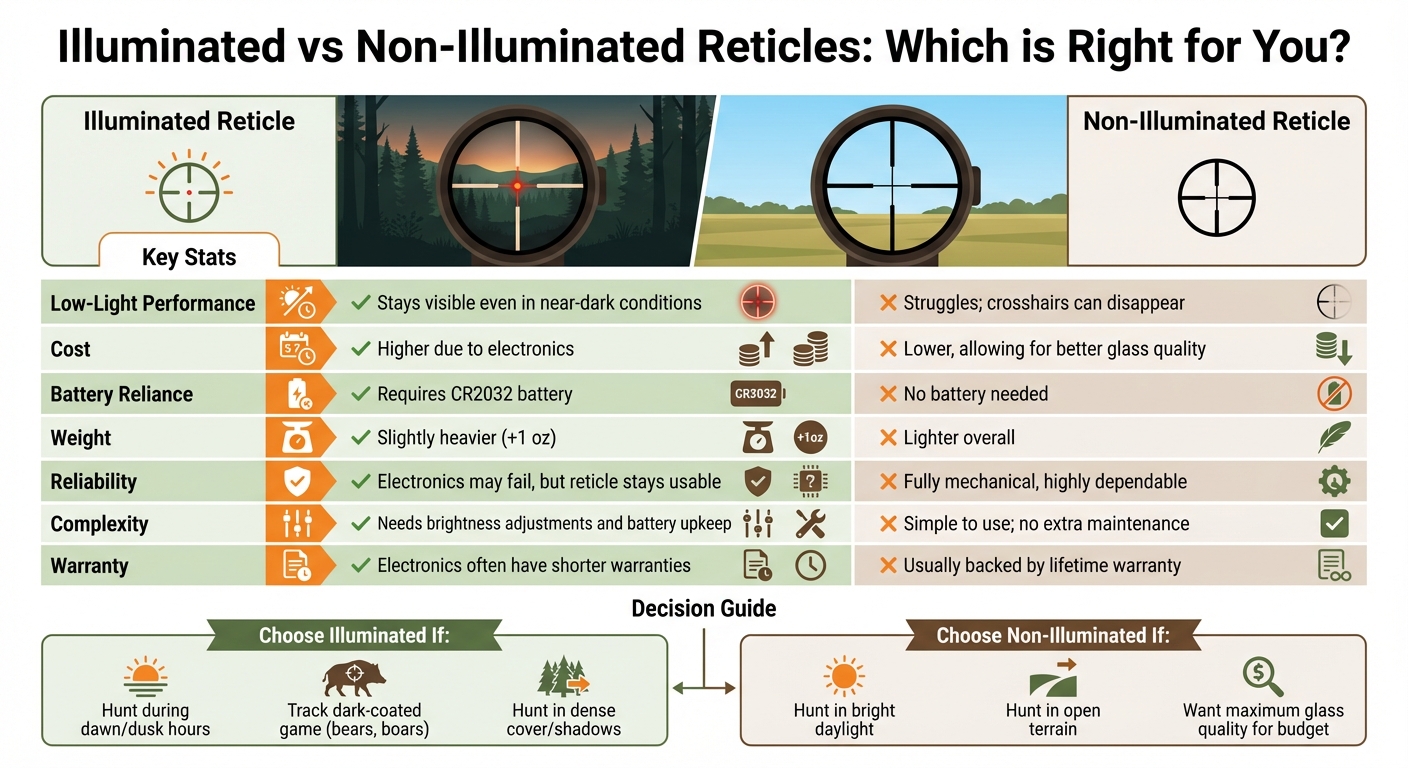
Illuminated vs Non-Illuminated Rifle Scope Reticles Comparison
When deciding whether to go for an illuminated reticle, it’s essential to weigh the benefits against the potential downsides. These reticles shine – literally – in certain conditions but come with their own set of challenges. Here’s a closer look at what you gain and what you might sacrifice.
On the upside, illuminated reticles are a game-changer in low-light environments. They can extend your hunting hours by approximately 15 minutes at both dawn and dusk – a crucial edge when every moment counts. They also provide much-needed contrast when targeting dark-colored animals like black bears or wild boars, especially in shadowy or dense wooded areas. And if the battery ever dies, most models include a fail-safe feature, ensuring the reticle remains visible in black.
On the downside, adding electronics increases the risk of technical issues. Firearms expert BradJ highlights this concern:
The electrical components used in the illumination process have a much higher failure rate compared to the essential scope components.
Illuminated scopes are also pricier and slightly heavier, with an added weight of about 1 ounce. Additionally, improper brightness settings can cause the reticle to "bloom", potentially obscuring your target and diminishing your natural night vision. Non-illuminated scopes, on the other hand, often allocate their lower price point toward better glass quality.
Illuminated vs. Non-Illuminated Reticles: A Quick Comparison
| Feature | Illuminated Reticle | Non-Illuminated Reticle |
|---|---|---|
| Low-Light Performance | Stays visible even in near-dark conditions | Struggles; crosshairs can disappear |
| Cost | Higher due to electronics | Lower, allowing for better glass quality |
| Battery Reliance | Requires a CR2032 battery | No battery needed |
| Weight | Slightly heavier (+1 oz) | Lighter overall |
| Reliability | Electronics may fail, but reticle stays usable | Fully mechanical, highly dependable |
| Complexity | Needs brightness adjustments and battery upkeep | Simple to use; no extra maintenance |
| Warranty | Electronics often have shorter warranties | Usually backed by a lifetime warranty |
Choosing the right reticle boils down to your hunting habits and surroundings. If you often find yourself in low-light scenarios or tracking dark-colored game in wooded areas, the illuminated option could give you a significant advantage. However, for daytime hunts in open terrain, a non-illuminated scope with top-tier optics might be the smarter pick.
Do You Actually Need an Illuminated Reticle?
Whether or not you need an illuminated reticle boils down to when and where you hunt. If your hunting hours are during low-light conditions – prime time for deer activity – an illuminated reticle could be the difference between landing your shot or watching your opportunity slip away.
The type of game you’re pursuing is just as important as the time of day. For example, if you’re after dark-coated animals like black bears, wild boars, or moose in shadowy timber or dense forest, illumination can provide the contrast you need. Douglas Morales from Outdoorsmans emphasizes this point:
An illuminated reticle is worth having even if you need to spend a few extra dollars to acquire. As usual, it’s better to have it and not need it than to need it and not have it.
Consider the experience of professional hunter Philip Massaro. In March 2024, he successfully took a tom leopard in Zimbabwe during the final moments of legal shooting light. Under the "grainy half-light", his standard crosshairs vanished, but the FireDot feature on his Leupold VX-5HD scope allowed him to place his shot with precision.
When weighing the cost against performance, think about your budget and priorities. If you’re deciding between better glass quality and illumination, go for the better glass. However, if the price difference for an illuminated reticle is relatively small – say, $50 to $100 – it’s often worth the upgrade. One Rokslide forum user shared how their illuminated red dot stayed visible even in sub-freezing temperatures, helping them secure a clean shot on a cow elk.
Scope design also plays a role in whether illumination is necessary. For those using First Focal Plane (FFP) scopes, illumination can go from being a nice feature to almost essential. At low magnification, the reticle on an FFP scope becomes very thin and hard to see in dim light . On the other hand, if you hunt in bright midday conditions on open farmland or moorland with a Second Focal Plane scope that has a thick duplex reticle, you can probably skip the illumination and save some cash.
Conclusion
An illuminated reticle isn’t something every hunter needs – it shines (literally) only in specific scenarios. If your hunting adventures often take place during the low-light hours of dawn and dusk, involve tracking dark-colored game in shadowy forests, or navigating dense woodlands with limited contrast, that added illumination can make all the difference between a clean shot and a missed chance.
What’s great is that you can switch off the illumination when it’s not necessary, and your scope works just like a regular one. As Nathan Rees from Optics Warehouse explains:
For many hunters, it’s just a tool – one you use when the conditions call for it, and ignore when they don’t.
This highlights that illuminated reticles are more of a situational advantage rather than an all-the-time necessity. So, take a moment to think about your hunting habits. If you’re mostly out in open fields under bright daylight, a standard reticle might be all you need – and it’ll save you some cash. But if you’re chasing whitetail during those early or late shooting hours, or tracking game in dimly lit environments, the slight cost increase could be well worth it.
FAQs
What are the benefits of using an illuminated reticle for hunting in low-light conditions?
An illuminated reticle offers a bright and easily visible aiming point, making it ideal for low-light scenarios like dawn, dusk, or shaded environments where standard reticles can be hard to spot. With adjustable brightness settings, you can fine-tune the illumination to match the surrounding light, easing eye strain and enhancing accuracy.
This feature proves particularly valuable for hunters operating in dense forests or during those early morning and late evening hours. It allows for quicker target acquisition and more precise shot placement, providing a clear edge when visibility is at its lowest.
How important is battery life for illuminated reticles when hunting?
Battery life plays a key role when it comes to illuminated reticles, particularly in low-light hunting situations where clear visibility can make all the difference. A dependable, long-lasting battery ensures your reticle remains illuminated precisely when you need it, giving you an edge during those critical moments at dawn, dusk, or under cloudy skies.
Today’s illuminated scopes are designed with compact, efficient batteries that can last for years – even in colder temperatures. This kind of reliability reduces the chances of your equipment failing in the middle of a hunt. Still, it’s smart to pack a spare battery in your gear, just in case, to ensure you’re always prepared.
Are illuminated reticles allowed for hunting in all states?
Some U.S. states place restrictions on the use of illuminated reticles for hunting. For instance, Montana prohibits their use entirely, while Idaho bans them specifically for big-game hunting. Regulations can vary by state, so always review your local hunting laws before heading out with one.