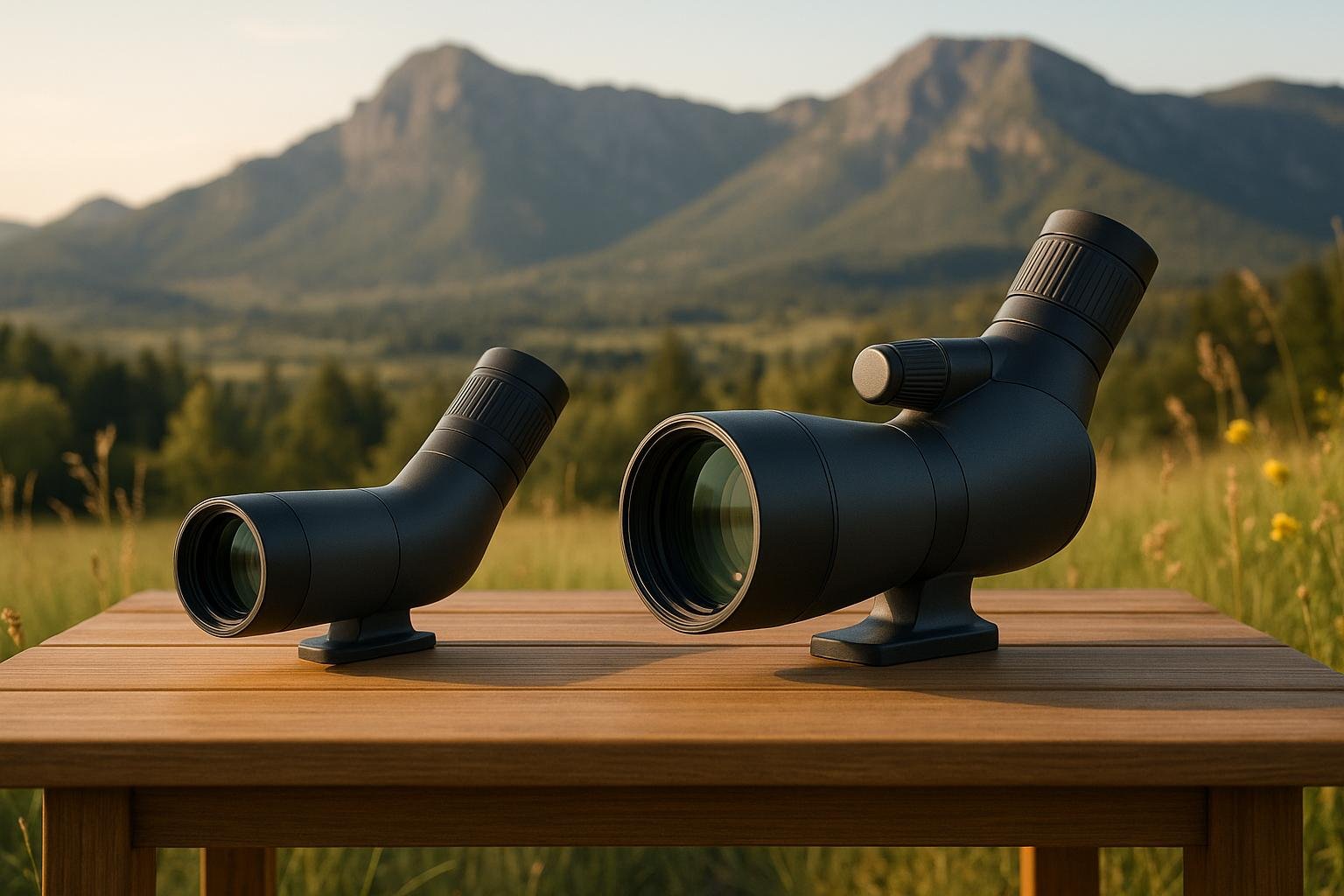
When deciding between compact and full-size spotting scopes, the choice boils down to portability vs. performance. Compact scopes are lighter, easier to carry, and ideal for activities like hiking or mobile hunting. Full-size scopes, while bulkier, deliver better image clarity, especially in low-light conditions, making them perfect for stationary wildlife observation or bird watching.
Key Differences:
- Compact Scopes: Lightweight (~2 lbs), smaller lenses (50–56mm), lower magnification (15–40x), better for mobility.
- Full-Size Scopes: Heavier (4–6+ lbs), larger lenses (65–86mm+), higher magnification (20–60x+), better for stationary use and low-light performance.
Quick Comparison:
| Feature | Compact Scopes | Full-Size Scopes |
|---|---|---|
| Weight | ~2 lbs | 4–6+ lbs |
| Objective Lens Size | 50–56mm | 65–86mm+ |
| Magnification Range | 15–40x | 20–60x+ |
| Portability | High | Low |
| Light Gathering | Limited | Superior |
| Best Use | Hiking, mobile hunting | Bird watching, stationary wildlife observation |
Your choice depends on your activity, lighting conditions, and budget. Compact scopes are affordable and travel-friendly, while full-size models offer advanced optics for detailed, long-range viewing.
Compact Spotter Overview | Which Ones Right for You?
Compact vs Full-Size Spotting Scopes: What’s the Difference
When it comes to spotting scopes, the key difference between compact and full-size models lies in the size of their objective lenses. This single factor affects their overall size, weight, and optical performance. While the design of the scope plays a role, the lens size is what primarily defines its capabilities and portability.
Understanding these distinctions is essential because each type caters to different needs. Your decision will depend on whether you value portability or superior optical clarity. Let’s break down the details.
Compact Spotting Scopes
Compact spotting scopes are built for mobility. Featuring smaller objective lenses, they are about 33% lighter than their full-size counterparts, making them an ideal choice for activities like hiking, backpacking, or mobile hunting – situations where every ounce matters.
Despite their smaller size, modern compact scopes often include advanced optical systems and high-quality lens coatings to offset some of the limitations of their reduced lens diameter. However, there are trade-offs. Compact scopes typically offer lower magnification ranges, usually between 15x and 30x (sometimes reaching 40x). They also struggle in low-light conditions, such as at dawn, dusk, or on overcast days, due to their limited ability to gather light.
Full-Size Spotting Scopes
Full-size spotting scopes, on the other hand, are designed for maximum optical performance. With larger objective lenses – often between 80mm and 85mm – they capture significantly more light, delivering brighter and sharper images. This makes them ideal for high magnifications and for use in challenging lighting conditions.
These scopes excel in stationary activities like bird watching, target shooting, or observing wildlife from a vehicle. Their larger lenses allow you to see finer details at greater distances, making them perfect for spotting game or examining distant subjects with precision. Full-size models also tend to feature more advanced construction, including superior lens coatings, precise focusing mechanisms, and enhanced weather resistance.
However, this level of performance comes with drawbacks. Full-size scopes are bulkier and heavier, making them less practical for long hikes or situations where portability is key. They also require more space in your gear and are generally more expensive due to their complex optical systems.
In short, compact scopes are the go-to option for those on the move, while full-size scopes cater to those seeking the best optical clarity in a stationary setting. With these differences in mind, let’s dive into the factors to consider when choosing the right spotting scope for your needs.
What to Consider When Choosing a Spotting Scope
Finding the right spotting scope depends on your specific needs and activities. Here’s a breakdown of the key factors to help you make the best decision.
Your Activity Type
The type of activity you plan to do should guide your choice. If you’re into hiking or backpacking, opt for a compact scope – lightweight and easy to carry. For stationary activities like hunting, bird watching, or long wildlife observation sessions, a full-size scope is a better fit thanks to its enhanced capabilities.
Magnification and Field of View
Think about how much detail you need versus how much area you want to see. Compact scopes typically offer magnification ranges like 15–45×, giving you a broader field of view to scan large areas. Full-size scopes, on the other hand, deliver higher magnification (20–60× or more), making them perfect for zooming in on distant details.
Light Gathering and Image Quality
The size of the objective lens plays a big role in how much light the scope can gather. Larger lenses produce brighter and clearer images, especially in low-light conditions. While compact scopes use advanced coatings to enhance performance, full-size models generally deliver better image quality in tough lighting situations.
Weight and Portability
Weight is a critical factor, especially if you’re on the move. Compact scopes are lightweight and portable, making them ideal for activities that require mobility. Full-size scopes, though heavier and often needing a sturdy tripod, shine in fixed setups where portability isn’t a priority.
Budget
Your budget will also influence your choice. Compact scopes are usually more affordable, making them a great option for beginners or those testing the waters. Full-size scopes, while pricier, offer superior performance and may require additional gear like tripods. Start with a compact model if you’re unsure of your long-term needs, and let your budget and goals guide your decision.
Compact vs Full-Size Spotting Scopes Comparison
When deciding between compact and full-size spotting scopes, it helps to see how they compare across key features. Here’s a side-by-side breakdown to highlight their differences and help you choose the right option for your needs.
Comparison Table
| Feature | Compact Spotting Scopes | Full-Size Spotting Scopes |
|---|---|---|
| Weight | Around 2 lbs | 4–6+ lbs (about 3× heavier than compact) |
| Objective Lens Size | 50mm to 56mm | 65mm to 86mm+ |
| Magnification Range | 15–30× to 17–40× | 20–60× or higher |
| Portability | Easily fits in a pack, highly portable | Requires a sturdy tripod, less portable |
| Light Gathering | Limited by a smaller lens size | Superior light collection |
| Image Quality | Good, with advanced coatings | Excellent, especially in low light |
| Best Use Cases | Hiking, backpacking, casual observation | Hunting, stationary wildlife watching |
| Setup Requirements | Lightweight tripod or handheld use | Heavy-duty tripod essential |
The weight difference is one of the most noticeable contrasts. For instance, the Swarovski ATC 17-40×56 weighs just over 2 pounds, making it an ideal choice for backpackers who prioritize portability.
Optical performance, however, is where full-size models shine. Compact scopes rely on advanced coatings to deliver respectable clarity, but their smaller lenses limit light collection. This makes them a great choice during the day or in well-lit environments. On the other hand, full-size scopes excel in low-light conditions – like dawn, dusk, or overcast days – when wildlife is often most active.
Magnification also varies significantly. Compact scopes typically offer 30–40× magnification with a wider field of view, which makes tracking moving subjects easier. Full-size scopes, with their 60× or higher magnification, deliver incredible detail but may narrow the field of view, complicating subject tracking.
For those seeking a balance, mid-sized scopes with 65mm objective lenses are worth considering. They provide better light-gathering ability than compact models without the bulk of the largest scopes. Evaluating these differences ensures you choose the right scope for your specific activities and preferences.
sbb-itb-31b92c7
Which Spotting Scope Size for Your Activity
When choosing a spotting scope, the size you select should match the specific demands of your outdoor activity. Whether you’re hiking, hunting, or observing wildlife, the right scope size can make all the difference.
For Backpacking and Hiking
If you’re heading out on a hike or a backpacking trip, compact spotting scopes are your best bet. Weighing around 2 pounds – roughly a third of the weight of larger 86mm models – these scopes are built for portability and feature objective lenses in the 50-56mm range for clear viewing on the go.
One major advantage of compact scopes is that they often eliminate the need for a tripod, making them ideal for long treks or quiet movements through wildlife areas. When picking a compact scope, aim to balance weight with optical performance. High-quality glass and advanced lens coatings can significantly enhance clarity without adding bulk. You’ll also need to decide between an angled design, which offers more viewing flexibility, or a straight-body design that fits more neatly into your backpack.
Take the Swarovski ATC 17-40×56, for example. It’s known for its top-tier glass and travel-friendly design, though it comes at a premium price. For a more budget-friendly option, the Maven S.2 offers a straight design that’s easy to pack, though it may have slight edge distortion.
For Hunting
Hunting requires a scope that can adapt to different environments and styles. Whether you’re constantly on the move or stationed at a fixed location, your choice of scope should reflect your needs.
For mobile hunters, compact spotting scopes are a practical choice. They are lightweight, take up minimal space, and are easy to handle in tight spots like tree stands. Their typically lower magnification also provides a broader field of view, which is useful for scanning large areas and tracking moving game.
On the other hand, if you’re glassing from a stationary position – say, in a vehicle or at a base camp – a full-size scope is the way to go. These scopes excel at long-distance spotting, allowing you to identify game from afar and plan your approach more effectively. Many hunters use a combination of both: a compact scope for mobility and a full-size model for detailed observation at long range.
For Bird Watching and Wildlife Observation
For serious bird watchers and wildlife enthusiasts, full-size spotting scopes are often the top choice. With objective lenses ranging from 80mm to 100mm, these scopes deliver brighter, sharper images, particularly in low-light conditions like dawn, dusk, or cloudy weather. This extra light-gathering power is invaluable for spotting subtle details, such as field marks that help differentiate similar species.
If you often observe from fixed locations, such as a bird hide or your backyard, a full-size scope is a great option. Their higher magnification – often up to 60x or more – makes them perfect for detailed views of distant subjects. They’re also ideal for digiscoping, a technique that combines a spotting scope with a camera for capturing stunning images of wildlife.
For birders who prefer to stay on the move or work in well-lit environments, compact scopes are a practical alternative. If you’re looking for a middle ground, consider mid-range spotting scopes with objective lenses between 70mm and 80mm. These provide a balance between portability and performance, making them versatile options for a variety of activities.
Expert Guidance from Scope It Outdoors

Deciding between compact and full-size spotting scopes can feel overwhelming, but Scope It Outdoors is here to make the process easier. Our team of experts provides practical, field-tested advice to help you choose the right scope for your needs.
At Scope It Outdoors, we know that every outdoor enthusiast has different priorities. Whether you’re a backcountry hunter trying to minimize weight or a birdwatcher needing high magnification for distant wildlife, we offer tailored recommendations. Our team has tested and reviewed spotting scopes across all price points – from budget-friendly options to premium models – so you can make a confident choice. The key is simple: identify the features you need in a spotting scope, and then focus your search accordingly.
Our reviews dive into important details like lens quality, objective size, body design, and weatherproofing, while also considering real-world performance. For example, the Gosky 20-60×80 is a standout model, earning a 4.5/5 star rating from 427 Amazon customers. In April 2025, Erik M praised its excellent optics and sturdy build, though he noted the tripod could be more stable, calling it:
"a great buy for the price".
Similarly, in May 2025, Yifei M highlighted the scope’s exceptional image clarity and solid construction, sharing that it:
"exceeded expectations with fantastic image clarity and solid build quality".
In addition to reviews, we provide practical advice for all outdoor activities. For instance, we emphasize that lens quality is crucial, with fully multi-coated lenses delivering the best image clarity. For birdwatchers and wildlife enthusiasts, we suggest objective lens sizes between 60 mm and 100 mm, paired with magnification levels ranging from 20× to 60×. We also explain why angled body scopes are more ergonomic for birding, while straight body scopes are better suited for viewing lower targets from elevated positions.
Beyond the technical details, Scope It Outdoors offers activity-specific guidance to match your spotting scope to your favorite outdoor pursuits. Spotting scopes bridge the gap between the close-range view of binoculars and the long-distance focus of telescopes. Whether you’re into birding, hunting, target shooting, or even stargazing, we help you balance portability and performance to find the perfect fit.
Explore our full library of expert reviews, comparisons, and recommendations at Scope It Outdoors by visiting https://scopeitoutdoors.com.
Conclusion
When deciding between compact and full-size spotting scopes, it’s all about matching the scope’s features to your specific needs. For example, compact scopes are ideal for backcountry hunters who prioritize portability, while full-size models, with their higher magnification (45–60×), are better suited for long-distance observation. Striking the right balance between performance and cost is key.
Your budget plays a major role in this decision. Quality scopes can be found for under $500, while high-end models can exceed $5,000. With such a broad price range, there’s something available for every budget.
Additionally, you’ll want to decide between angled and straight designs, as well as the type of focuser – whether single, double, or helical – that best suits your needs. Ultimately, the best spotting scope is the one that aligns with your activity, performance expectations, budget, and personal preferences.
FAQs
What should I consider when choosing between a compact and a full-size spotting scope?
When choosing between a compact and a full-size spotting scope, it’s essential to weigh factors like portability, image quality, and intended use. Compact scopes are lightweight and easy to carry, making them perfect for on-the-go activities like hiking or birdwatching where mobility is a priority. On the flip side, full-size scopes deliver better magnification and sharper image clarity, making them a solid choice for stationary tasks such as target shooting or observing wildlife in detail.
Your budget and preferences also play a big role. Compact scopes are often more affordable and easier to handle, while full-size scopes come with a higher price tag but provide advanced performance for those who need precision viewing. Think about what matters most for your outdoor plans to pick the scope that fits your needs.
How does the size of the objective lens impact a spotting scope’s performance in various lighting conditions?
The size of the objective lens is a crucial factor in determining how well a spotting scope performs under different lighting conditions. Larger lenses, typically between 50mm and 80mm, let in more light, which helps produce brighter and clearer images. This becomes especially handy during low-light periods like dawn or dusk, when natural visibility is limited.
If you’re planning to use your spotting scope for activities like wildlife observation during sunrise or sunset, opting for a model with a larger objective lens can make a noticeable difference in clarity and detail. That said, larger lenses can add extra weight and reduce portability, so it’s worth balancing these factors based on your specific needs and how you plan to use the scope.
What makes a mid-sized spotting scope a good choice compared to compact or full-size models?
A mid-sized spotting scope hits the sweet spot between performance and portability. It provides superior light gathering and sharper image clarity compared to compact models, making it ideal for spotting details over greater distances. At the same time, it’s lighter and more manageable than full-size scopes, which can be bulky and a hassle to carry around.
This balance makes mid-sized scopes a great fit for activities like birdwatching, hunting, and wildlife observation – situations where you need crisp visuals but also the freedom to move around easily. If you want a scope that offers flexibility without sacrificing too much in terms of image quality or convenience, a mid-sized option is a smart pick.