
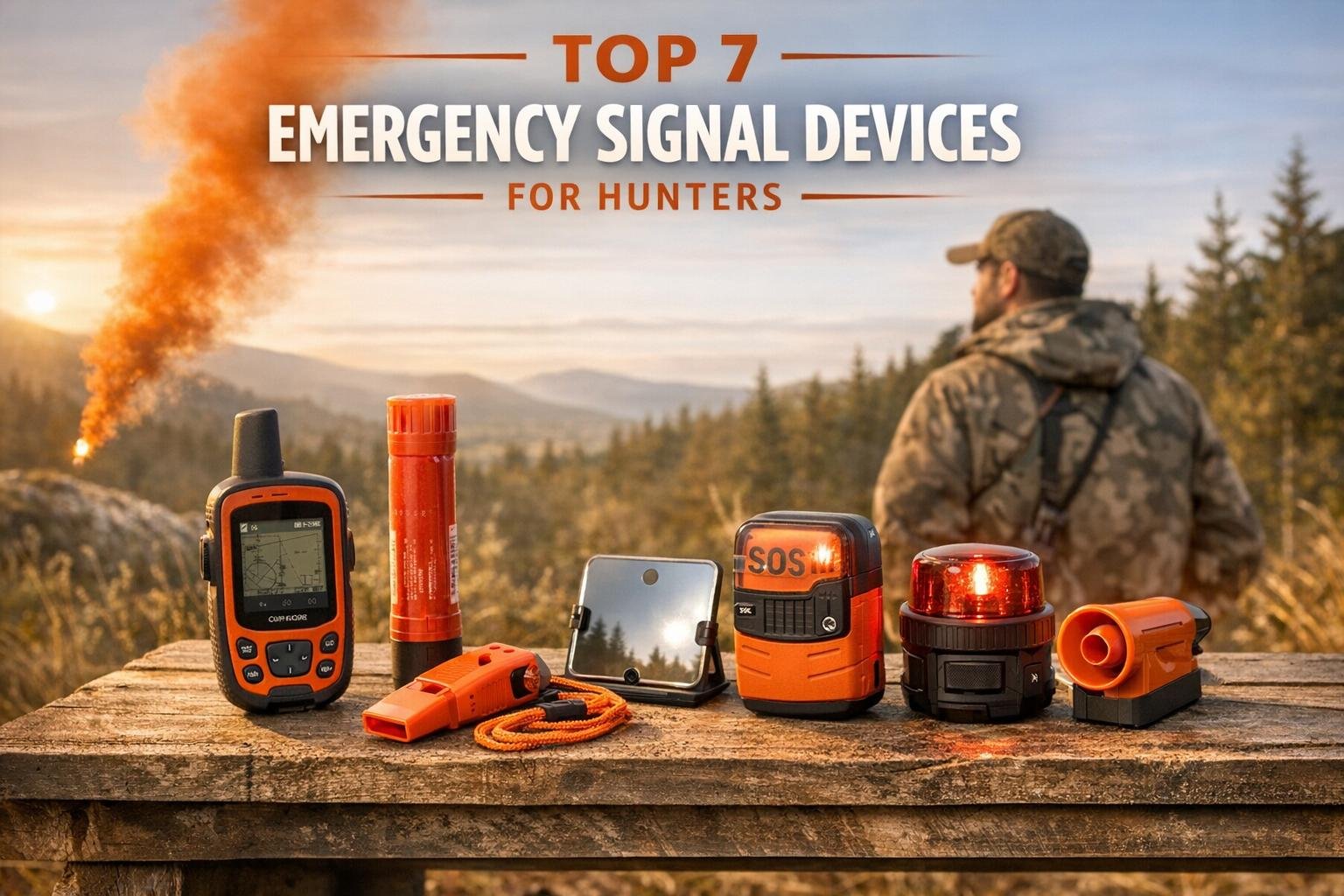
When you’re hunting in remote areas, having the right emergency signal devices can save your life. From compact GPS beacons to simple whistles, these tools ensure you can call for help when cell phones fail. Here’s a quick rundown of the best options:
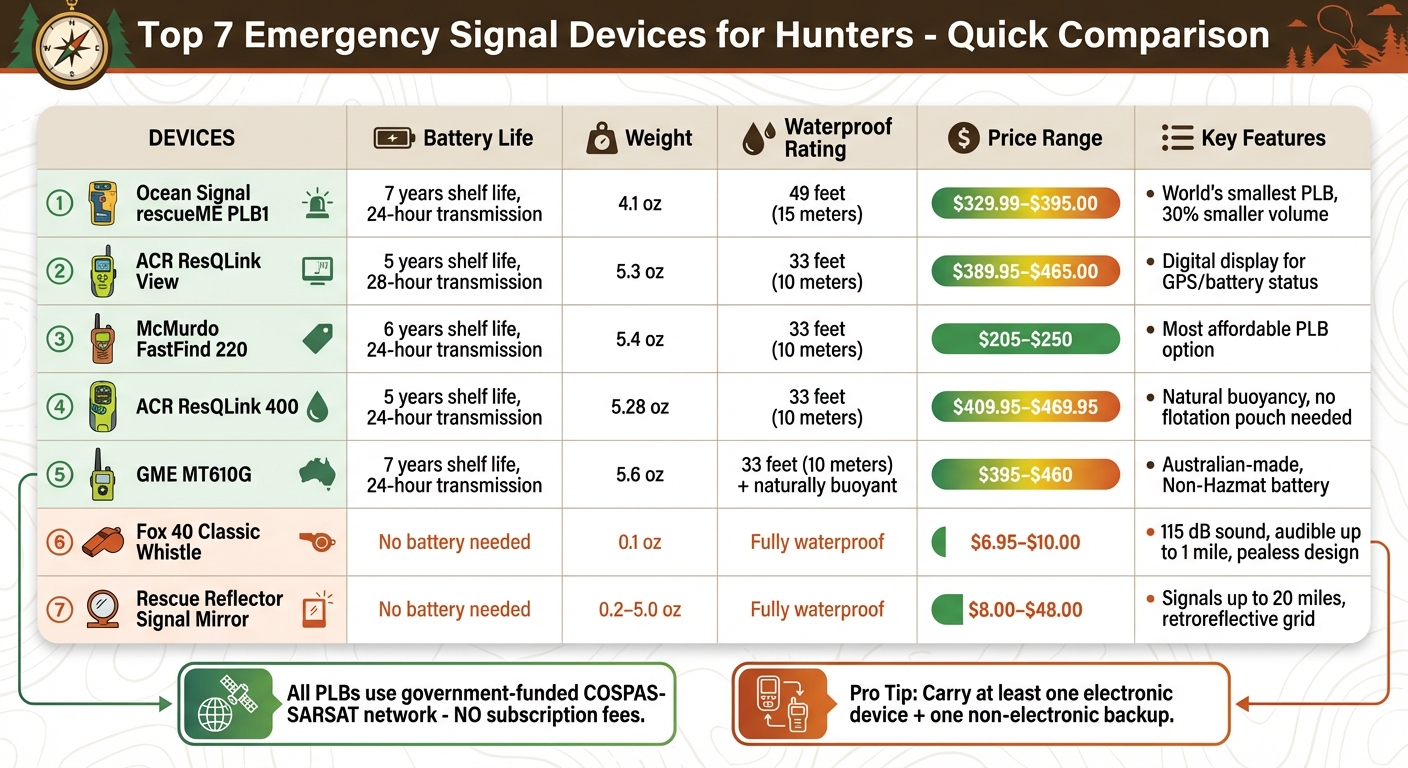
- Ocean Signal rescueME PLB1: Smallest personal locator beacon (PLB) on the market with a 7-year battery life, 24-hour transmission, and waterproof up to 49 feet. Price: $329.99–$395.00.
- ACR ResQLink View: Features a digital display for GPS and battery status, 5-year battery life, and 28-hour transmission. Price: $389.95–$465.00.
- McMurdo FastFind 220: Affordable PLB with 6-year battery life and 24-hour transmission. Price: $205–$250.
- ACR ResQLink 400: Durable PLB with natural buoyancy, 5-year battery life, and 24-hour transmission. Price: $409.95–$469.95.
- GME MT610G: Australian-made PLB with a 7-year battery life and 24-hour transmission. Price: $395–$460.
- Fox 40 Classic Whistle: Lightweight, pealess whistle producing 115 dB sound, ideal for quick distress signaling. Price: $6.95–$10.00.
- Rescue Reflector Signal Mirror: Non-electronic, sunlight-reflecting tool for signaling up to 20 miles. Price: $8.00–$48.00.
Quick Comparison:
| Device | Battery Life | Weight | Waterproof Rating | Price Range |
|---|---|---|---|---|
| Ocean Signal PLB1 | 7 years, 24 hours | 4.1 oz | 49 feet (15 meters) | $329.99–$395.00 |
| ACR ResQLink View | 5 years, 28 hours | 5.3 oz | 33 feet (10 meters) | $389.95–$465.00 |
| McMurdo FastFind 220 | 6 years, 24 hours | 5.4 oz | 33 feet (10 meters) | $205–$250 |
| ACR ResQLink 400 | 5 years, 24 hours | 5.28 oz | 33 feet (10 meters) | $409.95–$469.95 |
| GME MT610G | 7 years, 24 hours | 5.6 oz | 33 feet (10 meters) | $395–$460 |
| Fox 40 Whistle | No battery needed | 0.1 oz | Fully waterproof | $6.95–$10.00 |
| Rescue Mirror | No battery needed | 0.2–5.0 oz | Fully waterproof | $8.00–$48.00 |
Whether you need a high-tech GPS beacon or a simple, reliable whistle, these tools provide peace of mind and increase your chances of rescue. Always carry at least one electronic device and a non-electronic backup for maximum safety.
Emergency Signal Devices for Hunters: Complete Comparison Guide
Best Signaling Gear for Wilderness Survival (Real Rescue Stories)
sbb-itb-31b92c7
1. Ocean Signal rescueME PLB1
The Ocean Signal rescueME PLB1 stands out as a go-to emergency signal device for hunters, thanks to its compact size and dependable performance. Measuring just 3.0" × 2.1" × 1.3" and weighing a mere 4.1 ounces, it is hailed as the world’s smallest Personal Locator Beacon. To put it in perspective, it’s about the size of a small stack of credit cards, making it easy to carry in a pocket or pack. Professional hiking guide Cris Hazzard highlights its life-saving potential:
"The Ocean Signal rescueME PLB1 is the smallest and most compact personal locator beacon (PLB) available, designed to save your life in a pinch".
Battery Lifespan
The PLB1 is built for long-term readiness, boasting a 7-year battery shelf life. Once activated, it can transmit continuously for over 24 hours, even in extreme temperatures ranging from -4°F to 131°F. Unlike satellite messengers that need frequent recharging, this device remains ready to go – perfect for hunters who might overlook charging their gear before heading out. When the battery does need replacement (either after seven years or following activation), it can be serviced at authorized centers for $100–$250.
Weight and Portability
Weighing just 4.1 ounces, the PLB1 is 30% smaller in volume than similar devices. Its lightweight design ensures it won’t weigh you down, and its one-handed operation makes it practical in emergencies. A spring-loaded flap prevents accidental activation, while a retractable antenna deploys smoothly with a simple pull. As noted by GuideSpot:
"This device disappears in your pack until you need it".
Its portability is matched by its durability, with a design that can handle rugged conditions.
Waterproof Rating
The PLB1 is waterproof up to 49 feet (15 meters), making it reliable for hunts near water or in heavy rain. While it doesn’t float on its own, the included flotation pouch ensures it stays accessible in aquatic environments. Designed to withstand seawater and tough conditions, this device is built with hunters’ diverse needs in mind.
Cost-Effectiveness
Priced between $329.99 and $395.00, the PLB1 offers a solid balance of performance and affordability. It uses the government-funded Cospas-Sarsat satellite network, which means no subscription fees. This makes it a budget-friendly option compared to satellite messengers with recurring costs. Additionally, its powerful 5-watt signal outperforms many satellite messengers, which typically transmit at around 1.6 watts. This stronger signal boosts the chances of being detected, even in remote areas like canyons or dense forests. OutdoorGearLab recognized its value, awarding it "Best Value for SOS-only communication" with an 8.8/10 rating.
2. ACR ResQLink View
The ACR ResQLink View brings a digital display to personal locator beacons, giving hunters the ability to quickly check GPS coordinates, battery levels, and signal status when time is critical. With dimensions of 4.52″ × 2.03″ × 1.49″, it’s slightly larger than the Ocean Signal rescueME PLB1 but includes the added benefit of a live status screen. This display allows users to keep track of key information on the spot, making it an indispensable tool for emergencies. Professional hiking guide Cris Hazzard highlights its importance with a quote from a retired U.S. Coast Guard rescue pilot:
"Knowing the vital importance of a 406mhz beacon in a rescue situation ACR ResQLink optimizes rescue coordination in an emergency. Its small size and unmatched capability gives the individual the best chance of rescue regardless of climate, place or physical capacity."
Battery Lifespan
The ResQLink View is equipped with a battery that boasts a 5-year shelf life and can provide 28 hours of continuous transmission once activated. Its isolated design ensures there’s no accidental power drain, unlike rechargeable devices. Baxter Bowman puts it simply: "The battery is completely isolated from use until it’s needed which means they are very reliable". Over its lifespan, the device supports up to 60 basic and 20 GPS self-tests without significantly affecting battery performance. When replacement is needed, authorized service centers typically charge between $39 and $100.
Weight and Portability
At just 5.3 ounces, the ResQLink View is designed with portability in mind, making it a reliable companion in tough environments. It includes a clip system with options like belt clips, straps, and lanyards for secure attachment to your gear. Its buoyant design ensures it floats, which is particularly helpful for hunters crossing streams or working near water. While OutdoorGearLab rated its portability at 6.0/10 – mentioning it might feel bulky for ultralight enthusiasts – it remains a solid choice for general wilderness safety.
Waterproof Rating
Built to withstand harsh conditions, the device is waterproof up to 33 feet (10 meters) and operates in storage temperatures ranging from 22°F to 158°F. It also features built-in LED and infrared strobes, which improve visibility in low-light or bad weather conditions, making it easier for rescuers to locate you. These features, combined with its strong transmission capabilities, add to its reliability in emergencies.
Cost-Effectiveness
Priced between $389.95 and $465, the ResQLink View may seem like a significant upfront expense, but it eliminates the hassle of subscription fees. Its 5-watt transmitter – over three times stronger than the typical 1.6-watt output found in many satellite messengers – ensures a strong signal in challenging terrains. Impressively, the device can pinpoint your location within 330 feet, 95% of the time, within 5 minutes of activation. Designed for rugged outdoor use, this beacon balances advanced technology with durability. While it doesn’t offer two-way messaging, its focus as an emergency-only device supported by the government-operated Cospas-Sarsat network makes it a dependable long-term safety investment for remote adventures.
3. McMurdo FastFind 220
The FastFind 220 is a personal locator beacon (PLB) designed for hunters who need a dependable emergency device that doesn’t break the bank. Priced between $205 and $250, it stands out as an affordable option without compromising reliability. Weighing just 5.4 oz (152 g) and measuring 1.9 × 4.2 × 1.3 in., it’s compact enough to slip into a pocket or pouch. As TrekSumo highlights:
"The FastFind 220 PLB weighs a tiny 152g… It’s so light you barely even notice the additional weight once it’s packed away in an easily accessible place".
Battery Lifespan
The FastFind 220 offers a 6-year battery storage life from its manufacture date. Its built-in microprocessor keeps track of usage, and once activated, the device can transmit for at least 24 hours, even in temperatures as low as –4°F. Unlike rechargeable satellite messengers, which require frequent charging, this PLB uses a non-rechargeable Lithium Manganese battery that needs no maintenance until it’s time for replacement. Replacing the battery at a service center usually costs around $80 after six years. Backcountry Chronicles puts it this way:
"Think of it as an insurance policy that costs less than $100 per year for five years. If we need help, help will come".
Weight and Portability
The FastFind 220 includes a "safe stow" antenna that automatically deploys during activation, ensuring quick and hassle-free use in emergencies. For easier activation in cold conditions, you can remove the retaining screw on the red activation cap. While slightly heavier than ultralight models like the Ocean Signal rescueME PLB1 (4.1 oz), the weight difference is negligible for most hunters.
Waterproof Rating
This device is waterproof up to 33 ft for 5 minutes and operates in temperatures ranging from –4°F to 131°F. As a Category 2 PLB, it doesn’t float on its own, so using the included flotation pouch is essential when hunting near water or crossing streams. For nighttime emergencies, the high-brightness LED signal light flashes in a Morse code SOS pattern and can handle up to 30 operations.
Cost-Effectiveness
One of the biggest advantages of the FastFind 220 is that it operates on the government-managed Cospas-Sarsat network without requiring any subscription fees. Its dual GNSS receiver (GPS and Galileo) uses 72 channels to pinpoint your location within 62 m, and search-and-rescue teams can typically detect its 406 MHz signal within 45 minutes of activation. It also emits a 121.5 MHz homing signal, which assists rescuers during close-range operations. Registering the device with national authorities, such as NOAA in the U.S., extends its standard 1-year warranty to 5 years.
Up next, we’ll look at a device that incorporates digital features to enhance emergency signaling.
4. ACR ResQLink 400
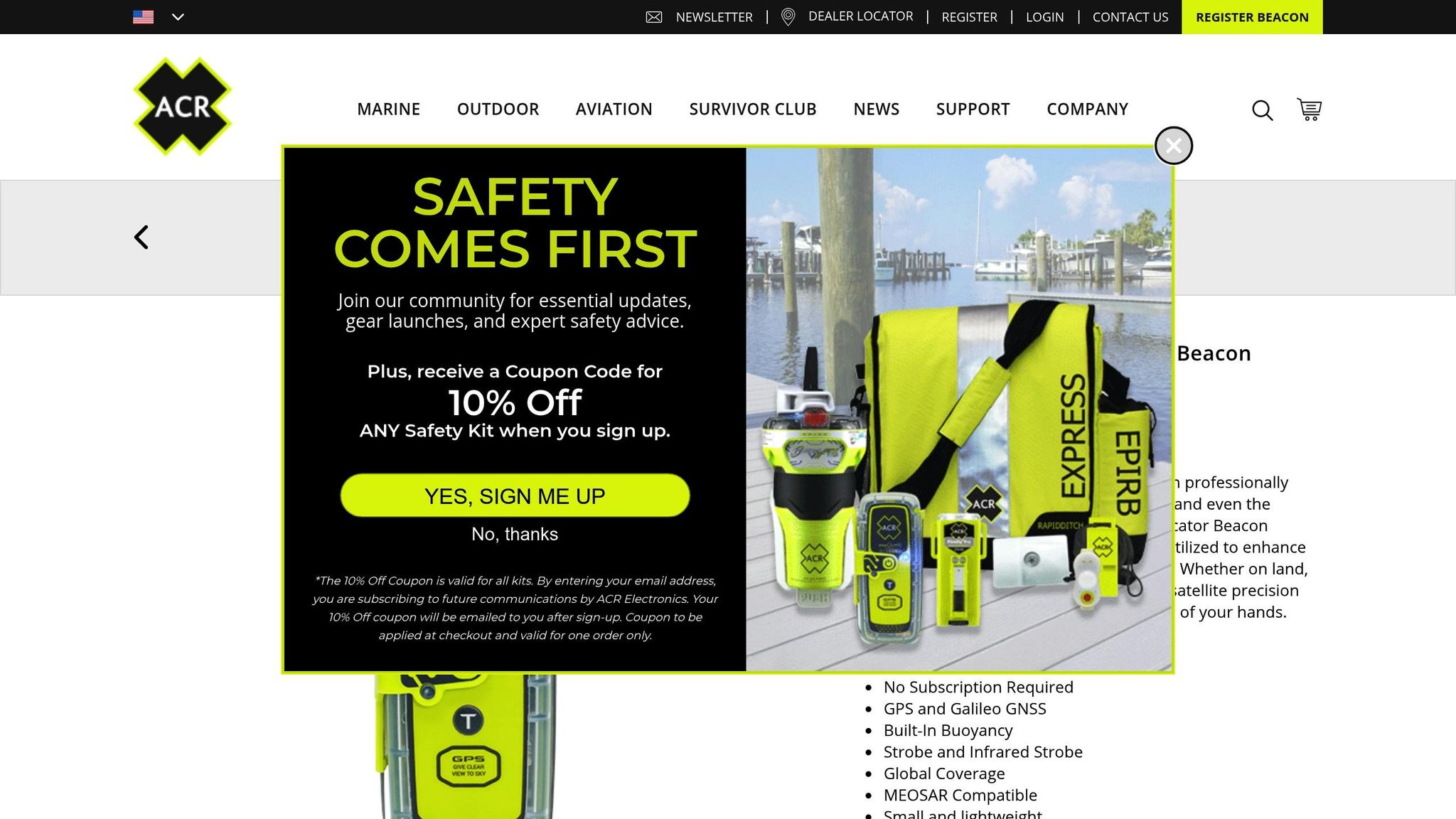
The ACR ResQLink 400 is a personal locator beacon designed for dependable emergency signaling, making it a solid choice for outdoor enthusiasts. Priced between $409.95 and $469.95, it offers a balance of affordability and performance. Weighing just 5.28 oz and measuring 4.52 × 2.03 × 1.49 in., this compact device is easy to carry on any adventure. Its user-friendly battery replacement and natural buoyancy add to its practicality. ACR Electronics emphasizes its durability:
"Small but resilient, the ResQLink 400 has been professionally engineered and tested to ensure it can withstand even the harshest elements."
Battery Lifespan
The ResQLink 400’s battery is designed to last five years and provides over 24 hours of transmission during emergencies. However, once used or after five years, it requires replacement at an ACR/Artex Certified Battery Replacement Center. The device includes a self-test and a GPS self-test feature. Monthly self-tests are recommended, while GPS tests should be limited to 20 total over the battery’s life to conserve its power.
Weight and Portability
At 5.28 oz, the ResQLink 400 is lightweight and fits comfortably in the palm of your hand. It comes with a multi-function clip system, making it easy to attach to belts, backpacks, or vests. Thanks to its natural buoyancy, it floats without needing a separate flotation pouch. A real-world example highlights its reliability: in June 2023, a solo hiker in Glenorchy, Queenstown, activated her ResQLink 400 after a fall, leading to her rescue in just 30 minutes.
Waterproof Rating
This beacon is highly durable, with a waterproof rating of 16.40 ft for 1 hour and 33 ft for 10 minutes. It functions in temperatures ranging from –4°F to 131°F, making it suitable for harsh conditions. While its rugged case protects it from rain, snow, and water crossings, the antenna must be upright and unobstructed for optimal signal transmission. For nighttime emergencies, the ResQLink 400 features both a standard LED strobe and an infrared strobe, aiding rescuers in low-visibility situations.
Cost-Effectiveness
The ResQLink 400 operates on the government-funded COSPAS-SARSAT network, requiring no subscription fees. It uses a 66-channel multi-constellation receiver, leveraging GPS and Galileo satellites to pinpoint your location within 100 meters. Registration with NOAA is mandatory and must be renewed every two years to ensure your emergency contact information is up to date. With a 4.6 out of 5-star rating on Sporty’s, it has garnered praise from users like Kent F., who said:
"It’s a great PLB personal locator beacon that I hope to never use. Easy registration with NOAA… If you go in or over remote locations, you need one of these."
The ResQLink 400 stands out for its reliability, portability, and cost-efficient operation. Up next, we’ll take a closer look at another personal locator beacon offering region-specific benefits.
5. GME MT610G
The GME MT610G is a personal locator beacon (PLB) designed with durability, portability, and long battery life in mind. Built in Australia, it features a 7-year battery shelf life and operates without subscription fees on the COSPAS-SARSAT network. Priced between $395 and $460, it’s a practical option for hunters heading into remote areas. Here’s a closer look at its standout features.
Battery Lifespan
With a 7-year battery life, the MT610G outlasts competitors like the ACR ResQLink series, which typically offers a 5-year battery life. Its Non-Hazmat battery pack is not only safer for transport but also makes shipping easier – an advantage for those flying to remote hunting spots. Equipped with a 72-channel GPS/Galileo receiver, the MT610G ensures fast and precise location reporting without any warm-up delay. To maximize battery life, GME recommends limiting GPS tests to twice a year.
Weight and Portability
Weighing just 5.6 oz (160 grams) and measuring 3.5 × 2.8 × 1.6 inches, this is GME’s most compact PLB model. Its small size makes it easy to carry in a pocket, attach to a belt, or store in a chest holster. The device is also inherently buoyant, meaning it will float if dropped in water – a handy feature for hunters navigating rivers or wetlands. As one user noted:
"Great compact size for carrying in my chest holster when I’m riding my quad bike hunting alone."
Waterproof Rating
The MT610G is built to survive tough environments, earning an IP68 waterproof rating. This means it can be submerged up to 33 feet (10 meters) for 60 minutes without damage. Its positive buoyancy ensures it stays near the surface, making retrieval easier. For added safety, the device includes a high-visibility strobe light and a 121.5MHz homing transmitter, which help rescuers locate you in low-visibility situations. Reviewer Angus Jones highlighted its durability, noting:
"The IP68 rating means the unit can survive 60 minutes submerged at 33 feet, while its buoyancy keeps it near the surface."
Cost-Effectiveness
The MT610G offers solid value with no recurring subscription fees and comes with a 6-year manufacturer warranty. To ensure proper use, registration with the Australian Maritime Safety Authority (AMSA) or your country’s equivalent authority is required. This step ensures that emergency services have access to your contact information. The device holds a 4.0-star rating from 345 reviews, with users frequently praising its reliability and compact design:
"No issues at all, has lasted well in a wet salty environment." – AS, Verified Reviewer, GME.
The next section explores a simpler signaling device that requires no batteries at all.
6. Fox 40 Classic Whistle
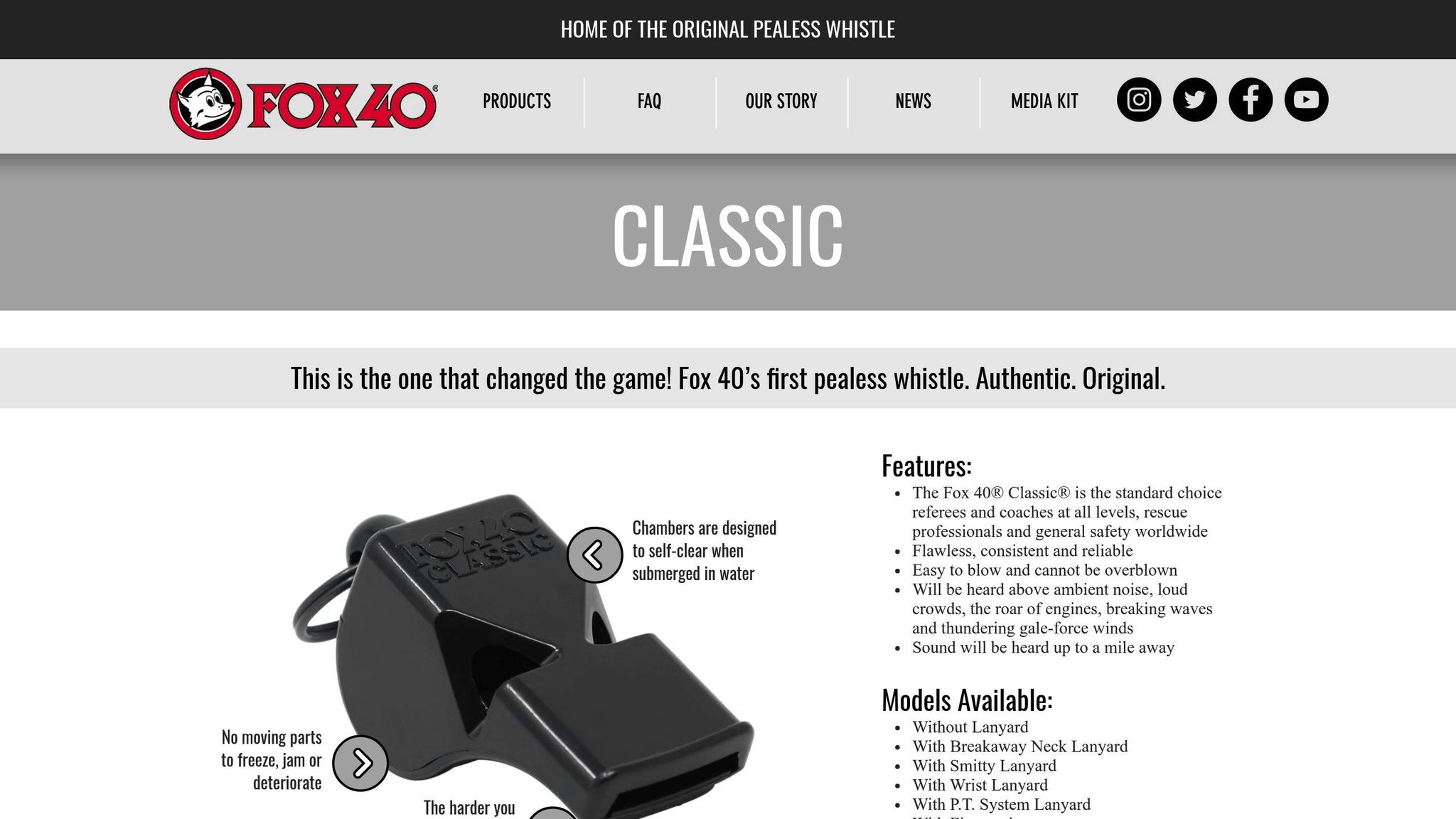
The Fox 40 Classic Whistle is a straightforward emergency signaling tool that doesn’t rely on batteries or electronics. At just $6.95 MSRP, it’s an affordable and dependable option for hunters who need a reliable way to call for help. Its pealess design eliminates the internal ball (or "pea") found in traditional whistles, which can freeze, jam, or corrode – common issues in harsh conditions.
Weight and Portability
Weighing only 0.1 oz, the Fox 40 Classic is incredibly lightweight and easy to carry. It can clip onto a backpack, lanyard, or belt loop, keeping it accessible when you need it most. Philip Werner, founder of SectionHiker.com, highlights its importance:
"The Fox 40 Classic Whistle weighs just 0.1 oz, but it is one of the most important pieces of safety gear that I own."
This whistle emits a powerful 115 dB sound at 4,000 Hz, audible up to one mile away. That’s significantly more effective than shouting, which can quickly exhaust you and is less reliable in windy or dense environments. Craig Caudill, Director of Nature Reliance School, emphasizes its utility:
"A whistle is one of those items that I call the ‘trifecta of survival equipment.’ It is lightweight, does not weigh much, and has little space in your pocket or pack."
Waterproof Design
The whistle’s 3-chamber, pealess construction is designed to self-clear after being submerged, ensuring it works even after falling into water or during heavy rain. Made from high-impact plastic, it resists rust and corrosion, making it a dependable choice for wet or damp conditions.
Affordability and Practicality
With a price tag under $9.00, the Fox 40 Classic is budget-friendly and requires no maintenance. It boasts a 4.6/5-star rating from over 6,345 Amazon reviews. For hunters, conserving energy is critical, and blowing a whistle is far less taxing than shouting. To ensure it’s always within reach, attach it to the exterior of your gear rather than tucking it away. Opting for a bright color like orange or yellow can also help you quickly locate it if it’s dropped in dense brush.
Up next, we’ll take a look at a signal mirror with advanced reflective capabilities.
7. Rescue Reflector Signal Mirror
The Rescue Reflector Signal Mirror is a simple yet highly effective emergency signaling tool. It works by reflecting sunlight into a focused beam to catch the attention of rescuers. Unlike electronic devices, it doesn’t rely on batteries or subscriptions, making it a dependable choice in any situation. A Navy Search and Rescue helicopter pilot put it best:
"The signal mirror is cheap, never runs out of batteries, works extremely well on sunny days, and is still effective on overcast days."
These mirrors use a polished glass or polycarbonate surface to reflect ambient light. High-quality versions include a retroreflective grid in the center, which creates a bright "fireball" to help you aim the reflection precisely. To signal, you look through the sighting aperture at your target – like a passing aircraft or a search team – and adjust until the fireball aligns with the target. Then, use three flashes to indicate distress. While it’s a low-tech tool, it pairs perfectly with advanced devices like PLBs to enhance your emergency signaling options.
Weight and Portability
Signal mirrors are incredibly lightweight and easy to carry. Most models range in size from 2″ x 3″ to 3″ x 5″ and weigh as little as 0.2 oz. Their slim design fits effortlessly into a wallet, small tin, or even a shirt pocket. Glass mirrors provide better reflectivity and resist scratches but are heavier (1.9–5.0 oz) and more fragile. On the other hand, polycarbonate models are lighter, shatterproof, and sometimes float, though they tend to scratch more easily.
Cost-Effectiveness
One of the biggest advantages of signal mirrors is their affordability. Prices start at about $8.00 for basic acrylic versions and go up to around $48.00 for military-grade glass models. Unlike flares, which are single-use, or PLBs that need occasional battery replacements, a good signal mirror can last indefinitely. Even a small mirror with just one square inch of reflective surface can signal targets up to seven miles away. Larger mirrors can extend that range to 10–20 miles.
W. Spivak from the U.S. Coast Guard Auxiliary emphasized the importance of this tool:
"If I had to limit myself to the two most important items… I would choose the 2 items that are easiest to learn to use and lightweight – the signal mirror and signal whistle."
To keep your mirror in top condition, store it in a padded sleeve to prevent scratches. It’s also worth practicing the "fireball" aiming method before you find yourself in an emergency. With its reliability, durability, and low cost, the signal mirror is a must-have when every moment matters.
Feature Comparison Table
Here’s a quick look at the key features of the seven emergency signal devices discussed earlier. This table can help you pinpoint which option best fits your needs.
| Device | Battery Life | Weight | Waterproof Rating | Price |
|---|---|---|---|---|
| Ocean Signal rescueME PLB1 | 7-year shelf life, 24-hour transmission | 4.9 oz | 15 meters (49 feet) | $360–$370 |
| ACR ResQLink View | 5-year shelf life, 28-hour transmission | 5.3 oz | 10 meters (33 feet) | $435 |
| McMurdo FastFind 220 | 5-year shelf life, 24-hour transmission | 4.9 oz | 10 meters (33 feet) | $250 |
| ACR ResQLink 400 | 5-year shelf life, 24-hour transmission | 5.0 oz | 10 meters (33 feet) | $370–$380 |
| GME MT610G | 7-year shelf life, 24-hour transmission | 5.6 oz | 10 meters (33 feet), naturally buoyant | $460 |
| Fox 40 Classic Whistle | No batteries required | Under 1 oz | Fully waterproof (pealess design) | $6–$10 |
| Rescue Reflector Signal Mirror | No batteries required | 0.2–5.0 oz (depending on material) | Fully waterproof | $8–$12 |
The Ocean Signal rescueME PLB1 stands out with the deepest waterproof rating, handling depths of up to 15 meters. Meanwhile, the ACR ResQLink View offers the longest transmission time at 28 hours, giving rescuers an extended window to locate you. For those keeping an eye on costs, the McMurdo FastFind 220 delivers reliable PLB functionality at just $250.
Non-electronic options like the Fox 40 Classic Whistle and Rescue Reflector Signal Mirror have the advantage of operating without batteries. As Jediah Porter notes, the SOS process can take anywhere from minutes to a few hours. Having backup tools that work instantly – without relying on batteries or satellites – can be a lifesaver while waiting for help.
This summary highlights the importance of these devices’ features in keeping you safe in remote areas. Keep in mind that all PLBs must be registered with NOAA (at no cost) in the United States. This registration connects your beacon to the Cospas-Sarsat rescue network, which has supported over 18,000 rescues since its inception.
Conclusion
Choosing the right emergency signaling device depends on your hunting environment and how you plan to use it. For remote backcountry areas, a Personal Locator Beacon (PLB) – like the Ocean Signal rescueME PLB1 or ACR ResQLink View – provides dependable SOS capabilities through the COSPAS-SARSAT network without requiring subscription fees. Whether you opt for a PLB or a simpler tool like a whistle or mirror, each is designed to improve your chances of survival during remote hunts.
Durability matters just as much as technology when facing tough conditions. If you’re a waterfowl hunter or frequently cross rivers, a buoyant device like the GME MT610G is a smart choice. For wet or freezing environments, pealess whistles are a reliable option since they won’t jam or freeze. Always keep your signaling device on you – secured to your vest or belt – so it’s accessible if you’re injured or separated from your gear.
Having a backup is essential. Pair electronic devices with non-electronic tools like the Fox 40 Classic Whistle or a signal mirror. These work instantly, don’t rely on batteries, and aren’t dependent on satellites. Remember the universal distress signal: three whistle blasts, three mirror flashes, or three fires.
Before heading out, make sure you’re fully prepared. Test your gear, and if you’re using a PLB, register it with NOAA – it’s a legal requirement and crucial for coordinating rescues. For more expert advice and tailored gear recommendations, visit Scope It Outdoors to explore detailed guides on outdoor equipment and safety tools.
FAQs
Do I need a PLB or just a whistle?
A whistle is compact, simple to use, and works well for signaling over long distances during minor emergencies. On the other hand, Personal Locator Beacons (PLBs) connect to satellites to send your precise location to search and rescue teams, making them critical in life-threatening or isolated situations. While a whistle might be enough for less urgent, local emergencies, a PLB provides much more dependable assistance in severe conditions.
Will a PLB work without cell service?
A Personal Locator Beacon (PLB) doesn’t rely on cell service to work. Instead, it connects to satellite networks to transmit emergency signals. This means you can request help even in isolated areas where cellular coverage is nonexistent.
What’s the best backup to carry with a PLB?
A good backup to pair with a PLB is a satellite messenger like the ZOLEO Satellite Messenger or Garmin inReach. These devices allow for two-way communication, GPS tracking, and emergency functions, giving you extra connectivity in remote locations. Together, they provide added safety by offering multiple ways to call for help if necessary.