
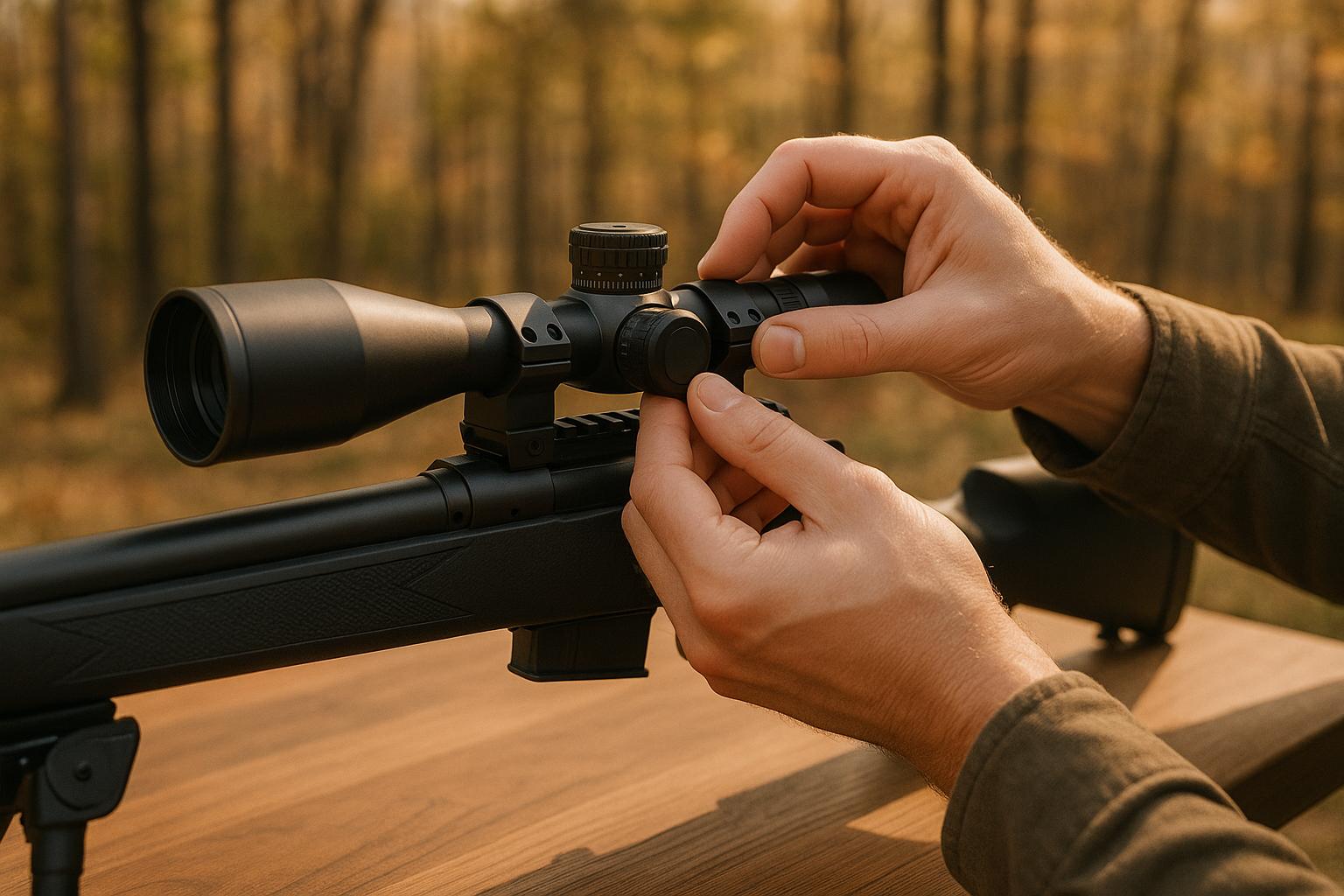
Adjusting your rifle scope’s eye relief is crucial for accuracy, comfort, and safety. Eye relief is the distance between your eye and the scope’s rear lens, where you see a clear, unobstructed image. Proper adjustment prevents issues like "scope bite" (caused by recoil) and ensures a full field of view without shadows or distortions. Here’s a quick breakdown of how to do it:
- Start Safe: Unload your rifle and point it in a safe direction.
- Gather Tools: Use a torque wrench, masking tape, screwdriver, and a stable rest.
- Set Your Shooting Position: Match your setup to your natural shooting stance.
- Loosen the Scope: Adjust the scope’s position by sliding it forward or backward.
- Fine-Tune: Use maximum magnification to find the clearest sight picture.
- Secure: Mark the position, level the reticle, and tighten the screws evenly.
Key tips include maintaining a consistent cheek weld, testing different shooting positions, and ensuring the scope matches your rifle’s recoil and design. Proper eye relief improves your shooting experience, reduces strain, and helps you hit your target with confidence.
Adjusting Eye Relief Before Scope Mounting
Preparing for Eye Relief Adjustment
Getting your eye relief just right starts with solid preparation. Taking the time to set up properly ensures adjustments are safe, precise, and efficient.
Safety First: Unload Your Rifle
Always unload your rifle before making any adjustments to your scope. Double-check that the chamber is empty, and remove all ammunition from the area. Throughout the process, make sure the muzzle is pointed in a safe direction – ideally downrange or toward a secure backstop.
Treat every firearm as if it’s loaded. This safety mindset should become second nature, whether you’re at the range, in your workshop, or out in the field.
Tools and Materials You Need
To make adjustments, gather these essentials: a torque wrench (calibrated for 15–25 inch-pounds, depending on your scope rings), masking tape, a small flashlight or headlamp, a screwdriver or hex key set, and a rifle rest or sandbags for stability.
Most scope ring screws are tightened to between 15 and 25 inch-pounds, but always refer to your scope’s manual for exact specifications. Masking tape is useful for marking the scope’s position once you’ve found the ideal setup. If you’re setting up multiple rifles or want to replicate the same configuration later, a measuring tape can also come in handy.
Once you’ve confirmed safety and gathered your tools, it’s time to get into position.
Set Up Your Shooting Position
Adjusting your scope from a bench might seem convenient, but it’s better to replicate the position you’ll use in the field. Your scope should align naturally with how you shoot.
Adopt the stance you use most often – whether that’s standing, kneeling, or prone. For hunters, this might mean setting up as if you’re taking a standing shot. If you typically wear a backpack while hunting, wear it during this process, as the straps can affect the distance between your eye and the eyepiece. This attention to detail ensures your setup matches real-world conditions.
"Consistency equals accuracy and speed, which is important to hunting, target practice, and competition".
Maintaining a consistent cheek weld and head position is crucial. Practice shouldering your rifle repeatedly during setup to find a natural, repeatable position. If you’re struggling to get a comfortable cheek weld or if the scope seems too high or low, you may need to adjust your equipment. Consider options like lower scope rings or adding a cheek riser before fine-tuning your eye relief.
Step-by-Step Guide to Adjusting Eye Relief
Now that you’re set up and ready to go, it’s time to fine-tune your eye relief. This process requires patience and precision, so take your time and follow these steps carefully.
Loosen the Scope for Adjustments
Begin by loosening the scope rings just enough to allow the scope to move smoothly. Make sure both rings remain evenly spaced while loosening. Refer to the manufacturer’s torque specifications for guidance. When it’s time to retighten, do so gradually in a zigzag pattern, similar to tightening car tires, and keep an eye on your reference level to maintain alignment.
Set to Maximum Magnification
Switch your scope to its highest magnification setting before making adjustments. This setting narrows the eye relief range, allowing you to make more precise adjustments. Starting with maximum magnification ensures the scope functions as intended across all magnification levels.
Find the Best Eye Relief Position
Using your established cheek weld, shoulder the rifle naturally, and close your aiming eye. Once in position, open your eye and let your natural stance guide you. Avoid forcing your head into an awkward position. Adjust the scope forward or backward until you achieve a clear sight picture.
"Eye relief is the distance between the eyepiece lens of a rifle scope and the shooter’s eye that allows for a full field of view without experiencing vignetting, blackouts, or other visual disturbances."
– Warne Scope Mounts
Position the scope in the middle of the eye relief range to account for slight movements in your head during shooting. If the scope’s optimal position causes it to press against the rings, consider moving the rings along the rail if possible. If adjustments to the rings aren’t an option, follow the optic manufacturer’s torque specifications carefully. Test your setup by shouldering the rifle several times to ensure the sight picture remains consistent without further adjustments. Once satisfied, mark the position and secure the scope.
Mark and Secure the Scope
Use masking tape to mark the optimal scope position, then tighten the screws incrementally in a zigzag pattern while checking the sight picture as you go. Ensure that the gaps between the rings are even.
"If you find yourself needing to reposition your cheek/eye placement behind the optic when you zoom in/out, then you almost certainly have not set the scope up properly for eye relief. It should be good to go from your most comfortable cheek weld position regardless of the magnification you find yourself set on."
– vortexoptics
Before fully tightening the rings, take a moment to level the reticle. This step is crucial, as rushing through it could undo all the careful adjustments you’ve made. Slow and steady wins the race here.
Tips for Best Eye Relief Results
Get consistent comfort and accuracy by fine-tuning your scope setup with these practical eye relief tips. Once your scope is mounted, use these strategies to perfect your adjustments.
Aim for the Midpoint of the Eye Relief Range
Position your scope at the center of its approximate one-inch eye relief range to maintain a clear sight picture across various shooting positions and magnification levels. This balanced setup ensures clarity whether you’re adjusting magnification or changing shooting stances.
Variable power scopes tend to offer longer eye relief at lower magnifications. To optimize your setup, adjust the scope while it’s at maximum magnification. By splitting the difference between the high and low eye relief numbers, you ensure consistent clarity across the entire zoom range.
Test Different Shooting Positions
Your shooting stance plays a big role in how your eye aligns with the scope. For instance, setting eye relief from a bench might not work well when shooting prone, as your head naturally moves closer to the optic in that position. Always maintain your established cheek weld when checking your alignment.
To test alignment, close your eyes, shoulder the rifle naturally, and then open your eyes to see if the sight picture is clear or if shadows or misalignments appear.
"Consistency equals accuracy and speed, which is important to hunting, target practice, and competition." – Warne Scope Mounts
Evaluate your setup by aiming at a 100-yard target with maximum magnification. This helps confirm that your eye relief stays consistent at range. Fine-tune your adjustments after testing each position to lock in accuracy.
Consider Rifle and Scope Differences
Adjustments for eye relief often depend on your rifle and scope combination. For example, high-powered rifles or magnum calibers require extra attention to eye relief due to their significant recoil. These adjustments build on the foundational setup techniques already covered.
If your rifle has a field-adjustable stock with a customizable length of pull (LOP), you can easily adapt to different shooting positions. For rifles with taller stocks, using canted bases can lower the scope’s position, improving eye alignment. Forward scope mounts can also help by moving the scope farther forward in the rings, providing extra distance when needed. Adjustable cheek risers are another useful tool for achieving proper comb height and alignment behind the optics.
Before each shooting session, double-check your eye relief and make adjustments as needed. Seasonal changes, like wearing thicker clothing, can alter your rifle’s fit and impact alignment. Some scopes come with adjustable features for eye relief, offering extra flexibility to match your shooting style. Take advantage of these options to refine your setup across different rifles and scenarios.
sbb-itb-31b92c7
Common Mistakes and Troubleshooting
Even seasoned shooters can stumble when it comes to adjusting eye relief. Knowing the common missteps can save you a lot of hassle and help you fine-tune your scope setup for better accuracy and comfort.
Common Adjustment Errors
One frequent mistake is rushing through the adjustment process. Many shooters position their scope in a "good enough" spot and then try to adjust their shooting form to match, rather than properly aligning the scope from the start. This shortcut often leads to discomfort and inconsistent performance, especially during longer shooting sessions.
Another common issue arises when shooters force their body into awkward positions to accommodate the scope placement. Instead, the scope should be positioned to align naturally with your shooting stance. If you let the scope dictate your posture, you’ll likely face inconsistency across different shooting scenarios.
Some shooters also make the error of setting eye relief by moving their eye closer to the scope, which can result in an inconsistent field of view and problems with the eyebox when switching positions. Others mistakenly base their adjustments on the zoom level rather than their natural shooting position, which can create further issues.
Incorrect mounting height is another pitfall. Ignoring ring height and assuming you can adjust your body to compensate often leads to a frustrating setup. Without the right mounting height, you may find yourself struggling against your equipment rather than working with it.
The good news? These problems can be addressed with a few targeted solutions.
Solutions to Common Problems
Once your scope is mounted correctly, fine-tuning your setup is key to achieving a clear and consistent sight picture. A dark ring around the edges of your view – known as vignetting – often indicates you’re too close or too far from the eyepiece. Adjust the scope forward or backward until the entire sight picture is clear.
If the reticle looks blurry, focus on the ocular lens adjustment. Point the scope at a blank surface and tweak the ocular lens until the reticle appears sharp and crisp.
For issues with cheek weld alignment, consider experimenting with ring heights or adding a cheek riser. If the scope sits too high, try lower rings or an adjustable comb. Conversely, if it’s too low, higher rings might be the solution.
Environmental factors can also impact clarity. Dirt and smudges on lenses can cause blurriness, so clean them regularly with a lens cleaning solution and microfiber cloth. In bright light, a sunshade can reduce glare and improve your sight picture.
Eye strain or fatigue is another common challenge. Shooting with both eyes open can help reduce strain, as can taping the non-dominant lens of your shooting glasses if needed. Staying hydrated and taking regular breaks can also make a big difference.
When to Seek Professional Help
If you’ve tried everything and still can’t resolve your issues, it might be time to consult a professional. Sometimes, the problem lies not with the adjustments but with the scope itself – its design, eye relief specifications, or even the length of the objective bell may not be compatible with your rifle.
Limited mounting slots can also prevent you from achieving proper eye relief. If you’ve exhausted your options with ring heights and positioning, it could indicate a mechanical issue within the scope. In such cases, a professional evaluation may be necessary.
If you’re maxing out the scope’s adjustment range and still struggling – for example, if bullets are consistently hitting low despite full elevation adjustments – you may need windage-adjustable bases or an inclined base to correct the problem.
Another red flag is if the scope’s ocular lens impacts your brow during recoil. This often means you need a scope with longer eye relief rather than further adjustments to your current setup. For example, Leupold users can call 1-800-LEUPOLD for expert guidance on mounting options.
Finally, if none of these solutions work, the issue might not be with the scope at all but with your rifle’s fit. Problems with the length of pull on your stock can interfere with proper eye relief. In such cases, a qualified gunsmith can assess whether modifications or a replacement stock are necessary.
Pros and Cons of Proper Eye Relief Settings
Getting your eye relief just right can make a big difference in safety, accuracy, and comfort, but it often takes some trial and error to dial it in perfectly.
Proper eye relief plays a key role in preventing injuries like "scope bite" from recoil and ensures a steady sight picture, which is critical for accuracy. Warne Scope Mounts puts it well:
"Consistency equals accuracy and speed, which is important to hunting, target practice, and competition".
When your sight picture stays consistent every time you shoulder your rifle, you won’t waste time adjusting your head position to see clearly. This consistency directly translates to better precision. Plus, proper eye relief reduces eye strain during long shooting sessions, allowing you to stay focused for extended periods. A clear, full sight picture also speeds up target acquisition, whether you’re at the range or out in the field.
However, achieving that perfect eye relief can be a bit of a process. You may need to experiment with scope ring heights, adjust the scope’s position, or even add accessories like cheek risers. Factors like your shooting stance, seasonal clothing, and individual physical traits can all influence what feels right for you. For instance, what works comfortably in summer might need tweaking when you’re bundled up in winter layers.
Comparison Table: Pros and Cons
| Aspect | Advantages | Challenges |
|---|---|---|
| Safety | Prevents recoil injuries and scope bite | Requires precise initial adjustments to avoid risks |
| Accuracy | Consistent sight picture improves precision | May need readjustment for varied shooting positions |
| Comfort | Reduces eye strain during long sessions | Initial setup can take time |
| Field of View | Full sight picture enhances target acquisition | Scope design can limit optimal positioning |
| Versatility | Adapts to different shooting styles | Seasonal clothing and environment may require changes |
Not all scopes are created equal when it comes to eye relief. Some rifles have mounting limitations that make it tricky to find the ideal setup. Standard eye relief usually ranges from 3.5 to 4 inches, while long eye relief scopes exceed 4.5 inches. These long eye relief options often provide a wider field of view but may sacrifice some magnification power.
For most shooters, the advantages of proper eye relief far outweigh the challenges. Taking the time to fine-tune your setup not only boosts safety and accuracy but also improves your overall experience. While it may require some patience upfront, the payoff is well worth it, especially when paired with professional gear recommendations from experts like Scope It Outdoors. Proper adjustments ensure you’re ready to make the most of every shot.
About Scope It Outdoors

If you’re looking for expert guidance on scope adjustments or the best gear for your outdoor adventures, Scope It Outdoors has you covered. Founded by a team of passionate outdoor enthusiasts, this trusted resource understands the unique challenges faced by hunters, bird watchers, and adventurers alike.
"Our team of experts are dedicated to helping you find the right product for your specific needs"
Expert Reviews and Recommendations
Scope It Outdoors delivers detailed reviews and recommendations from seasoned professionals. Their coverage spans scopes, binoculars, and hunting optics from leading brands, helping you make informed decisions based on your specific shooting needs. Experts like Richard Douglas, a firearms instructor with hands-on experience, contribute practical advice that’s grounded in real-world use. Whether you’re figuring out the ideal scope ring height, selecting the right magnification, or troubleshooting eye relief issues, their team offers personalized support to guide you through the process.
More Resources for Outdoor Enthusiasts
In addition to product reviews, Scope It Outdoors features a robust blog full of practical tips and how-to guides. Topics range from adjusting your scope for precision to selecting gear for activities like hunting, bird watching, and camping.
"We’re passionate about helping outdoor enthusiasts make the most of their time outside"
This passion shines through in their content, which tackles common challenges and offers actionable solutions to enhance your outdoor experiences. Whether you’re a hunter fine-tuning your optics or a camper seeking reliable gear, Scope It Outdoors provides the advice and tools you need to elevate your time in the great outdoors.
Conclusion
Adjusting eye relief isn’t just about comfort – it’s a key safety measure that influences your shooting accuracy and overall experience. When your scope is properly positioned, you can avoid recoil injuries while maintaining a clear sight picture and steady shot placement.
Key Takeaways
The essentials of eye relief adjustment revolve around safety, precision, and practice. Always begin with an unloaded rifle and take the time to find the ideal position where your scope provides a full, clear image without causing eye strain. Ensuring your scope is mounted correctly – using the right torque values – helps prevent equipment issues and keeps your settings intact.
"Prioritizing these practices keeps you, others around you, and the environment free from potential injuries or accidents. With safety as the top priority, you can thoroughly enjoy the shooting sports for many years to come."
– Amien Wang from Pinty Devices
Dialing in the correct eye relief builds muscle memory and increases confidence in your shooting. With your scope set up properly, you can focus on refining your shooting fundamentals rather than struggling with misaligned equipment. Now, it’s time to take these principles to the range and put them into action.
Practice Makes Perfect
Building muscle memory and safe shooting habits takes consistent practice. A well-adjusted scope is only as effective as the time you spend using it.
"Shooting is a skill that requires practice, dedication, and a commitment to continuous improvement".
Head to the range with your adjusted scope and commit to regular practice sessions. Each time you shoulder your rifle, you’ll strengthen the proper eye positioning and sight alignment that proper eye relief enables. Over time, this consistency leads to better accuracy and quicker target acquisition, whether you’re hunting or engaging in shooting sports.
Regular practice not only improves performance but also makes shooting sessions more enjoyable and productive. It’s a great way to connect with other enthusiasts while sharpening your skills. Start with shorter sessions to get comfortable with your new setup, then gradually increase your range time as your confidence and accuracy grow.
FAQs
What problems can arise from incorrect eye relief, and how can you prevent them?
Improper eye relief adjustment can cause serious problems, including scope bite – when the rifle’s recoil sends the scope crashing into your face or eye. This can lead to painful bruises, cuts, or even more severe injuries. Beyond that, incorrect eye relief can make it hard to see a clear, full image through the scope, which can hurt both your accuracy and overall shooting experience.
To avoid these issues, make sure your eye is positioned at the right distance from the scope. This should give you a full field of view while keeping your eye safely out of harm’s way from recoil. Always test your setup in a steady shooting position before heading out, and make any necessary tweaks to ensure you’re shooting safely and accurately.
How do I keep my scope properly adjusted for eye relief when changing positions or wearing different gear?
To ensure proper eye relief while switching shooting positions or wearing different gear, it’s crucial to mount your scope correctly. This setup should provide a clear, full sight picture without any dark edges (known as vignetting). Most scopes offer an eye relief range of 3 to 5 inches, depending on the model.
When fine-tuning, shoulder your rifle and confirm that your eye naturally aligns with the scope’s field of view. If you find yourself shifting your head too much, adjust the scope slightly forward or backward on its mount. Regularly double-check your setup, especially when wearing bulky gear like hunting jackets or shooting from varied stances. This ensures you maintain comfort, accuracy, and safety.
Why am I seeing dark edges or blackouts through my scope, even after adjusting the eye relief?
If you’re seeing dark edges (vignetting) or experiencing blackouts while looking through your scope, it’s likely that your eye isn’t aligned correctly with the scope’s optical axis. Start by checking your eye position. Make sure your eye is at the proper distance from the scope, matching its specified eye relief, and that it’s centered with the lens.
Should the problem persist, take a closer look at the scope’s mounting. It’s important that the scope is properly aligned with your rifle. Additionally, issues like dirty lenses or damaged optics can also lead to visual disruptions. Gently clean the lenses and inspect the scope for any visible damage. If none of these steps resolve the issue, it might be time to consult a professional to ensure the scope’s setup and alignment are accurate.