
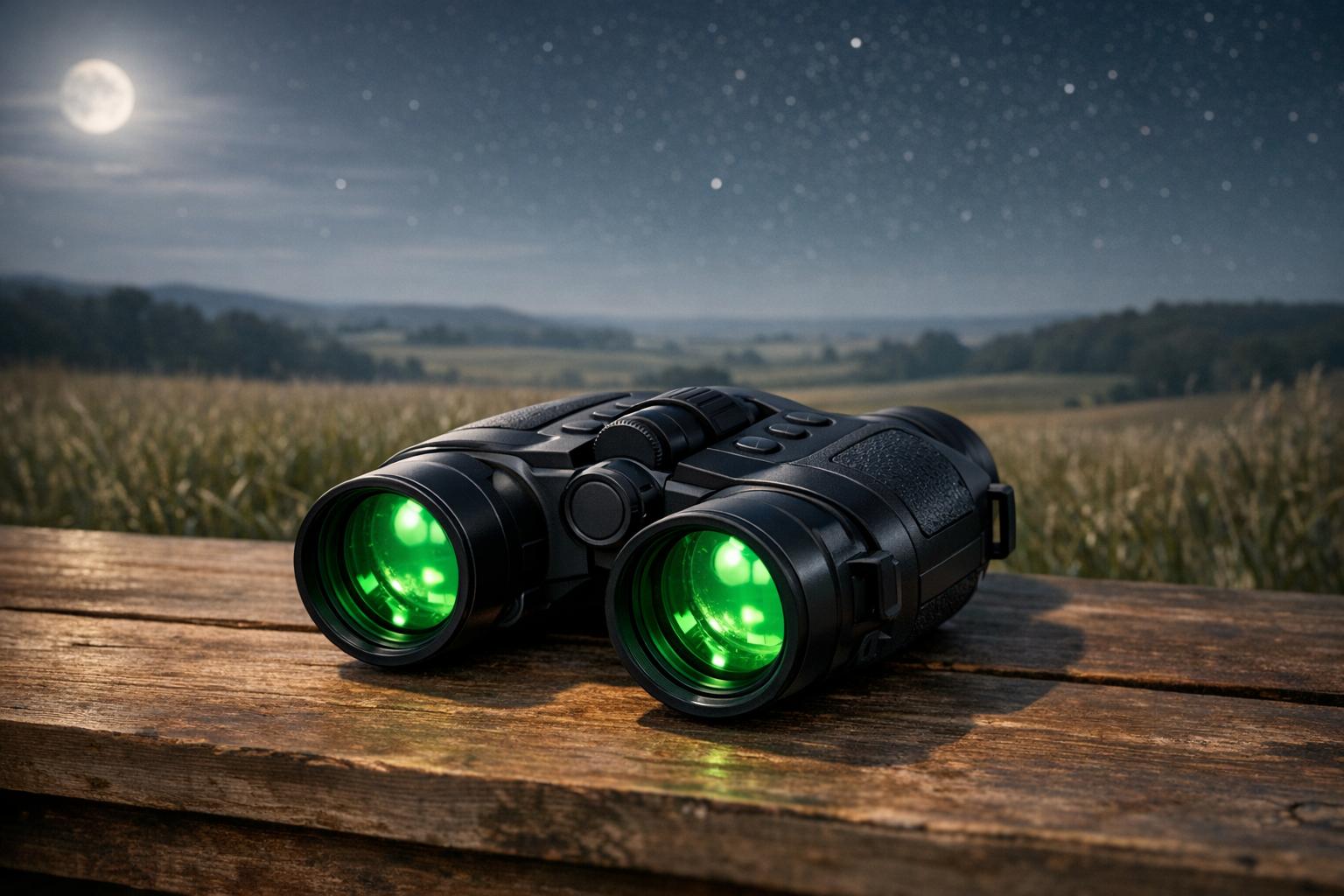
When hunting in open fields at night, selecting the right night vision binoculars is critical. Open landscapes demand equipment that balances long-range detection, clarity, and durability against challenging conditions like low light, fog, and moonlight glare. Here’s what you need to know:
- Magnification vs. Field of View: Opt for binoculars in the 10×42 to 15×50 range for detail clarity. Night vision models typically offer 1x to 5x magnification, with higher magnification requiring a tripod for stability.
- Night Vision Generations:
- Gen 1: Budget-friendly, effective up to 220 yards, but relies on IR illuminators.
- Gen 2: Sharper images, up to 656 yards, handles low light better.
- Gen 3: Best for near-total darkness, over 10,000 hours of tube life, but costs $4,000+.
- Durability: Look for waterproof and shockproof designs with an IP56 rating or higher to withstand harsh weather.
- Rangefinder Integration: Built-in rangefinders, like those in the ATN BinoX 4K, help estimate distances accurately.
Key Tip: Balance your budget with performance needs. For casual use, Gen 1 works. For long-range hunting, invest in Gen 2 or Gen 3 models.
Quick Comparison:
| Feature | Gen 1 | Gen 2 | Gen 3 |
|---|---|---|---|
| Range | ~220 yards | ~656 yards | 656+ yards |
| Image Quality | Basic | Sharp | Brightest |
| Tube Life | ~1,500 hours | ~5,000 hours | 10,000+ hours |
| Cost | $200–$600 | $1,000–$2,500 | $4,000+ |
For the best experience, test devices in low-light conditions, adjust for comfort, and ensure features like IR illuminators and rangefinders meet your needs.
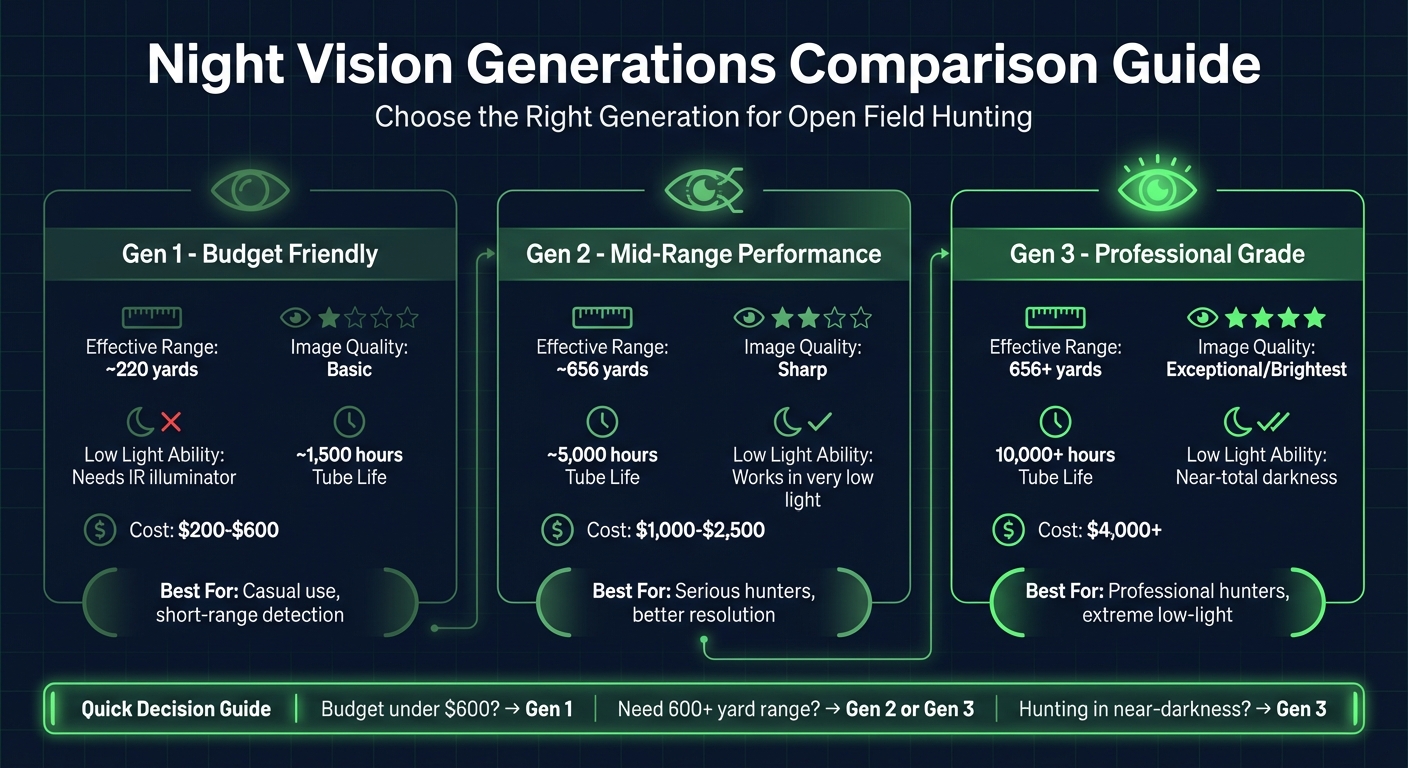
Night Vision Binoculars Generation Comparison Chart: Gen 1 vs Gen 2 vs Gen 3
What Makes Open Fields Different
Environmental Factors in Wide Open Spaces
Open fields provide sweeping, unobstructed views that can stretch as far as 600 yards. This expansive visibility calls for binoculars specifically designed for long-range detection. Choosing the right equipment tailored to these conditions can significantly improve both range and clarity – key elements for successful night hunting.
Without tree canopies to block light, open fields benefit from natural illumination like moonlight, starlight, or even diffused light from clouds, which enhances night vision performance. However, on moonless or overcast nights, integrated IR illuminators become indispensable. These unique lighting conditions highlight the importance of binoculars that strike the perfect balance between magnification and field of view.
Spotting specific details in such vast spaces can be tricky. As Adam from Binoculars Guides explains:
"Night vision binoculars is for identification and observation while thermal devices are for detection".
While thermal imaging is excellent for detecting heat signatures through obstacles like tall grass, traditional night vision is crucial for identifying finer details, such as the shape of antlers or other distinguishing features.
Why Open Fields Need Balanced Features
The challenges of open fields require gear that balances key features effectively. For instance, you need high magnification to spot distant targets but also a wide field of view to track movement seamlessly.
Dave Hurteau, Executive Editor at Field & Stream, puts it plainly:
"In open country, you may have to favor magnification over low-light performance – or lug around a model with bigger objective lenses".
However, there’s a trade-off with higher magnification. Once you go beyond 10x, even minor hand tremors can make the image unstable. That’s why many seasoned hunters working in open fields opt for tripod-adaptable binoculars when using models with 12x magnification or more.
Key Features for Open Field Night Vision Binoculars
Field of View vs. Magnification
When scanning open fields, it’s crucial to strike the right balance between magnification and a wide field of view. Higher magnification allows you to see distant details more clearly, but it narrows your view, making it harder to track moving animals without constantly shifting your position. For open-country hunting, binoculars in the 10×42 to 15×50 range offer excellent detail at a distance, though they come with the trade-off of added weight.
Night vision binoculars typically provide 1x to 5x optical magnification, which is much lower than their daylight counterparts. For example:
- 1x magnification offers a detection range of about 110 yards.
- 5x magnification extends that range to roughly 380 yards.
- 8x magnification can push detection to nearly 600 yards.
If wide-area scanning is your priority, aim for a viewing angle of at least 40 degrees. A "wide-field" binocular is generally defined as having a field of view of 450 feet or more at 1,000 yards.
Avoid digital zoom, as it doesn’t add real detail but instead crops and enlarges the existing image, often leading to pixelation or blurriness. Stick to fixed optical magnification for consistent image quality. For magnifications above 10x, a tripod is essential to maintain image stability.
Once you’ve decided on magnification and field of view, make sure the device’s generation aligns with your low-light performance needs.
Generation and Image Quality
The generation of night vision technology plays a huge role in how well the device performs in low-light scenarios. Here’s a breakdown:
- Generation 1 (Gen 1): These are budget-friendly options, often priced under $200. They have an effective range of about 200 meters (220 yards) and depend on an active infrared illuminator. However, they’re highly sensitive to ambient light from sources like streetlights or car headlights, which can wash out the image.
- Generation 2 (Gen 2): A noticeable upgrade, these devices extend effective distances up to 600 meters (656 yards) and offer sharper resolution across the entire field of view. They also handle light flares better and work well in very low light.
- Generation 3 (Gen 3): The top tier of night vision, these devices deliver the brightest images and excel in near-total darkness. As LensApexel explains:
"The difference from Gen 1 to Gen 3 is like a candle versus a spotlight, with a life expectancy five times longer for Gen 3".
Gen 3 units boast a tube life of over 10,000 hours, compared to approximately 5,000 hours for Gen 2 and 1,500 hours for Gen 1. For open-field use, where scanning large areas in minimal light is essential, prioritize devices with a high Figure of Merit (FOM) – calculated by multiplying resolution by signal-to-noise ratio. A FOM of 1,920 to 2,400 signals premium performance.
Expect to pay between $2,000 and $6,000 for professional-grade Gen 2 and Gen 3 models, while military-grade options can reach $4,000 to $9,000.
| Feature | Generation 1 | Generation 2 | Generation 3 |
|---|---|---|---|
| Effective Range | ~220 yards | ~656 yards | 656+ yards |
| Image Quality | Limited clarity | Sharp resolution | Exceptional |
| Tube Life | ~1,500 hours | ~5,000 hours | 10,000+ hours |
| Low Light Ability | Needs IR illuminator | Works in very low light | Near-total darkness |
Detection Range and Rangefinder Integration
A built-in rangefinder can significantly improve accuracy by eliminating the guesswork of estimating distances across vast open spaces. Take the ATN BinoX 4K, for instance – it includes a 1,000-yard rangefinder and allows you to mark locations and share them in real time using the ATN app. The Leica Geovid Pro goes even further, integrating rangefinding with GPS and ballistics data. It can also connect to Kestrel weather sensors via Bluetooth to help determine the best ammunition based on environmental factors.
For digital night vision, ensure the device includes a powerful or detachable long-range infrared illuminator to maximize detection capabilities. If spotting targets at extreme distances is your priority, thermal imaging may be a better choice, as it can detect a human figure from up to 1.25 miles away.
Once you’ve ensured accurate detection and rangefinder features, focus on durability to handle open-field conditions.
Durability and Weather Resistance
Open fields can be tough on equipment, exposing it to rain, dust, temperature changes, and rough handling. Look for binoculars with rugged builds and an IP56 rating or higher to protect sensitive electronics from moisture and debris. Waterproof and shockproof designs are especially valuable for hunting in unpredictable weather.
Weather-sealed housings prevent fogging and protect image intensifier tubes from moisture damage. For extended use, models with a rubber armor coating provide a secure grip and extra drop protection. If you’re using high-magnification binoculars, ensure they’re tripod-adaptable to reduce hand fatigue and stabilize your view during long observation sessions.
How to Choose the Right Night Vision Binoculars
Step 1: Set Your Budget
Your budget plays a big role in determining which night vision generation is right for you. Gen 1 models are a practical starting point for under $200, offering basic functionality within 200 yards. However, they rely heavily on IR illuminators and provide limited image clarity. Mid-range digital models like the ATN BinoX 4K or Nightfox Swift, priced between $300 and $600, come with extra perks such as video recording and daytime usability. For those needing better performance, Gen 2 devices ($1,000–$2,500) deliver sharper resolution and an effective range of up to 600 yards. At the top end, Gen 3 and Gen 4 models ($4,000–$9,000+) excel in near-total darkness, boasting tube lifespans of over 10,000 hours – five times longer than Gen 2.
As T. Logan Metesh from Field & Stream puts it:
"One thing almost always holds true: you get what you pay for – at both ends of the spectrum".
Choose based on how you plan to use the binoculars. If you’re a casual user, Gen 1 or budget digital models will suffice. But if you’re a professional hunter or need to scan large open areas at distances beyond 600 yards, Gen 2 or Gen 3 is worth the investment.
Step 2: Review Key Specifications
Once you’ve set your budget, focus on the technical specs to ensure the binoculars meet your needs for open-field use.
Start with the exit pupil, calculated by dividing the objective diameter by magnification. For low-light conditions, an exit pupil of 5mm to 7mm matches your eye’s natural dilation. Detection range changes with magnification: 1x covers around 330 feet, 5x extends to 1,150 feet, and 8x can reach up to 1,800 feet. For open-field performance, look for a Figure of Merit (FOM) of 1,920 or higher. This metric, derived from resolution and signal-to-noise ratio, indicates higher-quality performance.
If you wear glasses, make sure the eye relief is between 14mm and 18mm to avoid vignetting. Avoid models with digital zoom, as it merely crops the image and reduces clarity.
Step 3: Test for Open-Field Performance
After narrowing down your options, hands-on testing is essential to confirm the binoculars perform well in real-world conditions.
Start by adjusting the diopter setting. Focus the fixed eyepiece first, then fine-tune the adjustable side for your vision. Check for edge distortion by scanning across the field of view – the image should remain sharp from the center to the edges.
If the binoculars include a rangefinder, test its accuracy, particularly for slope-adjusted distances on uneven terrain. Ensure the IR illuminator offers adjustable levels to suit different low-light scenarios. For high-magnification models (12x or higher), confirm they are tripod-compatible to reduce hand shake at such magnifications. Lastly, look for features like Automatic Gain Control (AGC), which helps protect the internal components from sudden exposure to bright lights.
sbb-itb-31b92c7
Top 5 NIGHT VISION Binoculars for Hunting, Security & Wildlife (2026 Guide!)
Conclusion
When choosing night vision binoculars, aim to balance field of view (FOV), image clarity, and durability. A wider FOV – ideally over 6° – is essential for tracking moving wildlife across open landscapes, while higher-generation devices like Gen 2 or Gen 3 provide the sharpness needed for identifying targets at distances often exceeding 600 meters (around 650 yards).
Durability is key, so look for features like waterproofing and nitrogen purging to protect against rain, fog, and temperature changes. While your budget will influence your choice of generation, keep in mind that resolution plays a critical role in identifying distant objects.
For binoculars with magnifications above 12x, consider using a tripod to ensure a stable image. If you wear glasses, make sure the binoculars offer a minimum eye relief of 15–18mm for comfortable viewing.
FAQs
What are the main differences between Gen 1, Gen 2, and Gen 3 night vision binoculars?
The main distinctions between night vision generations come down to their image quality, performance, and price.
Gen 1 night vision binoculars are the most budget-friendly option. They amplify ambient light a few thousand times, producing a green-tinted image. However, they often come with some trade-offs: noticeable distortion around the edges, a faint high-pitched whine during use, and a slight afterglow when powered off.
Stepping up to Gen 2 models brings a clear improvement. Thanks to a micro-channel plate, these devices deliver sharper images with less distortion and better light amplification. They’re also more durable and sit in the mid-range price bracket.
At the top of the line are Gen 3 binoculars. These feature advanced technology like a gallium-arsenide photocathode and often a white-phosphor screen, offering unmatched resolution and brightness. Many also include autogating, which protects the device when light conditions change. While they provide the best overall performance and durability, they come with a higher price tag to match.
Why is the field of view important when using night vision binoculars in open fields?
The field of view determines how much of the scene you can see through your binoculars without needing to move them around. When you’re out in open areas, having a broader field of view can make a big difference. It lets you quickly scan wide spaces and easily follow moving subjects – whether that’s wildlife, game, or other points of interest.
A narrow field of view, on the other hand, can be frustrating. You’ll likely find yourself constantly shifting the binoculars to keep up, which gets tiring fast. For open-field adventures, opt for night vision binoculars that strike a good balance between magnification and a wide, clear field of view. It’ll make your experience much more efficient and enjoyable.
Why is durability essential when choosing night vision binoculars for open fields?
Durability is a key factor when it comes to night vision binoculars designed for open fields. These environments can be harsh, exposing your equipment to elements like dust, rain, wind, and sudden temperature swings. Such conditions can wreak havoc on delicate components like lenses and electronics. That’s why having binoculars with a waterproof, shock-resistant design is essential – they’ll keep performing reliably even when the weather or terrain gets tough.
Open fields also come with their fair share of rugged terrain, making bumps, accidental drops, and uneven surfaces almost inevitable. A solid, well-constructed frame acts as a safeguard, protecting your binoculars from damage and ensuring they last longer. Opting for durable binoculars not only keeps your gear intact but also saves you money over time by cutting down on repair or replacement costs.