
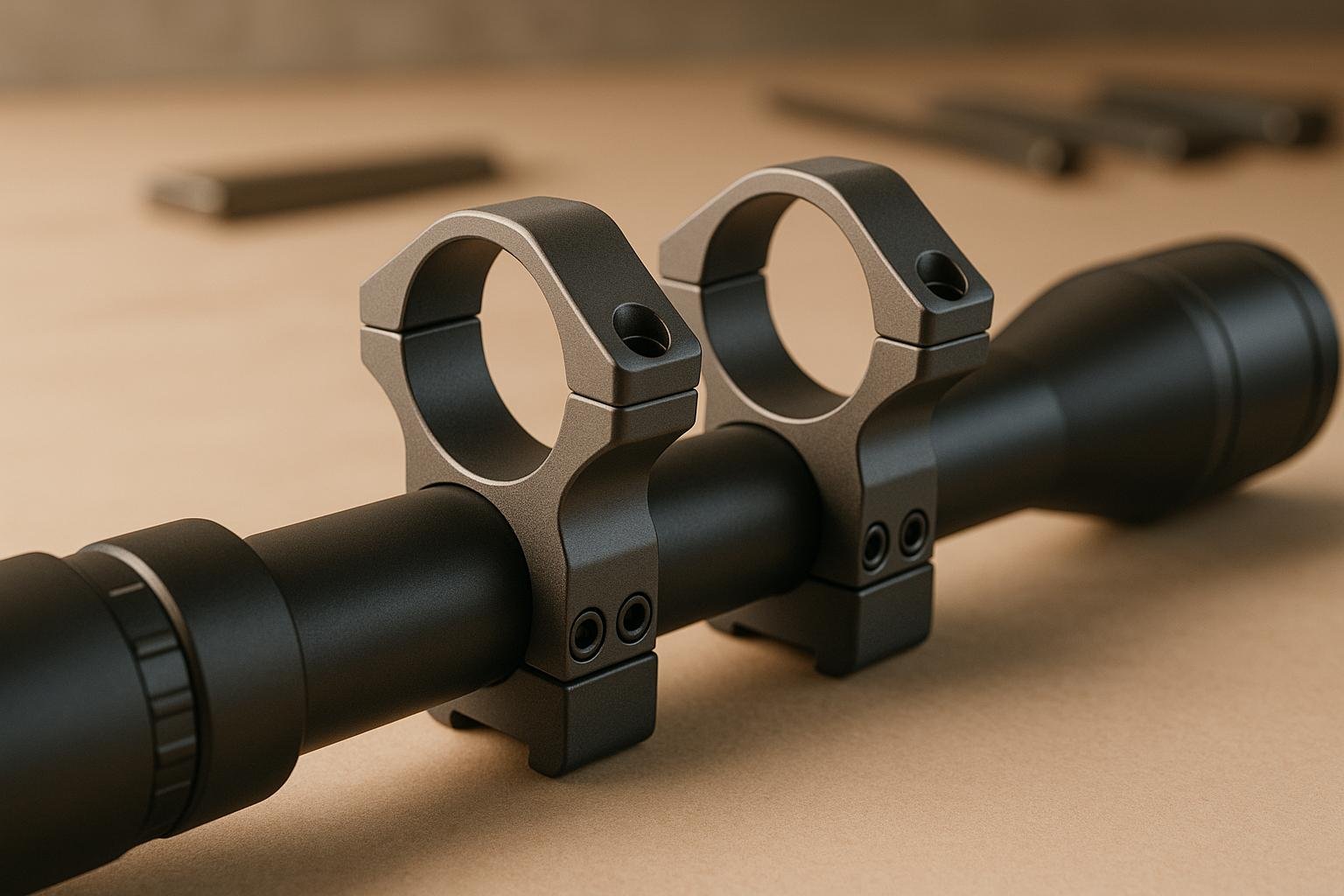
Choosing lightweight scope rings can make a big difference in your shooting experience, especially if you’re a hunter or shooter who values reduced weight and improved balance. Here’s a quick breakdown of what to keep in mind:
- Material Matters: Lightweight rings are often made from aircraft-grade aluminum (6061-T6 or 7075-T6). 7075-T6 is stronger and more durable, while 6061-T6 is still a solid choice for moderate use.
- Compatibility Is Key: Match the ring diameter (e.g., 1-inch, 30mm, 34mm) to your scope tube and ensure the rings fit your rifle’s mounting system (Picatinny, Weaver, or dovetail).
- Proper Ring Height: Choose a height that ensures your scope’s objective bell clears the barrel while maintaining a comfortable cheek weld.
- One-Piece vs. Two-Piece: One-piece mounts offer more stability, especially for heavy-recoil rifles, while two-piece mounts save weight and provide better access to the rifle’s action.
For ultralight performance, look for rings made with 7075-T6 aluminum, a hard anodized finish, and proper torque installation to ensure durability and zero retention. Whether you’re trekking through the backcountry or hitting the range, the right rings can make all the difference.
Scope Ring or Mount Selection Guide – How To Measure Scope Ring Height -Are Rings Or Mounts Better
What to Consider When Choosing Scope Rings
Selecting lightweight scope rings involves focusing on three main factors: the material, compatibility with your rifle and scope, and ensuring the ring height provides proper clearance and fit.
Material and Weight
Lightweight scope rings are often made from either 6061-T6 or 7075-T6 aircraft-grade aluminum. Between the two, 7075-T6 is the stronger option. To put it in perspective, steel rings typically weigh around 5–7 ounces, while aluminum rings are much lighter, coming in at just 2–3 ounces.
When choosing aluminum rings, look for a hard anodized finish. This finish enhances surface hardness and offers protection against corrosion – an important feature if you hunt in wet, snowy, or coastal conditions. A matte finish can also help minimize glare when you’re out in the field. If you prefer steel rings for handling the recoil of a magnum rifle, make sure they’re made of stainless steel or have a protective coating like nitride or phosphate to guard against rust.
Once you’ve considered the material, ensure the rings are compatible with both your scope and rifle system.
Rifle and Scope Compatibility
Getting the right fit starts with matching the inside diameter of the rings to your scope tube. Common sizes include 1 inch, 30mm, and 34mm. It’s crucial to verify your scope’s tube diameter before purchasing since, for example, a 34mm ring won’t fit a 1-inch scope tube.
You’ll also need to match the ring base to your rifle’s mounting system. Picatinny rings are made specifically for Picatinny rails, which are standard on many modern hunting and precision rifles. Weaver-style rings, on the other hand, are designed for Weaver bases and may fit Picatinny rails (though not always the other way around). Dovetail rings are specific to certain rimfire rifles and traditional hunting rifles with 3/8-inch grooves. For example, a Remington 700 with a Picatinny rail will require Picatinny-compatible rings, while a rimfire rifle with a 3/8-inch dovetail groove will need dovetail rings. Using the wrong type of ring can lead to mounting problems.
Ring Height and Clearance
Ring height is measured from the top of the rail to the center of the scope tube. You’ll need enough height to ensure the objective bell clears the barrel, action, and any iron sights, but not so much that it disrupts your cheek weld. A good rule of thumb is that the ring height should slightly exceed half the diameter of your objective bell, while also accounting for your barrel contour and rail thickness.
For instance, a 40mm objective typically works well with low or medium rings on a standard barrel. Larger objectives, like 50mm or 56mm, or rifles with heavy bull barrels, often require medium or high rings. After loosely mounting the rings, check that the bolt handle clears the eyepiece when cycled. You can also use a thin piece of paper to test clearance between the objective bell and the barrel – if the paper gets pinched, you may need to opt for a taller ring height.
For tailored advice, consider reaching out to experts like Scope It Outdoors for fit recommendations.
One-Piece vs. Two-Piece Mounts
When choosing lightweight scope rings, the decision between one-piece and two-piece mounts plays a significant role in your rifle’s performance. Your choice should align with your shooting needs, whether you prioritize stability, weight savings, or specific functionality for your discipline.
One-piece mounts feature a continuous base, which offers excellent stability. By evenly distributing recoil, they help protect the scope tube from damage. Modern one-piece mounts made from 7075-T6 aluminum match the strength of steel while cutting down on weight, making them a solid choice for demanding setups.
Two-piece mounts, on the other hand, consist of separate rings that attach individually to the rail or receiver. This design is lighter – typically weighing just 2–3 oz in total – and provides better access to the rifle’s ejection and loading port. For hunters navigating steep terrain, such as those pursuing whitetail or elk, saving 2–4 oz at the top of the rifle can enhance balance and reduce fatigue over long treks.
However, two-piece mounts come with a potential downside: misalignment. If not mounted with precision, the independent rings can cause issues, especially on rifles with heavy recoil or in rugged conditions. That said, for moderate-caliber hunting rifles like .243, .270, or .308, this risk is minimal when using quality components and proper installation techniques.
For magnum rifles like .300 Win. Mag. or .338 Lapua, or long-range precision rifles, one-piece mounts are better suited. They help maintain scope alignment and ensure smooth elevation adjustments. On the other hand, lightweight mountain rifles or backcountry builds benefit from the reduced weight and improved handling of two-piece mounts.
One-Piece Mounts: Strengths and Weaknesses
One-piece mounts shine in scenarios where stability is critical. Their single, solid design minimizes the chance of misalignment during installation, which can otherwise stress the scope tube. They also simplify setup – adjusting eye relief often involves loosening just a few screws rather than dealing with multiple components.
These mounts are particularly well-suited for AR-style rifles and modern sporting rifles. Cantilevered one-piece mounts ensure proper scope height and eye relief on flat-top receivers. Many models also feature a built-in cant (e.g., 20 MOA), which adds elevation for long-range shooting without overextending your scope’s internal adjustments.
The downsides? One-piece mounts add extra weight due to the connecting bridge, which can affect balance, especially on lightweight rifles under 7 lbs. They also limit access to the receiver’s top, which can be inconvenient for hunters accustomed to top-loading cartridges or carrying their rifles in specific ways.
Two-Piece Mounts: Strengths and Weaknesses
Two-piece mounts, while less rigid, offer distinct advantages in weight reduction and accessibility. They allow for independent height adjustments and maintain a classic low-profile look favored by many hunters. With the receiver’s top more open, top-loading cartridges becomes easier – an appealing feature for hunters who like to keep their magazine partially loaded while on the move.
For instance, ZEISS Ultralight two-piece rings weigh just 4.41 oz for a 30mm pair, and Vortex Pro Series rings weigh about 44.7g per ring, both performing reliably in tough field conditions.
Precision matters more with two-piece systems. You’ll need to ensure the scope rotates freely in the rings and that the reticle tracks correctly after installation. Proper torque settings – typically 25 in-lbs for ring screws on aluminum mounts – are essential to avoid issues. While two-piece mounts may be slightly less resistant to movement on magnum-caliber rifles or in harsh environments, high-quality materials and careful installation can mitigate these concerns effectively.
Balancing Strength and Durability
When reducing weight, it’s crucial not to sacrifice zero retention. Lightweight rings must endure recoil, environmental stress, and impacts like accidental drops, vehicle transport, or brush contact during field use. These stresses, especially from hard-kicking calibers, can lead to ring movement, causing zero shifts and inconsistent shot groups.
Rings made from 7075-T6 aluminum offer an impressive balance of lightness and durability, often passing rigorous tests while being much lighter than steel. Warne highlights how these rings deliver robust performance without the extra weight. Similarly, XLR Industries has challenged the old belief that only steel rings can handle heavy use, with many top shooters now favoring aluminum rings and bases. However, achieving this performance starts with proper installation, particularly correct torque settings.
Torque Specifications
Getting the torque right is essential for ensuring a secure mount while protecting your scope and ring threads. Most manufacturers recommend ring cap screw torque between 15–25 in-lb and base or Picatinny rail screws in the 20–30 in-lb range, depending on the screw size and material. Always refer to the specific torque values provided by your ring manufacturer. If torque is too low, the rings might slip under recoil. Too high, and you risk crushing the scope tube, distorting its internals, or stripping threads – especially with aluminum rings.
To ensure accuracy, use a calibrated inch-pound torque wrench. Start by degreasing the threads and applying a manufacturer-approved threadlocker. Lightly snug the cap screws, level the rifle, and then tighten them gradually in a crisscross pattern until you reach the final torque value. Aim for an even gap on both sides of the ring caps to avoid distorting the scope tube. For base screws, ensure they are torqued to the specified values and that the base is fully seated and square.
Testing for Strength and Stability
After installation, test the mount’s strength and stability in the field. Begin by zeroing your rifle and firing 20–40 rounds to confirm the point of impact remains steady. Next, perform a bump test by lightly tapping the stock or scope against a padded surface (with the rifle unloaded), then re-check your zero to ensure there’s no movement. After your first range session, verify that all screws still meet the specified torque values. If any screws have loosened, it could indicate insufficient torque or thread issues.
For live-fire testing, fire a cold-bore shot followed by a short group at 100 yards to confirm consistent impact points. Test from various shooting positions – prone, sitting, and standing – using your heaviest-recoiling loads to check for any flex in the rings or bases under different conditions. For example, one reviewer fired over 1,000 rounds of .300 Win. Mag. using ZEISS Precision Ultralight rings and reported they "maintained zero flawlessly", proving that well-designed aluminum rings can handle even magnum recoil.
sbb-itb-31b92c7
5 Lightweight Scope Ring Options
Now that we’ve covered the basics of installation, let’s dive into five lightweight scope ring options that stand out for their durability and low weight.
Tally Lightweight Mounts
Tally mounts are popular for their simple, lightweight aluminum construction. While detailed technical specs aren’t always provided, these rings are a go-to choice for hunters who prioritize shedding every unnecessary ounce from their setup.
Nightforce X-Treme Duty Ultralite Rings

Nightforce combines innovation and strength with their X-Treme Duty Ultralite Rings. These rings feature a hybrid design: 7075-T6 aluminum for the ring bodies and titanium for the crossbolts and jaws. This combo delivers steel-level strength at nearly half the weight. Available in 30mm and 34mm tube sizes with various height options, the 30mm medium rings weigh about 3.3 oz per pair. Thanks to their precision machining, lapping isn’t required. You can choose between 4-screw or 6-screw configurations, and they’re compatible with Picatinny rails. These rings are perfect for setups where maintaining zero is critical. Expect prices between $150 and $200.
Warne Hyperlite Ultra-Lightweight Rings
Warne’s Hyperlite series is all about cutting weight without sacrificing reliability. Made from machined 7075-T6 aluminum, these rings feature a minimalist design that’s both strong and lightweight. The Hyperlite MSR model (30mm) weighs just 4.25 oz, significantly lighter than the 6.5 oz of many competitors. This makes them ideal for lightweight rifles chambered in calibers like .308 or 6.5 Creedmoor. Offered in 1-inch and 30mm sizes with low, medium, and high configurations, they’re compatible with both Picatinny and Weaver rail systems. These rings also handle recoil well and are gentler on scope tubes compared to steel options. Prices range from $70 to $110 [13,15].
Seekins Precision Rings
Seekins Precision Rings are known for their high-quality CNC machining and tight tolerances, which often eliminate the need for lapping. Crafted from 7075-T6 aluminum, the 30mm medium rings weigh about 3.9 oz per pair. Their design includes a 4-screw T-15 Torx system and an integrated recoil lug for added stability. These rings are available in various tube sizes with stepped height options and work with both Weaver and Picatinny rails. Precision shooters value their reliable performance. Prices fall between $130 and $180.
Zeiss Ultralight Precision Rings

Zeiss designed their Ultralight Precision Rings to perfectly complement their scopes, ensuring proper cheek weld and balance. Made from 7075-T6 aluminum with a Mil-Spec Type III hard anodized finish, the 30mm low rings weigh around 4.41 oz, while the medium rings are about 4.4 oz. A standout feature is the built-in anti-cant bubble level, which helps maintain accuracy on uneven ground. These rings use Type 303 stainless steel cap screws torqued to 25 in-lbs and are available in 30mm, 34mm, and 36mm sizes. U.S. buyers should double-check tube diameter and base compatibility for a seamless setup. Prices range from $100 to $150.
Scope Ring Comparison Table
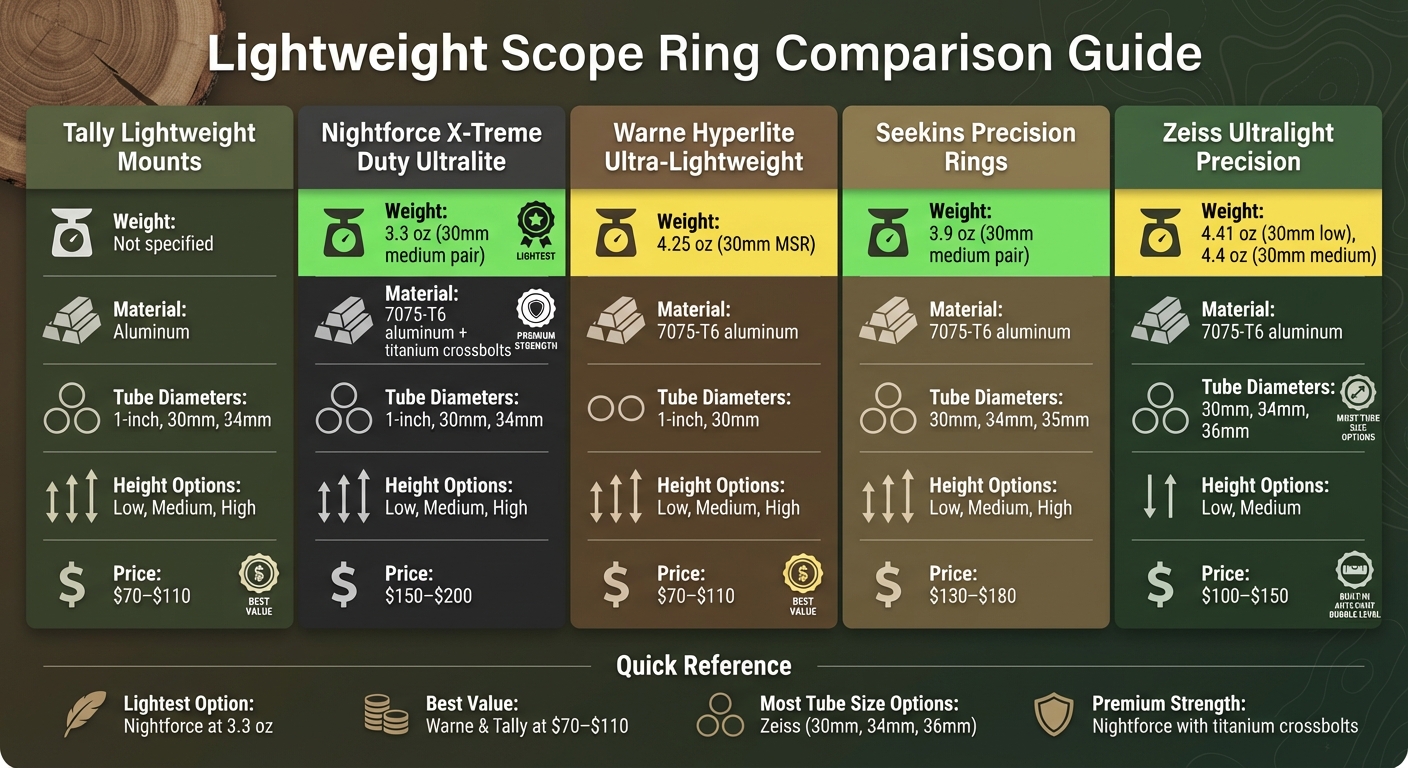
Lightweight Scope Rings Comparison: Weight, Material & Price Guide
Specifications Comparison
Here’s a quick overview of the key specifications for the lightweight scope rings mentioned earlier:
| Model | Weight (oz) | Material | Tube Diameters | Height Options | Price Range (USD) |
|---|---|---|---|---|---|
| Tally Lightweight Mounts | Not specified | Aluminum | 1‑inch, 30mm, 34mm | Low, Medium, High | $70–$110 |
| Nightforce X-Treme Duty Ultralite Rings | 3.3 oz (30mm medium pair) | 7075‑T6 aluminum + titanium crossbolts | 1‑inch, 30mm, 34mm | Low, Medium, High | $150–$200 |
| Warne Hyperlite Ultra‑Lightweight Rings | 4.25 oz (30mm MSR) | 7075‑T6 aluminum | 1‑inch, 30mm | Low, Medium, High | $70–$110 |
| Seekins Precision Rings | 3.9 oz (30mm medium pair) | 7075‑T6 aluminum | 30mm, 34mm, 35mm | Low, Medium, High | $130–$180 |
| Zeiss Ultralight Precision Rings | 4.41 oz (30mm low), 4.4 oz (30mm medium) | 7075‑T6 aluminum | 30mm, 34mm, 36mm | Low, Medium | $100–$150 |
This table highlights the standout features of each model. If you’re prioritizing lightweight options, the Nightforce and Seekins rings are among the lightest. For added strength, the Nightforce rings incorporate titanium crossbolts. On the other hand, Warne and Zeiss rings are slightly heavier but still fall into the lightweight category.
All options provide various tube diameters and height configurations, ensuring compatibility with different scopes and rifles. By comparing these details, you can find the rings that best meet your needs and preferences.
Conclusion
When it comes to choosing lightweight scope rings, the key is to match material strength, ring height, and mount type with your rifle’s specific needs. Start by determining your scope’s tube diameter, the base or rail interface on your rifle, and the minimum ring height required to clear the objective bell and action. High-quality aluminum rings, such as those made from 7075-T6, are an excellent choice – they offer steel-like durability while being much lighter. Many top precision shooters favor aluminum for its strength-to-weight ratio and its ability to minimize stress on optics during recoil.
Your choice should also reflect how you plan to use the rifle. Backcountry hunters often benefit from ultralight two-piece rings. These not only save weight but also allow easier access to the ejection port. On the other hand, precision shooters or those using rifles with heavy recoil might lean toward one-piece mounts or rings with titanium hardware, like the Nightforce X-Treme Duty Ultralite, for added rigidity and reliability. Regardless of your choice, aim to mount your scope as low as possible to ensure a natural cheek weld and consistent eye relief.
Once you’ve selected and installed your rings, remember to torque all screws according to the manufacturer’s guidelines. Afterward, fire 20–40 rounds to test zero retention. This step ensures your rings can handle recoil and field conditions without shifting.
If your rings are properly fitted, designed to handle your rifle’s recoil, and mounted correctly, you can trust your optic to stay secure when it counts. For more personalized advice on setups, check out Scope It Outdoors.
FAQs
Why is 7075-T6 aluminum a great choice for lightweight scope rings?
When it comes to lightweight scope rings, 7075-T6 aluminum stands out as a top-tier material. It offers an impressive combination of strength and low weight, keeping your gear tough without weighing you down. Its built-in corrosion resistance makes it perfect for outdoor adventures, even in challenging weather, and its toughness ensures it can handle the recoil from powerful rifles. This blend of durability, lightness, and reliability makes it a favorite among hunters and outdoor enthusiasts alike.
How can I choose the right ring height for my scope and rifle?
When selecting the right ring height for your rifle scope, the goal is to ensure the scope’s objective lens clears the barrel while keeping your shooting position comfortable. To get started, measure the diameter of your scope’s objective lens, including its housing. Then, factor in your rifle’s design – particularly the height of the receiver and barrel. Alignment is crucial for maintaining accuracy and proper eye relief.
Using rings that are too high or too low can lead to discomfort, like neck strain, or throw off your sight picture. A simple guideline? Opt for the lowest ring height that still allows enough clearance for the scope.
What are the advantages and disadvantages of one-piece and two-piece scope mounts?
One-piece scope mounts offer superior stability and alignment, making them ideal for precision shooting. Their design ensures durability and reduces the risk of shifting during use. That said, they can be trickier to install and often require precise fitting, which might not be compatible with every rifle.
Two-piece mounts, on the other hand, are easier to install and adjust, giving you more flexibility to accommodate various rifle setups. They’re also lighter and often have a sleeker appearance. However, they don’t match the rigidity of one-piece mounts, which could slightly affect accuracy over time.