
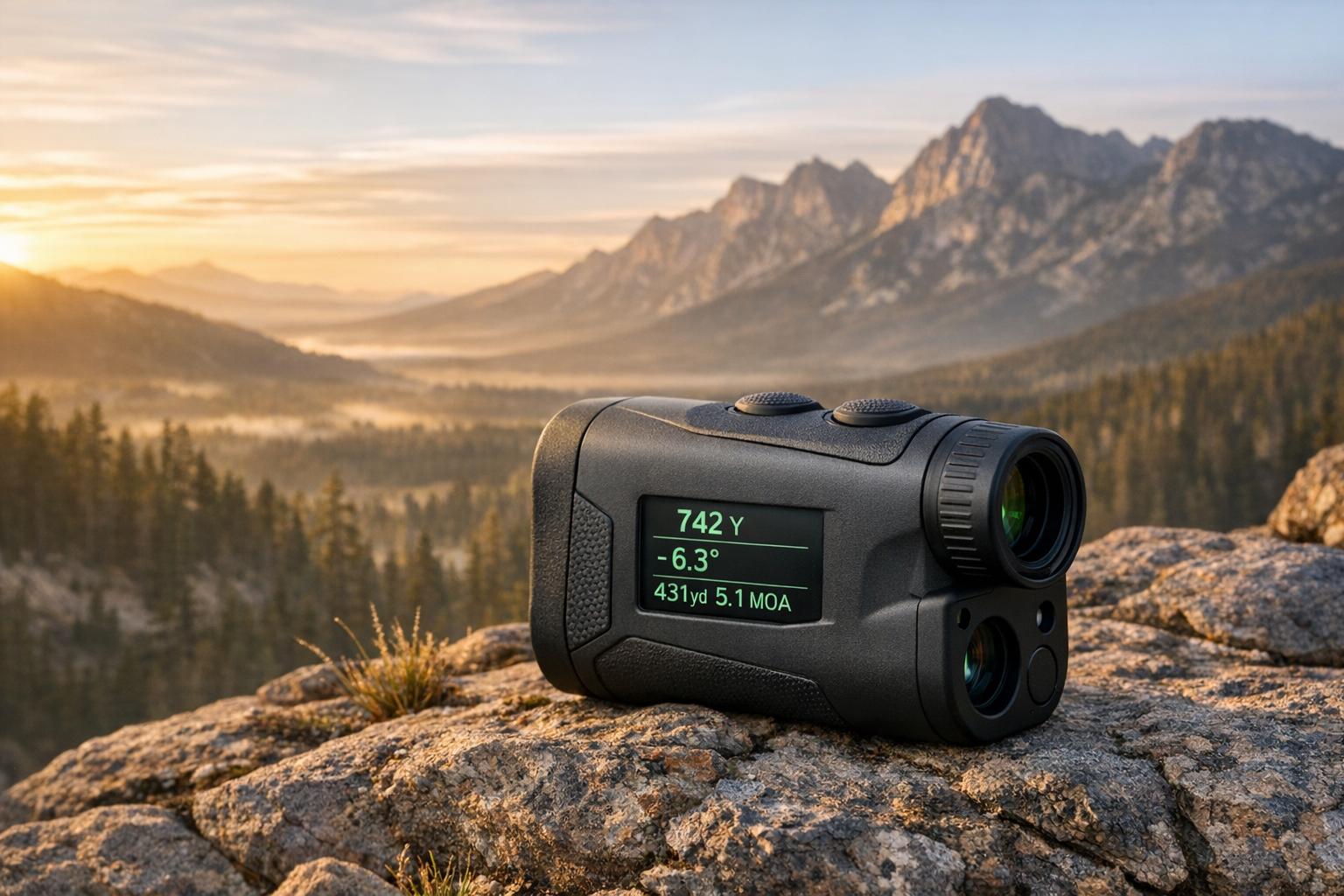
When it comes to long-range shooting or hunting, having a rangefinder with a ballistic calculator can make all the difference. These devices calculate critical shooting adjustments like holdover and windage, ensuring accuracy for every shot. Key features to look for include:
- Ballistic Calculators: Automatically adjust for bullet drop, wind, and other variables.
- Angle Compensation: Essential for steep terrains, adjusting effective shooting distance.
- Environmental Sensors: Some models account for temperature, pressure, and humidity.
- Bluetooth Connectivity: Sync custom rifle and bullet profiles via apps for tailored solutions.
Top picks include:
- Sig Sauer KILO5K BDX: Ranges up to 5,000 yards with advanced ballistic software and app integration.
- Leupold RX-1400i TBR/W Gen2: Budget-friendly option under $200 for hunters shooting up to 500 yards.
- Vortex Razor HD 4000 GB: Premium model with sensors for precise adjustments at long distances.
- Leupold RX-FullDraw 5: Designed for bowhunters with arrow-specific calculations.
- Maven RF.1: Offers extreme range up to 4,500 yards for reflective targets.
Quick Comparison
| Model | Price | Max Range (Reflective) | Max Range (Deer) | Ballistic Solver | Best For |
|---|---|---|---|---|---|
| Sig Sauer KILO5K BDX | $699.99 | 5,000 yards | 2,000 yards | Applied Ballistics Ultralite | Long-range rifle shooting |
| Leupold RX-1400i TBR/W Gen2 | Under $200 | 1,400 yards | ~500 yards | TBR/W | Budget-friendly hunting |
| Vortex Razor HD 4000 GB | ~$800 | 4,000 yards | 2,200 yards | GeoBallistics | Precision long-range shooting |
| Leupold RX-FullDraw 5 | $499.99 | N/A | N/A | Archer’s Advantage | Bowhunting |
| Maven RF.1 | $550 | 4,500 yards | 2,700 yards | Angle Compensation | Extreme-range scouting |
Choose based on your shooting range, budget, and hunting style. Whether you’re a long-range shooter or a bowhunter, the right rangefinder will improve your accuracy and confidence in the field.
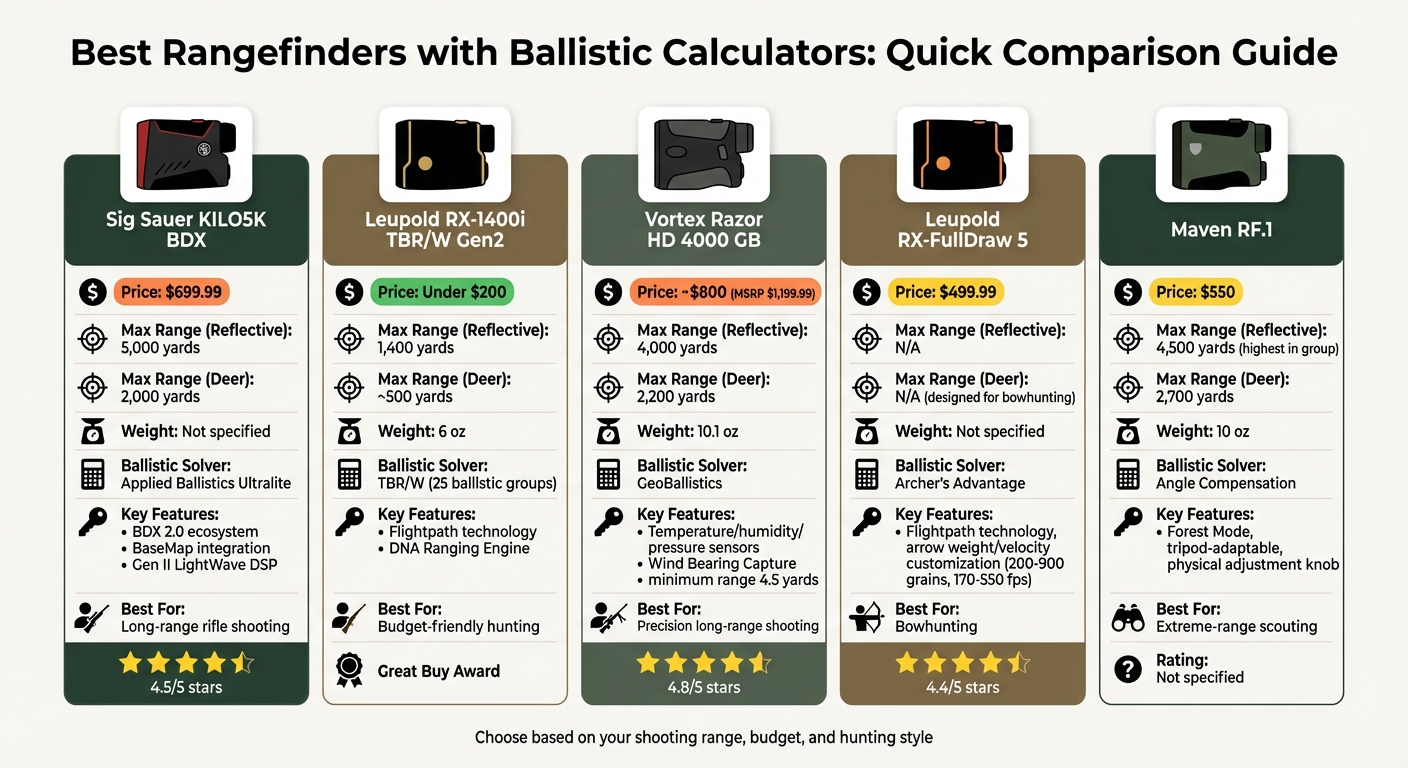
Best Rangefinders with Ballistic Calculators: Complete Comparison Chart
Why You Need a Smart Range Finder
Best Rangefinders for Long-Range Shooting
Here’s a closer look at three standout rangefinders designed to deliver precise performance over extended distances. Each model caters to specific shooting needs, offering unique features and capabilities.
Sig Sauer KILO5K BDX
The Sig Sauer KILO5K is built for extreme distances, boasting a reflective range of up to 5,000 yards. It can range deer at 2,000 yards and trees at 2,500 yards, making it a reliable choice for hunters and long-range shooters alike. Andy York, President of SIG SAUER Electro-Optics, highlighted its capabilities:
"The new KILO5K can range reflective targets up to 5,000 yards, trees up to 2,500 yards, and deer up to 2,000 yards".
This rangefinder integrates with the BDX 2.0 ecosystem, allowing seamless pairing with compatible scopes and the BaseMap app. With this setup, you can drop waypoints directly onto your mapping software. It also features the Gen II LightWave DSP engine, offering five targeting modes, including Extended Range (XR) and Fog, for fast and accurate performance in various conditions. For ballistic solutions, the Applied Ballistics Ultralite software provides data up to 800 yards, while the "BDX External" mode extends functionality with external devices. Temperature and pressure sensors further enhance accuracy, though it lacks humidity sensing. Priced at $699.99, it balances advanced features with affordability.
| Pros | Cons |
|---|---|
| 5,000-yard reflective range | Ballistic solutions limited to 800 yards onboard |
| BaseMap app integration | Accuracy issues reported at very close range |
| Fast Gen II LightWave DSP engine | Requires external devices for extended solutions |
The KILO5K is powered by a CR2 battery, offering approximately 4,000 ranges per charge. With a 4.5/5 star rating from 27 reviews, users praise its speed and the convenience of BaseMap integration.
Leupold RX-1400i TBR/W Gen2
If you’re looking for a budget-friendly option without sacrificing performance, the Leupold RX-1400i is worth considering. At under $200, it’s an excellent choice for hunters who don’t need extreme range. Scott Einsmann, Gear Editor at Outdoor Life, remarked:
"This is a great choice for the multi-season hunter who isn’t shooting past about 500 yards with a rifle, which is most of us".
Awarded "Great Buy" status by Outdoor Life, this rangefinder offers impressive value for its price. It comes equipped with TBR/W (True Ballistic Range/Wind) software, which accommodates 25 ballistic groups and provides wind hold values for a 10-mph crosswind at 90° out to 800 yards. The DNA Ranging Engine ensures reliable performance up to 1,400 yards on reflective targets, while its lightweight design – just 6 ounces – makes it highly portable.
| Feature | Performance Metric |
|---|---|
| Price | Under $200 |
| Max Range (Reflective) | 1,400 yards |
| Weight | 6 ounces |
| Ballistic Software | TBR/W (25 ballistic groups) |
While it lacks Bluetooth connectivity and environmental sensors, it compensates with pre-programmed ballistic curves. Bowhunters will appreciate the Flightpath technology, which displays the apex of an arrow’s trajectory to help avoid overhead obstructions. This model proves you don’t need to spend a fortune to get advanced ballistic features.
Vortex Razor HD 4000 GB

The Vortex Razor HD 4000 GB is a powerhouse for long-range shooting, combining multiple ballistic functions into a single device. As Vortex puts it:
"The Razor® HD 4000 GB eliminates the guesswork from longer shots – delivering critical data for first-shot accuracy at the push of a button".
With a 4.8/5 star rating from 20 reviews, users appreciate its ability to consolidate environmental data into one compact tool. The GeoBallistics solver uses onboard sensors to measure temperature, humidity, barometric pressure, and wind direction with a digital compass, delivering precise solutions for targets up to 4,000 yards. It pairs seamlessly with the GeoBallistics App and Kestrel® weather meters for even more robust functionality.
Real-world tests show it can range non-reflective targets up to 2,800 yards and deer-sized game at 2,200 yards. Built with a magnesium chassis, it’s lightweight yet durable, and its ArmorTek coating protects the HD glass from scratches and harsh conditions.
| Feature | Description |
|---|---|
| Ballistic Solver | Integrated GeoBallistics® |
| Sensors | Temperature, Pressure, Humidity, Compass |
| Wind Modes | Full Crosswind & Wind Bearing Capture |
| Third-Party Pairing | Kestrel® Weather Meters |
| Optical System | HD Glass with XR™ Plus Coatings |
One standout feature is Wind Bearing Capture Mode – simply point the rangefinder downwind, press a button, and it records the wind direction relative to your target. Four targeting modes (Normal, First, Last, and ELR) add versatility for different scenarios.
At an MSRP of $1,199.99 (often available for around $800), it’s the priciest option here, but its comprehensive features make it a worthy investment. With pinpoint accuracy and a full suite of sensors, it’s ideal for shooters tackling targets beyond 800 yards in challenging conditions.
Rangefinders for Specific Hunting Scenarios
When it comes to hunting, the tools you need can vary greatly depending on whether you’re bowhunting or rifle hunting. Each discipline presents its own challenges, and the terrain only adds to the complexity. The following rangefinders are designed to meet those specific needs.
Leupold RX-FullDraw 5
The Leupold RX-FullDraw 5 is a bowhunter’s dream, featuring Archer’s Advantage software and Flightpath technology. Priced at $499.99, this rangefinder goes beyond basic functionality by calculating ranges tailored to your setup. It factors in arrow weight (200–900 grains), velocity (170–550 fps), and peep height. As Eric Overstreet, Product Line Manager at Leupold & Stevens, Inc., explains:
"Bows are custom-built to suit their owner, so your rangefinder needs to be, too".
The Flightpath technology adds another layer of precision, showing your arrow’s peak trajectory directly in the reticle. This feature helps you steer clear of overhead obstacles, offering either a 20-yard shooting lane indicator or a "Mid" mode that represents the highest point of the arrow’s flight. It even works through mesh blind windows and glass.
Equipped with a DNA engine, the RX-FullDraw 5 delivers accuracy to 0.5 yards up to 175 yards. Its Last Target Mode cuts through rain, fog, and snow to pinpoint the farthest object in the laser’s path. With a battery life of over 3,000 actuations and an IPX-4 water resistance rating, this rangefinder is built to last. Users have rated it 4.4/5 stars across 55 reviews, often highlighting its performance at steep angles and the clarity of its red OLED display.
| Pros | Cons |
|---|---|
| Custom ballistic solutions with Archer’s Advantage | Limited field of view due to 6x magnification |
| Flightpath technology avoids overhead obstructions | No Bluetooth or mobile app for easier setup |
| Accurate even at steep angles and long distances | Manual data entry required via device buttons |
| Performs well in adverse weather | Higher price compared to entry-level models |
Maven RF.1 and Bushnell Bone Collector 1800
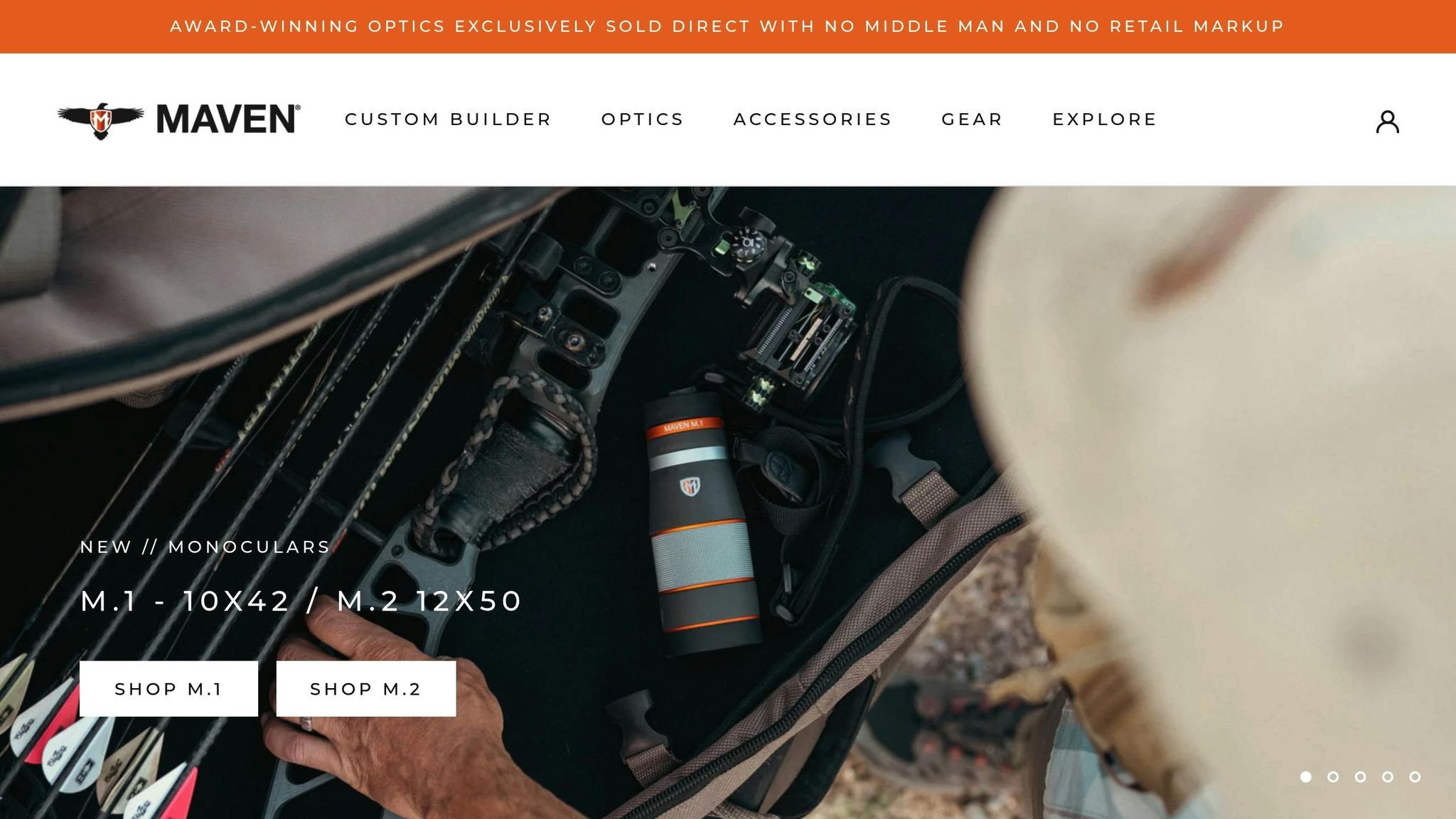
For rifle hunters, the Maven RF.1 and Bushnell Bone Collector 1800 offer distinct advantages depending on your priorities – long-range precision or convenience.
The Maven RF.1 is all about extreme range. It can measure reflective targets up to 4,500 yards, trees at 3,000 yards, and deer at 2,700 yards. Its Forest Mode is particularly useful for targeting objects partially obscured by trees or brush. Zach Burton from GearJunkie notes:
"Forest mode will make it easier to range objects that are moving through trees, behind bushes or brush, or when you’re in rainy and snowy conditions".
This rangefinder is tripod-adaptable and features a physical side knob for quick adjustments to menus and brightness. Weighing 10 ounces and priced at $550, it offers 0.5-yard accuracy up to 300 yards.
Meanwhile, the Bushnell Bone Collector 1800 focuses on ease of use with its Applied Ballistics Ultralite software. At $349.99, it provides ballistic solutions out to 800 yards without requiring external charts. It pairs with a smartphone app for simpler setup and offers optional upgrades to extend its range beyond 2,000 yards for an additional $49.99 to $149.99. With a 4.5/5 star rating from 12 reviews, users praise its ability to deliver both range and firing solutions simultaneously.
| Feature | Maven RF.1 | Bushnell Bone Collector 1800 |
|---|---|---|
| Max Range (Reflective) | 4,500 yards | 1,800+ yards |
| Ballistic Solver | Line of Sight / Angle Compensation | Applied Ballistics Ultralite |
| Terrain Optimization | Field/Forest Modes | EXO Barrier lens protection |
| Usability | Physical knob for adjustments | Smartphone app pairing |
| Tripod Adaptable | Yes | Not specified |
| Price | $550 | $349.99 |
If you need extreme range and terrain-specific modes, the Maven RF.1 stands out. On the other hand, the Bushnell Bone Collector 1800 is a budget-friendly option for hunters who value integrated ballistics and straightforward setup over ultra-long-range capabilities. Both models showcase how specialized features can elevate your hunting experience.
sbb-itb-31b92c7
Rangefinder Comparison Chart
When choosing a rangefinder, it’s important to weigh key factors like price, range, weight, and ballistic solver capabilities. Here’s a breakdown of standout models to help you pick the right one for your needs:
- Leupold RX-1400i TBR/W Gen2: At under $200, this model offers ballistic calculations and wind holds, making it an excellent budget-friendly choice for hunters and shooters.
- Vortex Razor HD 4000 GB: Priced at $799, it integrates GeoBallistics software and has a minimum range of just 4.5 yards. It’s versatile enough for both extreme long-range shooting and close-range archery.
- Maven RF.1: With an impressive 5,000-yard reflective range – the highest in this group – this model excels in scouting and navigation, though most hunters will use it for ranges under 1,000 yards due to ballistic limitations.
For long-range enthusiasts, the Vortex Razor HD 4000 GB and Sig Sauer KILO5K BDX stand out, offering integrated ballistic solutions and deer ranges exceeding 2,000 yards. On the other hand, bowhunters will find the Leupold RX-FullDraw 5 particularly appealing, thanks to its Archer’s Advantage software, which factors in arrow weight, velocity, and obstacles along the flight path.
If you’re a competitive shooter or a dedicated long-range hunter, models with advanced ballistic systems like the Vortex Razor HD 4000 GB or Sig Sauer KILO5K BDX are worth the investment. However, if you’re looking for a reliable, affordable option for multi-season use, the Leupold RX-1400i TBR/W Gen2 delivers excellent performance without the need for extreme ranges.
Here’s a quick comparison chart to summarize the key specs:
| Model | Price | Max Range (Reflective) | Max Range (Deer) | Weight | Ballistic Solver | Notable Features |
|---|---|---|---|---|---|---|
| Sig Sauer KILO5K BDX | N/A | N/A | >2,000 yards | N/A | Applied Ballistics | Image stabilization, integrated ballistic solver |
| Leupold RX-1400i TBR/W Gen2 | Under $200 | N/A | N/A | 6 oz | TBR/W | Lightweight, wind holds, best value |
| Vortex Razor HD 4000 GB | $799 | N/A | >2,000 yards | 10.1 oz | GeoBallistics | Minimum range of 4.5 yards |
| Leupold RX-FullDraw 5 | N/A | N/A | N/A | N/A | Archer’s Advantage | Tailored for bowhunters with arrow-specific ballistics |
| Maven RF.1 | N/A | 5,000 yards | N/A | N/A | N/A | Highest reflective range in the group |
This chart highlights the strengths of each model, helping you decide which features align with your shooting or hunting preferences.
How to Choose the Right Rangefinder
Picking the right rangefinder starts with knowing how you’ll use it. For long-range shooters, features like integrated ballistic calculators (such as Applied Ballistics Elite or GeoBallistics) are a must. These tools provide real-time adjustments for holdover and windage by factoring in details like temperature, air pressure, humidity, and even advanced variables like spin drift and the Coriolis effect. If you’re working with high-caliber rounds like the 6.5 Creedmoor at distances beyond 1,000 yards, this technology becomes crucial. On the other hand, if your firearm has a shorter effective range – like a .30-30 or a shotgun – a more affordable unit will do just fine.
For bowhunters, the needs are a bit different. Angle compensation is key when shooting from treestands or on steep terrain, as it adjusts for holdover in these scenarios. Features like Leica‘s EHR mode or SIG’s AMR mode are specifically designed for this purpose. Additionally, you’ll want a rangefinder with a low minimum range (around 5 yards) and a display that’s easy to read in low light – both critical when hunting in challenging environments.
It’s also important to understand the technical aspects of rangefinders. The maximum range advertised often refers to reflective surfaces, not actual targets like deer. For instance, a rangefinder rated for 4,000 yards on reflective surfaces might only measure a deer at about 2,200 yards. If you plan to shoot at longer distances, consider a model with a tripod adapter to help stabilize the laser for accurate readings.
Budget is another factor to weigh. Entry-level models like the Maven CRF.1, priced at $295, cover the basics for hunters without overspending. Mid-range options, such as the Vortex Razor HD 4000 GB at $799, come with more advanced features like GeoBallistics software and environmental sensors. For those looking for top-tier performance, premium models like the Leica Rangemaster CRF Max at $1,499 offer superior optics and military-grade ballistic capabilities. Be sure to match your choice to your hunting setup. For example, if you’re primarily hunting within 500 yards, there’s no need to invest in a $3,000 long-range model.
To find the best rangefinder for your specific needs, check out Scope It Outdoors. Their expert reviews and field tests can guide you toward features like Bluetooth connectivity, advanced targeting modes, and high-quality optics that suit your hunting style.
Conclusion
Choosing the right rangefinder with a ballistic calculator boils down to matching it with your shooting style and the environment you’re navigating. For those taking shots beyond 1,000 yards, options like the Sig Sauer KILO5K and Vortex Razor HD 4000 GB stand out, offering advanced ballistics and environmental adjustments for pinpoint accuracy. On the other hand, bowhunters will appreciate the RX-FullDraw 5, which features flightpath technology and excels at close-range precision.
Price is another key factor. The market offers a wide spectrum, from the Maven CRF.1 at $295 to the Leica Rangemaster CRF Max at $1,499. The trick is to find a model that meets your needs without overspending. As David Lane wisely notes:
"If you don’t range your target accurately, you’re not going to hit it".
Accuracy begins with selecting a rangefinder tailored to your typical shooting distances – whether that’s a 300-yard shot in thick woods or a 2,000-yard challenge across open terrain. The difference between a $300 entry-level device and a $1,500 high-end model often lies in optical clarity, maximum range, and the complexity of the ballistic system.
For in-depth reviews and expert advice to help you find the best rangefinder for your hunting or shooting needs, check out Scope It Outdoors.
FAQs
What should I look for in a rangefinder with a ballistic calculator?
When selecting a rangefinder with a built-in ballistic calculator, prioritize features that improve both accuracy and ease of use. Key elements to consider include angle compensation to account for uphill or downhill shots, quick response times for fast readings, and precise ranging with an accuracy of ±1 yard or better to eliminate guesswork. Opt for models with high-quality optics, offering 7×–8× magnification and a clear display like an OLED or red LED screen, which are especially helpful in low-light or challenging conditions.
The ballistic calculator should offer customization options and include environmental sensors to measure factors like temperature, altitude, and pressure. Some models even let you store multiple load profiles and make real-time adjustments – perfect for long-range shooting. A rugged design with waterproofing and shock resistance is crucial for handling tough outdoor environments. Don’t overlook battery life; choose a rangefinder that can last through extended outings. For personalized recommendations and in-depth reviews, check out Scope It Outdoors, where experts can guide you to the right choice for your needs.
How do environmental sensors improve the accuracy of rangefinders?
Environmental sensors – like those that measure temperature, barometric pressure, humidity, and sometimes wind speed – play a critical role in providing real-time atmospheric data to a rangefinder’s built-in ballistic calculator. These environmental factors directly impact air density, which affects a bullet’s drag and flight time. By factoring in these variables on the spot, the rangefinder delivers a ballistic solution tailored to the exact conditions at the moment of the shot.
High-end rangefinders, such as those highlighted by Scope It Outdoors, incorporate these sensors to automatically adjust ballistic calculations in real time. This not only removes the possibility of manual input errors but also speeds up the process and enhances accuracy for long-range shooting. For hunters and precision shooters, this means tighter shot groups and dependable performance, even when facing varying climates across the United States.
What are the advantages of Bluetooth in rangefinders?
Bluetooth connectivity lets rangefinders wirelessly sync with compatible devices like apps or wind meters, sharing distance readings, environmental details, and other measurements. This feature enables real-time ballistic calculations, making it simple to adjust shooting profiles while you’re out in the field.
By using Bluetooth, you can simplify your setup and make precise adjustments for long-range shooting without the hassle of manual data entry. It’s a handy tool for hunters and marksmen aiming to boost accuracy and efficiency during their outings.