
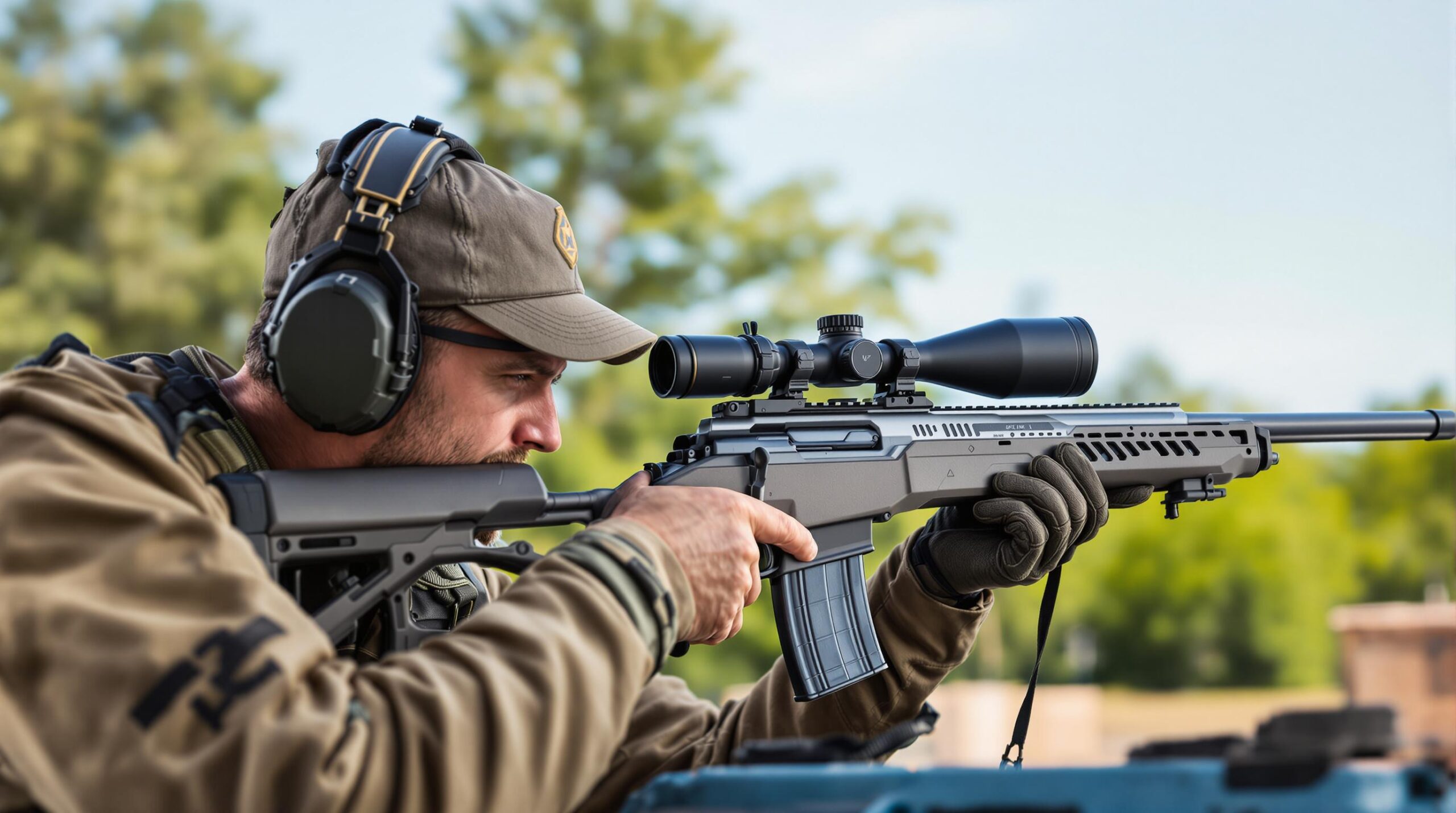
A properly mounted and zeroed rifle scope is essential for accurate shooting. Whether you’re a hunter, competitor, or recreational shooter, this guide simplifies the process into three main steps:
- Mounting the Scope: Choose the right rings and base, adjust eye relief, and level your scope for proper alignment.
- Bore Sighting: Align your scope with the rifle’s bore to save time and ammo before live firing.
- Range Zeroing: Fine-tune your scope so your point of aim matches your point of impact at a specific distance.
Tools You’ll Need:
- Torque Wrench ($99.99): Ensures screws are tightened correctly.
- Gun Vise: Keeps your rifle steady during setup.
- Reticle Leveling System ($64.99): Aligns the reticle perfectly.
- Laser Bore Sighter ($129.99–$174.99): Speeds up initial alignment.
Quick Tips:
- Use a stable workspace with good lighting.
- Start bore sighting at 25 yards using a laser or visual alignment.
- Zero your rifle at a range that matches your shooting needs (e.g., 50/200 yards for AR-style rifles).
This guide covers everything from setup to troubleshooting common issues like zero shifting or poor shot groups. Follow these steps to improve your accuracy and confidence.
How to Properly Mount a Scope
Required Tools and Setup
Getting your workspace and tools ready is the first step. Here’s what you’ll need to get started.
Tool Checklist
Mounting a scope requires some specialized tools. Below is a list of essentials:
- Gunsmithing Screwdriver Set: Choose a professional set with hollow-ground bits to avoid damaging screws.
- Torque Wrench: The F.A.T. Stix™ Preset Torque Wrench Set ($99.99) ensures screws are tightened to the correct tension without overdoing it.
- Gun Vise: Keeps your rifle steady during the mounting process.
- Reticle Leveling System: A professional system ($64.99) ensures your reticle is perfectly aligned.
- Laser Bore Sighter: Ranging from $129.99 to $174.99, this tool helps with initial alignment.
- Bubble Levels: The Level-Level-Level system ($19.99) helps ensure your scope is properly oriented.
Once you have these tools, make sure to select the appropriate mounting hardware for your rifle and scope.
Choosing Scope Rings and Bases
Picking the right mounting system is key to your scope’s accuracy and stability. Here are some options to consider:
| Mount Type | Best For | Characteristics |
|---|---|---|
| Two-Piece Rings | Hunting rifles | Lightweight, allows flexible positioning |
| Single-Piece Mount | Tactical/precision | Offers better stability but is heavier |
| Quick Release (QR) | Multiple optic users | Easy to remove while keeping zero |
Aim to mount your scope as low as possible while ensuring the lens clears the barrel. Most scopes feature tube diameters of 1 inch, 30mm, or 34mm – make sure your rings match your scope’s specifications.
Setting Up Your Work Area
Once you’ve chosen your hardware, set up a stable and well-lit workspace. Here’s how your rifle should be positioned:
- Parallel to the ground: Ensures proper alignment.
- Secured in a gun vise: Keeps it steady for precision work.
- At a comfortable height: Makes the process easier and more accurate.
- Well-lit from multiple angles: Helps you spot any alignment issues.
For the best results, consider using the Ultra Scope Mounting Kit ($249.99), which includes alignment tools and a high-quality vise. This kit can help you achieve a professional-level setup.
Mounting Your Scope
Installing the Base
Start by cleaning the rifle’s mounting surfaces with a degreaser. Attach the base to the receiver, aligning it with the existing mounting holes. Experts at Vortex Optics note that improper base installation is a common cause of accuracy problems with scopes.
Use a torque wrench to tighten the base screws to 35–45 inch-pounds, following a cross-pattern to evenly distribute the pressure. Tools like the Wheeler FAT Wrench, included in the Professional Mounting Kit ($111.56), help ensure precise torque settings for consistent results.
Setting Eye Relief
Getting the right eye relief is key for both comfort and safety. Most modern scopes offer an eye relief range of 3–5 inches. To adjust it, place your scope in the rings but don’t fully tighten them yet. Set the scope to its highest magnification and assume your typical shooting stance with all your gear on.
"Consistency equals accuracy and speed, which is important to hunting, target practice, and competition." – Warne Scope Mounts
Move the scope forward or backward until you get a clear, full sight picture. Usually, there’s about an inch of room for adjustment. Lightly mark the correct position on the scope tube with a pencil for future reference.
Leveling and Tightening
Leveling your scope ensures the reticle lines up perfectly with the rifle’s action. Using the Wheeler Engineering Professional Leveling Kit ($64), follow these steps:
| Step | Action | Torque Setting |
|---|---|---|
| Initial Ring Setup | Place the scope in the bottom ring halves | Hand-tight only |
| Turret Leveling | Level the turret using a bubble level | N/A |
| Ring Tightening | Tighten screws in a cross-pattern | 15–18 inch-pounds |
| Final Check | Confirm levels match between barrel and scope | N/A |
"What you are doing by leveling your scope is trying to make sure the rifle scope is on the same horizontal plane as the action of your gun. That’s important because if your scope is rotated even a couple of degrees left or right, when you put your cross-hairs on a target and your scope is not perfectly level, your gun barrel is actually canted right or left, and you won’t know it."
Tighten the ring screws in half-turn increments using a cross-pattern. Avoid using Loctite on the ring screws. Once everything is secure, double-check all levels before moving on to bore sighting. With your scope properly mounted and aligned, you’re ready for the next step.
sbb-itb-31b92c7
Bore Sighting Basics
Understanding Bore Sighting
Bore sighting is the process of aligning your rifle’s barrel (or bore) with your scope. This step helps save time and ammunition when you head to the range for final zeroing. While it doesn’t replace final zeroing, bore sighting ensures your scope is roughly aligned for better initial accuracy.
"Bore-sighting is the process of centering a target through the rifle’s open bore with your eye while simultaneously centering the same target through your scope. This process aligns the rifle’s barrel with the scope making zeroing the scope at the range much easier."
Now that you understand the basics, let’s look at the tools that can make bore sighting easier.
Bore Sighting Tools
There are several tools available for bore sighting, ranging from simple to advanced. Here’s a quick comparison of some popular options:
| Tool Type | Price Range | Best For | Key Benefits |
|---|---|---|---|
| SiteLite Ultra Mag | $219.00 | All calibers | Green laser, long battery life |
| Wheeler Professional | $116.49 | Universal fit | Durable, easy to align |
| Barska Iron Kit | $69.99 | Multiple calibers | No batteries required |
| MidTen Green Laser | $28.99 | 9mm only | Bright laser, weather-resistant |
Green laser bore sighters, like the SiteLite Ultra Mag and Wheeler Professional, are especially useful because they are easier to see in daylight compared to red lasers. Although they cost more, their precision and convenience make them a favorite among serious shooters.
Once you’ve chosen the right tool, you’re ready to move on to the bore sighting process.
Bore Sighting Steps
Bore sighting lays the groundwork for accurate zeroing at the range. Start at 25 yards and use an orange circle as your target. Make sure your rifle is securely placed in a stable rest since even small movements can throw off your alignment.
"1-inch low at 25 yards is the magic starting point for most deer rifles with scopes that are usually 1.75 to 2 inches above the bore." – Lance Hopper
For AR-style rifles, which often have higher scope mounts (about 2.5 inches above the bore), adjust your reticle to sit 1.5 inches below the target center at 25 yards. This adjustment accounts for the higher mounting position.
Next, center the laser dot on your target and align your reticle to match. Keep in mind that scope adjustments during bore sighting work in the opposite direction compared to standard zeroing.
Finally, take a test shot at 25 yards to confirm your setup. This step ensures your rifle is properly aligned and ready for final zeroing at longer distances.
Range Zeroing
Once you’ve aligned your scope through bore sighting, the next step is to zero your rifle at the range for accurate shooting.
Picking Your Zero Range
Choose a zero range that matches your shooting goals. For AR-style rifles chambered in .223/5.56, many shooters prefer a 50/200-yard zero. This setup minimizes holdover for targets between 0 and 250 yards.
| Zero Distance | Ideal For | Benefits |
|---|---|---|
| 50/200 yards | All-purpose shooting | Minimal holdover up to 250 yards |
| 100 yards | Long-distance accuracy | Better for fine-tuning adjustments |
| 50 yards | Close-range hunting | Suited for dense environments |
If you’re using an LPVO (Low Power Variable Optic) with BDC or MRAD/MOA reticles, a 100-yard zero is a good starting point. This range allows for easier holdovers or dial adjustments during longer-range shots.
Making Scope Adjustments
After selecting your zero distance, you’ll need to fine-tune your scope. The turrets on your scope control two key factors:
- Elevation: Adjusts the vertical point of impact.
- Windage: Adjusts the horizontal point of impact.
Here’s how to make adjustments:
- Fire a five-shot group to determine your baseline.
- Measure the distance between the center of your group and the bullseye.
- Adjust the elevation turret: turn clockwise to raise the impact point or counterclockwise to lower it.
- Use the windage turret (usually on the side) to adjust left or right, following your scope’s specific instructions.
Once adjustments are made, confirm them by firing additional groups at the range.
Testing Your Zero
Place a fresh target at your chosen zero range and fire 5–10 shots. This larger group size gives a clearer picture of your rifle’s accuracy compared to a single shot.
After confirming your zero, reset your turrets to zero, set the zero stop (if your scope has one), and document your settings. Be sure to note the ammo type and environmental conditions for future reference.
Fixing Common Issues
Zero Shifting
Zero shifting can be a frustrating issue, even after you’ve carefully mounted and zeroed your scope. Here are some common causes and how to prevent them:
| Issue | Common Causes | Prevention |
|---|---|---|
| Hardware Problems | Loose scope bases, rings, or mounting screws | Tighten to proper torque specs; check often |
| Environmental Factors | Temperature changes, impacts, or rough handling | Inspect gear after exposure to harsh conditions |
| Mounting Issues | Inconsistent mounting techniques or improper bedding | Follow manufacturer specs; consider rail bedding |
For example, in May 2021, a shooter using a .308 Savage rifle struggled with inconsistent accuracy. The culprit? A loose front scope base screw. Reassembling the setup according to specifications restored the rifle’s performance.
Once you’ve addressed zero shifting, it’s time to tackle shot grouping issues to fine-tune your accuracy.
Shot Group Problems
Poor shot grouping often boils down to hardware or technique issues. Here’s how to address both:
Hardware-Related Fixes:
- Ensure scope bases and rings are torqued correctly.
- Allow the barrel to cool between shot strings.
- Check your ammunition for consistency and quality.
Technique-Related Tips:
- Use Cartridge Base To Ogive (CBTO) measurements instead of COAL for better consistency.
- Shoot 10-shot groups rather than smaller 4-5 shot groups to get a clearer picture of your precision.
- Focus on maintaining consistent shooting fundamentals.
"Establishing a high quality zero really comes after you learn to establish consistent groups." – Matt, Primary Author and Owner, The Everyday Marksman
Crooked Reticle Fixes
After improving shot group consistency, check your reticle alignment. A misaligned reticle can throw off your accuracy, especially at longer distances. Here’s how to fix it:
- Use a bubble level to ensure the rifle is level.
- Check vertical alignment with a plumb bob.
- Confirm the turret housing is square to the reticle.
Professional Help: If the reticle is significantly misaligned, reach out to the manufacturer for repair or replacement. For example, Burris successfully repaired a customer’s scope that had a canted reticle caused by overtightened rings.
"If the reticle isn’t true to the erector assembly, dialing elevation will induce windage drift and reduced elevation correction, and vice versa." – Reticlelife
While some manufacturers allow a small tolerance for reticle alignment, don’t hesitate to seek professional help if the issue impacts your accuracy. A properly aligned reticle ensures elevation adjustments move straight up and down, avoiding windage drift during long-range shots.
Addressing these common problems will help you maintain a reliable zero and improve your shooting performance.
Conclusion
Process Summary
Proper mounting and zeroing are crucial for maintaining accuracy. Experts at Vortex Optics highlight that many scope performance issues arise from incorrect mounting techniques. Achieving success requires precision and the right tools, like a torque wrench and leveling kit. Here’s a quick breakdown of the process:
| Phase | Key Focus Areas | Tools You Need |
|---|---|---|
| Mounting | Proper torque, alignment | Torque wrench, leveling kit |
| Bore Sighting | Rough alignment, zeroing | Bore sighting tool, stable rest |
| Fine Tuning | Adjustments, grouping | Gun vice, targets |
These steps lay the groundwork for keeping your scope in top condition.
Tips for Better Results
The US Army TC 3-22.9 manual reminds us:
"Zeroing is a maintenance procedure that is accomplished to place the weapon in operation, based on the Soldier’s skill, capabilities, tactical scenario, aiming device, and ammunition".
Here are some practical tips to enhance your results:
- Keep a log of your zero settings, ammo type, and shooting conditions.
- Allow the barrel to cool between shot groups to avoid heat distortion.
- Regularly check your torque settings to ensure nothing shifts over time.
- Use a gun rest to reduce shooter-caused errors.
Vortex Optics’ testing shows that even a slight rotation in the scope can cause shots to stray left or right, despite the crosshairs appearing centered. Keep your tools organized and track your zero settings consistently to ensure your optics deliver reliable performance.