
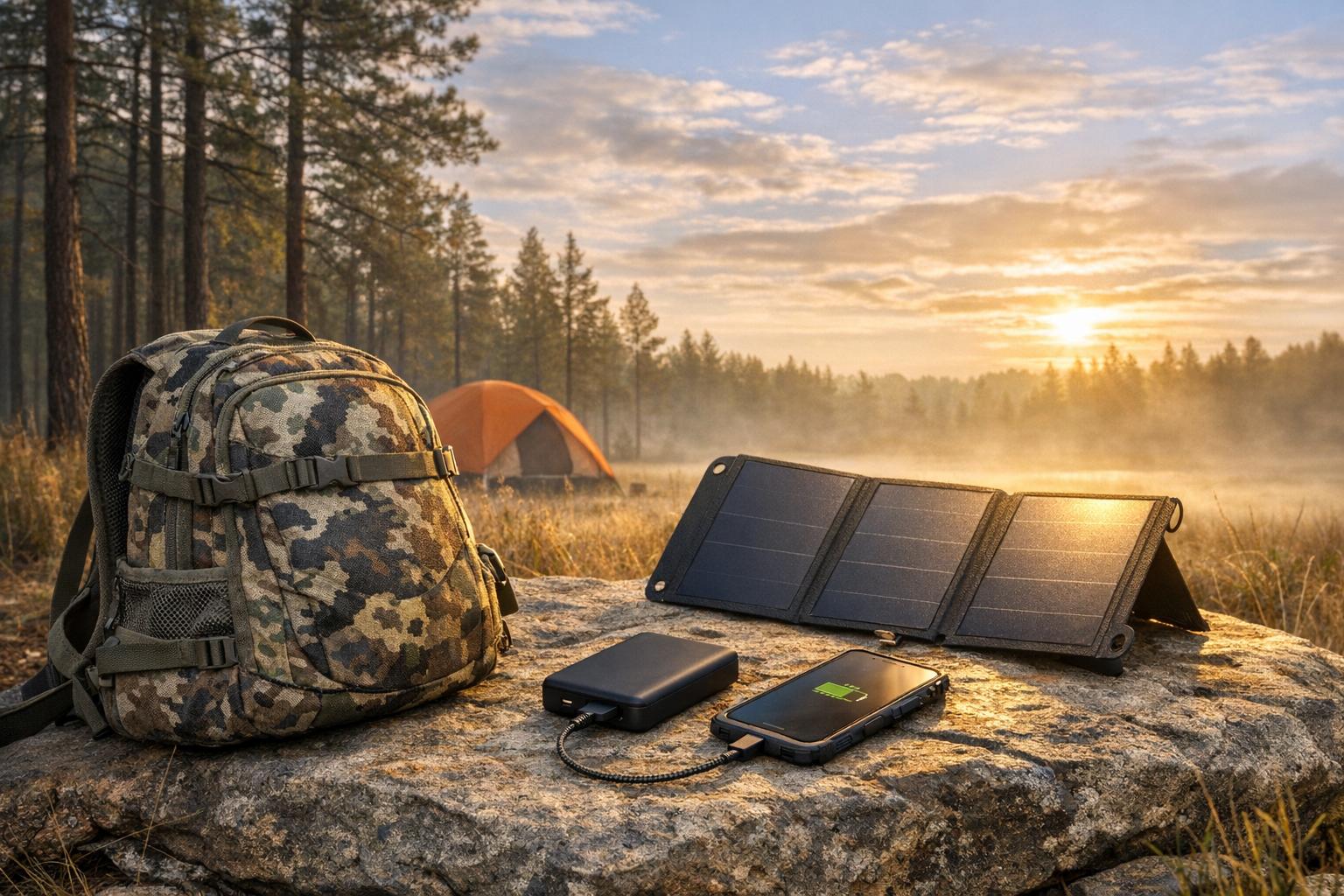
When you’re hunting in remote areas, keeping your devices powered is critical. Portable power banks and solar chargers are your main options, each with distinct advantages:
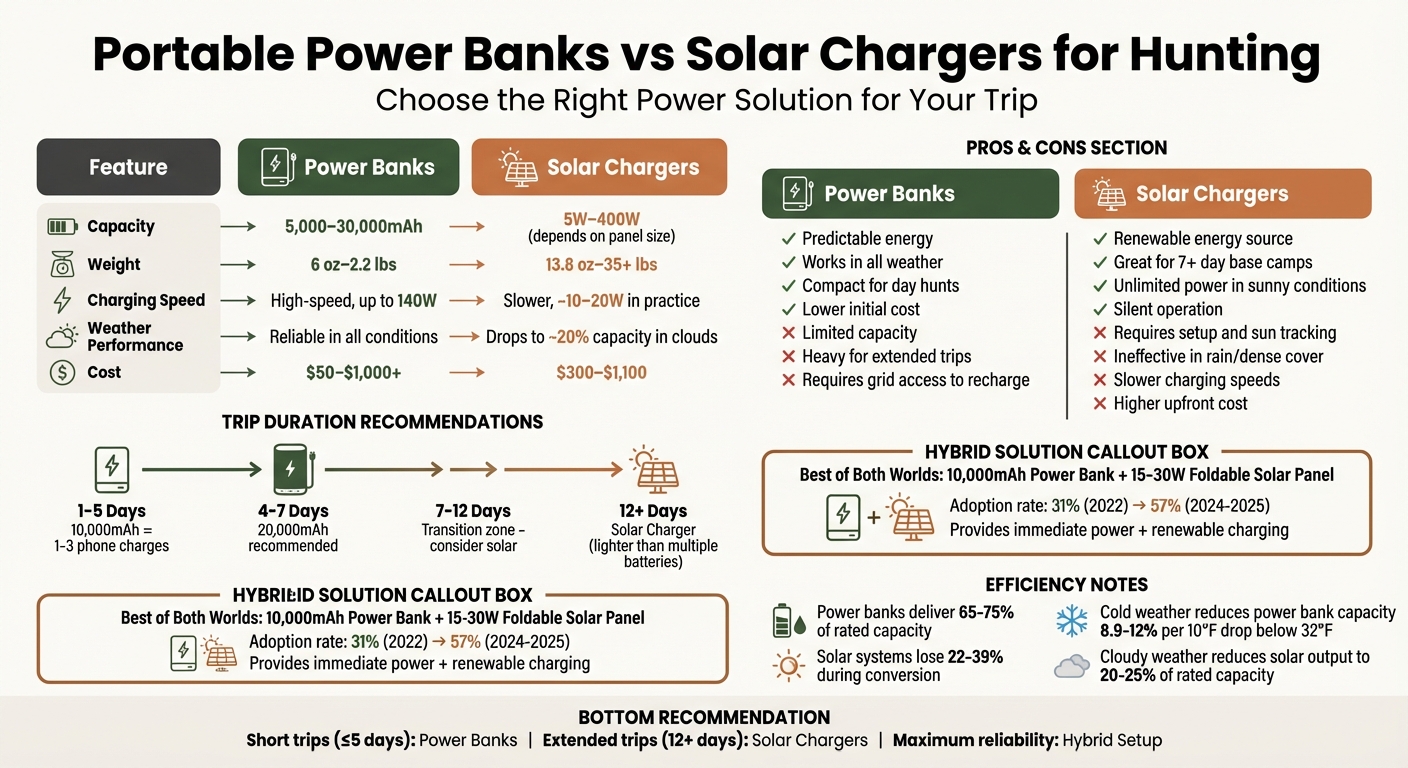
- Power Banks: Pre-charged at home, they’re reliable in all weather and perfect for trips up to 4–7 days. A 10,000mAh model provides 1–3 phone charges, while a 20,000mAh unit suits longer trips. They’re compact but lose charge in extreme cold and require grid access to recharge.
- Solar Chargers: Ideal for extended trips (7+ days), they generate energy from sunlight, offering renewable power. However, they’re weather-dependent, slower, and bulkier than power banks. Pairing a solar charger with a power bank creates a reliable hybrid setup for long hunts.
Quick Tip: For short trips, stick to power banks. For 12+ day hunts, consider a solar charger. A hybrid setup balances reliability and longevity.
Quick Comparison:
| Feature | Power Banks | Solar Chargers |
|---|---|---|
| Capacity | 5,000–30,000mAh | 5W–400W (depends on panel size) |
| Weather Performance | Reliable in all conditions | Drops to ~20% capacity in clouds |
| Weight | 6 oz–2.2 lbs | 13.8 oz–35+ lbs |
| Charging Speed | High-speed, up to 140W | Slower, ~10–20W in practice |
| Cost | $50–$1,000+ | $300–$1,100 |
For short hunts, power banks are simpler and lighter. For extended trips, solar chargers offer renewable energy. Combine both for maximum reliability.
Portable Power Banks vs Solar Chargers for Hunting: Complete Comparison Guide
This Solar Power Bank Will Change My Deer Hunting FOREVER!
sbb-itb-31b92c7
Portable Power Banks: Features and Benefits
Portable power banks, charged at home before your trip, offer a dependable power source no matter the weather. For hunters tackling shorter outings or dealing with unpredictable conditions, these devices are a smart choice for trips lasting up to a week.
Battery Capacity and Device Charging
It’s important to note that power banks don’t deliver their full rated capacity due to energy losses during conversion. For example, a 10,000mAh power bank typically provides about 65–75% of its stated capacity, equating to roughly two full smartphone charges. Considering most smartphones need 3,000–5,000mAh per charge, a 10,000mAh bank is perfect for 1–3 day trips, offering 1–2 full phone charges along with extra power for a GPS unit or headlamp. For longer adventures spanning 4–7 days, a 20,000mAh bank is a better fit, capable of supporting multiple devices throughout the week.
In January 2026, Outdoor Tech Lab’s gear testing team, led by JC Courtland, crowned the Nitecore NB10000 Gen 3 as the top ultralight power bank after putting it through its paces over 500 trail miles. During a 3-day field test in the Sierra Nevada, this 5.3 oz unit managed to charge an iPhone 15 twice while still retaining power, showcasing an efficiency of 1,887 mAh per ounce in real-world use.
Next, let’s dive into how size and weight play a role in making these devices trail-friendly.
Size and Weight Considerations
When you’re on a backpacking hunt, every ounce matters. Budget-friendly models like the Anker PowerCore Slim 10K weigh in at 8.6 oz and cost between $15–$25, offering reliable performance. For those prioritizing ultralight gear, carbon fiber models like the Nitecore NB10000 Gen 3 are a popular choice. At just 5.3 oz, it’s 40% lighter than typical power banks, though it comes with a higher price tag of $60–$70.
For extended hunts that demand 20,000mAh capacity, the Nitecore NB20000 Gen 3 is a standout option. Weighing 10.3 oz, it can power a smartphone, Garmin InReach Mini, and headlamp for six days, with room to spare. If you’re using heated gear like vests or socks, size becomes a key factor since the power bank needs to fit comfortably in garment pockets.
But size and weight aren’t the only considerations – durability and performance in tough conditions are just as crucial.
Reliability in Hunting Conditions
Unlike solar chargers, which rely on direct sunlight, power banks reliably deliver energy even in cloudy, rainy, or heavily wooded environments.
One major challenge to consider is cold weather. Freezing temperatures can reduce a power bank’s capacity by 8.9% to 12% for every 10°F drop below 32°F. To counter this, keep the power bank close to your body during the day – an inside jacket pocket works well – and store it in your sleeping bag at night. This simple step helps maintain efficiency.
For wet or rugged conditions, opt for a power bank with an IP67 rating, which ensures it’s dustproof and water-resistant. The NestOut Power Bank, for instance, earned Outdoor Life’s "Best for Bad Weather" title thanks to its durable IP67 design. If your power bank isn’t waterproof, storing it in a dry bag can protect it from moisture and prevent port corrosion.
Modern features like USB-C Power Delivery (PD) are essential for quickly charging phones, GPS units, and headlamps. Pass-through charging is another handy feature, allowing you to recharge the power bank and a device simultaneously – ideal for quick stops at trailheads. Additionally, trickle charge mode ensures smaller devices like earbuds or smartwatches draw enough power to stay charged without deactivating the bank.
With these features in mind, the next step is understanding how solar chargers stack up against power banks for your hunting adventures.
Solar Chargers: Features and Benefits
Solar chargers tap into sunlight to keep your devices powered during long hunting trips. Unlike pre-charged power banks, these chargers generate energy as needed. Most use monocrystalline silicon cells, which are designed to minimize energy loss and maximize efficiency. Built tough, many models boast high IP ratings (IP67 to IP68), making them waterproof, dustproof, and ready to handle rugged terrain. Let’s break down how wattage, battery setups, and weather conditions influence their performance.
Wattage and Power Output
The actual wattage output of solar chargers often falls 25%–50% below their lab ratings. For smaller gadgets like GPS units or older phones, a 10W panel is usually enough. For instance, the Lion Energy 10W charger, which weighs just 10 oz and costs $24, produced 6.4W in full sunlight during tests. For more power-hungry devices like smartphones or tablets, panels in the 28W to 50W range strike a good balance between portability and performance. A great example is the BigBlue SolarPowa 30, priced under $100, which delivered 17.8W through USB-C under ideal conditions. For laptops or portable power stations, larger panels – 100W or more – are typically required.
Interestingly, the angle of the panel can make a huge difference. A properly angled panel at 6 PM can outperform a flat one at noon. For hunters on the move, look for models with loops that let you attach the panel to your backpack, allowing for continuous trickle-charging while you hike.
Built-In vs. Separate Battery Storage
Efficiency isn’t just about wattage – it’s also about how the energy is stored. Solar chargers generally come in two designs: those with built-in batteries (solar power banks) and standalone panels that charge separate battery packs. Built-in options often fall short because their small panels can’t gather enough sunlight to fully charge the battery. Outdoor Life’s Laura Lancaster explains:
"Solar power banks basically don’t work… that solar component is, in the vast majority of cases, effectively worthless".
Standalone panels paired with separate power banks are a better option. This setup keeps the power bank shaded and cool while the panel stays in direct sunlight, reducing the risk of heat damage to the battery. Plus, standalone panels have a larger surface area, which speeds up charging. One standout exception in the built-in category is the BioLite SolarPanel 5+, which performs well thanks to its emphasis on a larger panel-to-battery ratio.
Weather Impact on Performance
Sunlight is the lifeblood of solar chargers, and cloudy weather can significantly impact their output. Under overcast skies, performance can drop to just 20%–25% of the panel’s rated capacity. For example, the Bluetti PV120 produced 110W in full sun but only managed 25W (21% of capacity) under clouds. On the other hand, the Lion Energy 50W panel performed slightly better, maintaining 13.7W in shade – about 60% of its sunny output.
In areas like the Pacific Northwest, heavy cloud cover can limit usable sunlight to less than 4 hours per day, providing only 12–18 watt-hours – barely enough to charge a single smartphone. While colder temperatures below 41°F can slightly improve panel efficiency (about 0.5% per degree), they can also hinder a battery’s ability to hold a charge. High heat brings its own challenges, reducing panel performance and potentially damaging lithium-ion batteries in integrated units.
To navigate these challenges, it’s best to charge a portable power bank first and then use it to power your devices. This approach protects your electronics from overheating and the voltage swings caused by inconsistent sunlight. With these factors covered, the next step is comparing solar chargers directly to power banks.
Portable Power Banks vs Solar Chargers: Direct Comparison
This section dives into a head-to-head comparison of portable power banks and solar chargers, specifically for hunting applications.
Feature Comparison Table
| Feature | Portable Power Banks | Solar Chargers (Portable Panels) |
|---|---|---|
| Capacity | 5,000mAh to 30,000mAh+ (small); 200Wh to 2,000Wh+ (large stations) | Generates 5W to 400W depending on panel size |
| Weight | 6 oz to 2.2 lbs (small); 20 to 60 lbs (large stations) | 13.8 oz (small 5W) to 35+ lbs (large 400W panels) |
| Charging Speed | High-speed charging (up to 140W with USB-C PD/Quick Charge) | Slow – typically 10W to 20W in real-world conditions; highly weather-dependent |
| Weather Performance | Reliable in all conditions until depleted; sensitive to extreme heat/cold | Drops to 20–25% capacity under clouds; useless in heavy rain or dense tree cover |
| Cost | $50 to $1,000+ | $300 to $1,100 for 100W to 400W panels |
Solar systems lose between 22% and 39% of energy during the conversion process. For shorter hunts (under five days), high-capacity power banks are often the lighter and more practical choice. On longer trips (12+ days), however, solar setups can offer a weight advantage over carrying multiple spare batteries.
The table below highlights the key pros and cons of each option.
Pros and Cons Table
| Option | Pros | Cons |
|---|---|---|
| Portable Power Bank | Predictable energy; plug-and-play operation; works at night and during storms; compact for day hunts; lower initial cost. | Limited capacity; heavy for extended trips; loses charge over time in storage; requires grid access to recharge. |
| Solar Charger | Renewable energy source; great for 7+ day base camps; no fuel cost after purchase; silent operation; unlimited power in sunny conditions. | Requires setup and sun tracking; can be bulky and heavy; ineffective in heavy rain or dense tree cover; slower charging speeds; higher upfront cost. |
The comparison shows why many hunters now combine both options for greater reliability. Dr. Lena Cho, a Senior Battery Systems Engineer at the National Renewable Energy Laboratory, explains:
"The real advantage of solar isn’t longevity – it’s operational independence when infrastructure fails. Choose solar not for battery health, but for mission-critical autonomy".
This hybrid approach – pairing a 10,000mAh power bank with a 12W to 20W foldable solar panel – has gained traction among long-distance hikers, with adoption rates climbing from 31% in 2022 to 57% in 2024–2025. It’s a setup that offers the dependability of a power bank alongside the extended reach of solar recharging. For hunters, where every watt counts, finding the right balance – or embracing a hybrid solution – can make all the difference in the field.
Best Use Cases for Hunting
Let’s break down how different power solutions cater to various hunting trip durations.
Short Hunts (4–5 Days)
For hunts lasting four to five days, a high-capacity portable power bank is your go-to option. A 10,000mAh power bank can provide around 1.5 to 3 full phone charges and performs well even in challenging weather conditions. As Adriel, Founder of Hunting Gear Guy, explains:
"For a 5 day trip out of range, a 10k mAh battery bank will offer additional margin".
To make the most of your power bank, keep it at a stable temperature, and enable airplane mode on your phone or GPS to save battery. Solar chargers, on the other hand, aren’t practical for short trips – they add unnecessary weight and take time to set up, with minimal energy payoff.
When your hunting adventure extends beyond a few days, however, pre-charged power banks alone might not cut it.
Extended Hunts (7+ Days)
For trips lasting seven days or more, bringing enough pre-charged power banks becomes cumbersome. This is where a solar panel proves invaluable. As Sam Schild, a gear analyst at OutdoorGearLab, points out:
"If you are without power for four or more days, however, a panel will likely serve you better than a battery".
The tipping point for switching to a solar setup – where it becomes lighter than carrying multiple battery banks – is usually around 11 to 12 days. A foldable solar panel rated between 15W and 30W can recharge a 10,000mAh to 20,000mAh power bank during daylight, keeping your devices powered throughout your trip. However, remember that solar panels need direct sunlight to work efficiently and may struggle under dense tree cover or cloudy skies.
Combining Both for Maximum Reliability
For the best of both worlds, combine a power bank with a solar panel to create a dependable system for extended hunts. A 10,000mAh power bank paired with a 12W to 20W foldable solar panel offers both immediate power and renewable energy. This hybrid setup is increasingly popular for longer trips. The power bank stores energy captured by the solar panel during the day, allowing you to charge your devices – like GPS units, phones, or best hunting headlamps – overnight.
You can even attach the solar panel to your backpack to trickle-charge the battery while on the move. Always prioritize charging the power bank first to protect sensitive electronics. This setup ensures you have reliable, on-demand power while benefiting from renewable energy during extended backcountry adventures.
Conclusion
Deciding between a power bank and a solar charger comes down to the length and conditions of your trip. For shorter hunts – up to four or five days – a high-capacity power bank is a dependable choice. It provides consistent power and eliminates the need for on-site charging, regardless of the weather.
For extended hunts beyond five days, a solar setup becomes more practical, especially around the 12-day mark. At that point, the weight of a solar charger is less than carrying multiple pre-charged batteries, making it a more efficient option.
To get the best of both worlds, consider a hybrid approach. Combining a 10,000 mAh power bank with a 15W to 30W foldable solar panel ensures you have reliable power on hand and the ability to recharge sustainably. Laura Lancaster from Outdoor Life shares this insight:
"Solar chargers can be a nice complement to an emergency blackout kit or a backpacking trip, but if you have to choose one, go with one of the best power banks."
Keep in mind that neither system operates at full efficiency due to energy loss. Plan for about a 30% loss when calculating your power needs. Also, fully charge your power bank before using it to power sensitive devices like GPS units or smartphones.
For more expert reviews and detailed gear recommendations, check out Scope It Outdoors. Their guides can help you find the right tools to keep your essential devices powered during any adventure.
FAQs
How big of a power bank do I need for my hunt?
When choosing a power bank, its size should match the length of your trip and the devices you plan to charge. For short trips or overnight outings, a 10,000 mAh power bank is typically sufficient to recharge small devices once or twice. If you’re heading out on a longer adventure or need to power larger devices, opt for a capacity of 20,000 mAh or more. Just remember, higher capacity comes with added weight, so find a balance between portability and the power you’ll need.
What solar panel wattage is enough to recharge a power bank?
A solar panel rated between 10W and 30W is typically enough to recharge a power bank, though this depends on the power bank’s capacity and the available sunlight. Smaller panels, around 10W, are suitable for power banks with capacities up to 10,000 mAh. On the other hand, larger panels, closer to 30W, recharge higher-capacity power banks more quickly. For outdoor activities like hunting, panels in this range strike a good balance between efficiency and portability.
How do I keep batteries working in freezing temperatures?
In freezing temperatures, standard batteries can lose up to 50% of their capacity when exposed to conditions below 32°F. To combat this, consider using power banks specifically designed for cold weather. These are built to perform reliably even in sub-zero environments.
Another tip: keep your batteries warm. Store them close to your body, inside your clothing, or in insulated containers. This simple step can help preserve their charge when you’re out in the cold.