

The right binocular design can make or break your outdoor experience. Poorly designed binoculars lead to neck strain, eye fatigue, and hand discomfort, cutting your adventures short. To stay comfortable for hours, focus on these key factors:
- Eye Relief: At least 16 mm is ideal, especially for eyeglass wearers. Anything below 14 mm can cause discomfort.
- Weight Distribution: A well-balanced 35-oz pair feels lighter than an unbalanced 28-oz model. Balance matters more than weight alone.
- Eyecups: Twist-up eyecups with multiple stops let you adjust for glasses or bare eyes.
- Grip and Materials: Rubber coatings offer a secure, non-slip hold and protect the optics from shocks.
- Focus Wheel and Diopter Settings: Smooth, precise controls reduce hand fatigue and ensure sharp vision for both eyes.
- Prism Type and Lens Coatings: Roof prisms are compact, while Porro prisms provide better depth. Fully multi-coated lenses improve brightness and clarity, reducing eye strain.
The best binoculars combine ergonomic design with optical quality, ensuring long-lasting comfort and clear views. Test models in person to find the perfect fit for your needs.
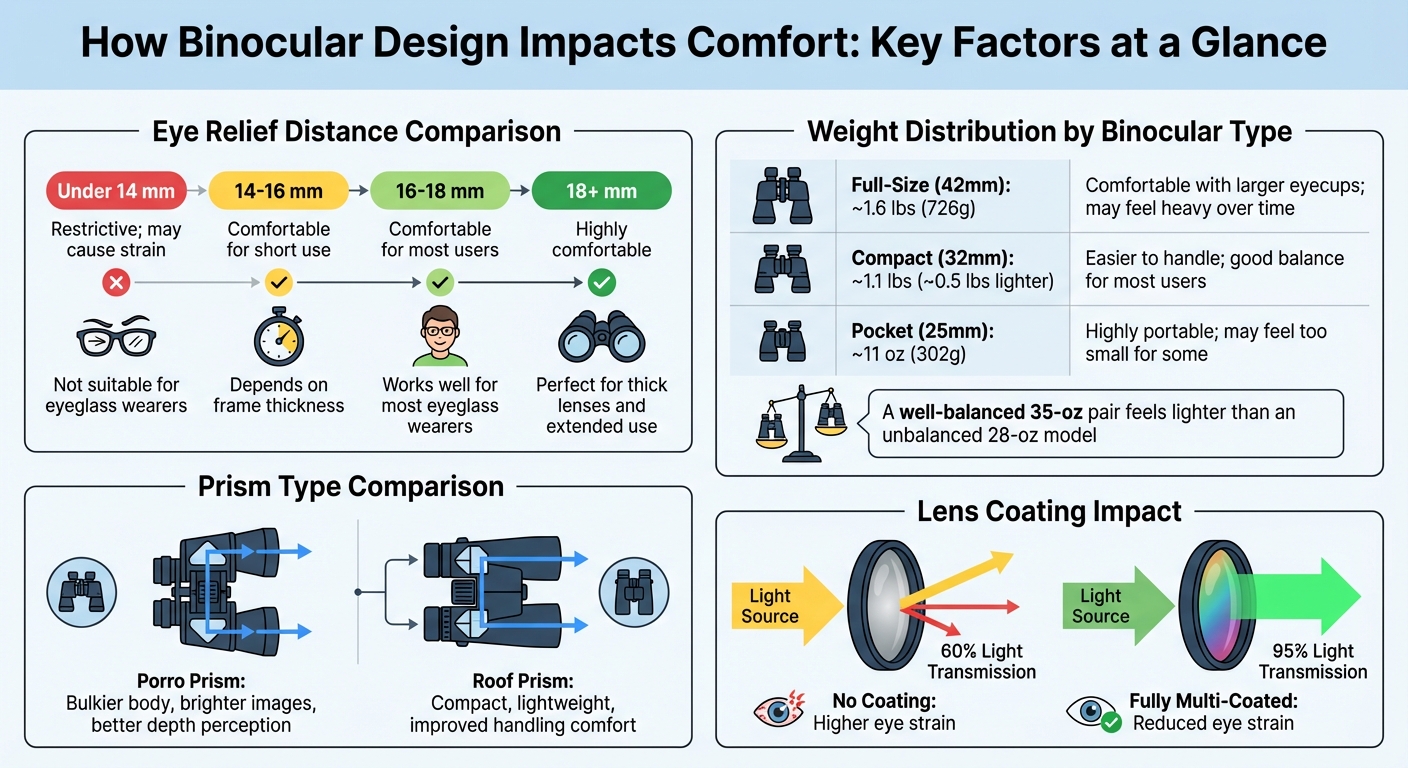
Binocular Design Comfort Factors: Eye Relief, Weight, and Prism Types Comparison
Eye Relief and Eyecup Design
Understanding Eye Relief Distance
Eye relief refers to the ideal distance between your eye and the eyepiece where you can see the entire field of view clearly. Nikon Consumer describes it this way:
"Eye relief is the distance from the outer surface of the eyepiece lens to the position where the exit pupil is formed (eyepoint). Looking through binoculars from the eyepoint, you can obtain the whole field of view without vignetting."
If your eye is too far or too close to the eyepiece, you might encounter issues like black rings (vignetting) or shadows in the image. This can make viewing uncomfortable and limit the field of vision.
Most binoculars have an eye relief range of 10 mm to 20 mm. However, for eyeglass wearers, a longer eye relief – at least 15–16 mm – is necessary to see the full field of view. Premium binoculars often offer 17 mm to 24 mm, accommodating thicker lenses.
| Eye Relief Distance | Comfort Level | Suitability for Eyeglass Wearers |
|---|---|---|
| Under 14 mm | Restrictive; may cause strain | Not suitable |
| 14 mm – 16 mm | Comfortable for short use | Depends on frame thickness |
| 16 mm – 18 mm | Comfortable for most users | Works well for most eyeglass wearers |
| 18 mm and above | Highly comfortable | Perfect for thick lenses and extended use |
Here’s a quick way to test: Look through the binoculars without your glasses, then with them on. If your field of view becomes smaller with glasses, the eye relief is likely too short for your needs.
Next, let’s explore how to adjust eyecups to maintain this optimal eye relief.
How to Adjust Eyecups Properly
Adjusting the eyecups on your binoculars ensures you maintain the correct eye relief whether you wear glasses or not. For non-eyeglass users, fully extend the eyecups. If you wear glasses, fold them down to bring your eyes closer to the eyepiece .
Modern binoculars often feature twist-up eyecups with multiple click stops, allowing for precise adjustments based on your facial structure and glasses thickness . This customization ensures comfort during extended viewing sessions.
If you have astigmatism, keep your glasses on, as the binoculars cannot correct this condition. However, for those with simple nearsightedness or farsightedness, the binocular’s focus mechanism may eliminate the need for glasses. In colder weather, if your lenses fog up, slightly lowering the eyecup extension can help release trapped warmth and reduce fogging.
How to set up your binoculars!
Body Shape and Weight Distribution
The design of a binocular isn’t just about aesthetics – it plays a major role in how comfortable it is to use. Just like eyecup design affects visual comfort, the shape and weight distribution of binoculars are critical for reducing strain on your hands and wrists.
Grip Texture and Materials
The material covering your binoculars can make or break your experience during extended use. Rubberized coatings stand out for providing a secure, non-slip grip, unlike the slippery feel of rigid plastics. Beyond comfort, rubber armoring also protects the internal optics from shocks and muffles impact sounds.
The ZEISS Hunting Team highlights this benefit perfectly:
Rubber armoring provides additional protection for binoculars and spotting scopes, ensures a secure grip and absorbs sounds when it accidentally hits something.
You’ll typically find this rubberized texture on mid-range and premium models, whereas budget options often rely on harder plastics, which lack the same security and comfort.
The shape of the binoculars also matters. Your hands should naturally fall into place on the barrels without needing awkward adjustments. Also, ensure that strap lugs don’t interfere with your grip when you’re reaching for the controls. Manufacturers often use materials like magnesium, aluminum, or glass-fiber reinforced composites (sometimes containing up to 60% glass) to achieve a balance between durability and a lightweight feel.
But there’s more to comfort than just grip – weight distribution plays a huge role too.
Balanced Weight for Extended Use
When it comes to comfort, how the weight is distributed can be just as important as the overall weight. Jessica Riconscante from GearLab explains:
Weight and balance have a significant impact on comfort.
Binoculars with a balanced design feel lighter and are easier to hold steady, reducing the strain on your hands and wrists during long viewing sessions. For example, standard 8×42 binoculars weigh around 1.6 pounds (726 grams), while compact 8×32 models shave off about half a pound, and pocket-sized 8×25 options are even lighter at just 11 ounces (302 grams). Interestingly, a well-balanced heavier model can feel more comfortable than a lighter one that’s front-heavy.
To test for balance, hold the binoculars in your typical viewing stance and see how the weight settles in your palms. This simple step can reveal whether a pair will be comfortable for extended use.
| Binocular Type | Objective Lens | Typical Weight | Comfort Profile |
|---|---|---|---|
| Full-Size | 42 mm | ~1.6 lbs (726 g) | Comfortable with larger eyecups; may feel heavy over time |
| Compact | 32 mm | ~1.1 lbs (~0.5 lbs lighter) | Easier to handle; a good balance for most users |
| 25 mm | ~11 oz (302 g) | Highly portable; may feel too small for some |
Finding the right combination of grip, shape, and weight distribution can make all the difference in your overall experience.
sbb-itb-31b92c7
Focus Wheels and Diopter Settings
Beyond features like eyecup design and weight distribution, precise focus and diopter adjustments are essential for a comfortable and effortless viewing experience. Just like grip and balance, these settings can make or break how enjoyable and fatigue-free your time with binoculars feels.
The focus wheel plays a pivotal role in user comfort. Diane and Michael Porter from BirdWatching emphasize its importance:
"This [the focus knob] is your most important control. You don’t have to be a binocular expert to judge it. Is it well located? Does it turn smoothly?"
Ideally, the focus wheel should rest naturally under your index finger, allowing adjustments without needing to shift your grip. High-quality wheels operate smoothly, with no slack, and respond instantly to even the smallest movement . This level of precision reduces unnecessary cranking, which can lead to hand fatigue.
Center Focus Wheel Design
The design and mechanics of the focus wheel greatly influence its functionality. Binoculars with internal focusing systems are particularly effective, as they move lens elements within a sealed housing. This keeps out dust and moisture, ensuring the mechanism remains smooth and reliable over time.
Another key factor is the speed of the focus system. Models with "fast-focus" or "dynamic focus" designs allow for quick transitions between near and far objects, often requiring just one full rotation of the wheel . This minimal finger movement is especially beneficial when tracking fast-moving subjects like birds or wildlife.
Diopter Adjustment for Individual Vision
The diopter adjustment is just as crucial, as it compensates for differences in vision between your eyes. Properly setting the diopter can significantly reduce eye strain. Scott Einsmann, Gear Editor at Outdoor Life, explains:
"Without proper focusing, the best binoculars have no advantage over the worst."
Interestingly, about 90% of binocular users are unaware of how to properly focus their optics. The diopter is typically found on the right eyepiece as a rotating ring, though some premium models incorporate it into the center column . Most binoculars provide a diopter range between +2.5 and -5.0 diopters, which covers the vision differences of most users.
To adjust the diopter correctly, start by covering the right lens and use the center focus wheel to sharpen the image for your left eye. Then, cover the left lens and adjust the diopter ring to fine-tune the image for your right eye – without touching the center wheel . Once set, you’ll only need the center focus wheel for distance adjustments. This method not only ensures optimal clarity but also reduces eye fatigue during extended use. When combined with an efficient focus wheel, proper diopter calibration enhances your overall viewing comfort.
Prism Types and Lens Coatings
Optical components such as prism designs and lens coatings play a key role in reducing eye strain. By improving brightness, sharpness, and contrast, these features work hand-in-hand with ergonomic designs to ensure a more comfortable experience during long periods of use.
Porro Prism vs. Roof Prism Design
The choice between Porro and roof prisms can influence both comfort and performance. Porro prisms use a Z-shaped light path, which creates a larger, bulkier body. However, this design offers brighter images and better depth perception due to full internal reflection and widely spaced objective lenses. On the downside, the added size can make it harder to maintain a steady grip during extended use.
Roof prisms, on the other hand, are more compact and lightweight, featuring a straight-through design that improves handling comfort. To prevent light loss, roof prisms rely on mirror coatings, but they are more prone to misalignment, which can lead to collimation drift and, ultimately, eye strain.
How Lens Coatings Reduce Eye Strain
Lens coatings significantly influence how much effort your eyes need to process images. Without coatings, lens surfaces reflect about 5% of light, reducing overall transmission to just 60%. Fully multi-coated lenses, however, can increase light transmission to 95%, enhancing image clarity and reducing the strain on your eyes. For roof prisms, phase-correction coatings are particularly important, as they align light waves to preserve sharpness, eliminating the need for frequent squinting or refocusing.
When evaluating binoculars, look for terms like "fully multi-coated" and "phase-coated" in the specifications. These features are designed to minimize eye fatigue, ensuring a more comfortable viewing experience. Together with other thoughtful design elements – like adjustable eyecups and ergonomic grips – these optical enhancements make binoculars not only effective but also enjoyable for extended outdoor adventures.
Conclusion
When choosing binoculars, prioritize features that enhance comfort for both your eyes and hands. Eye relief is especially important – aim for at least 16 mm, particularly if you wear glasses. Adjustable eyecups can help you fine-tune this distance, while a calibrated diopter reduces eye strain caused by improper focus.
The shape and weight of the binoculars also play a big role, especially for extended use. Compact 8×32 models, for instance, are about half a pound lighter than full-size options but still offer generous eye relief. Features like a rubber-armored grip improve handling in wet conditions and help stabilize the image when tracking moving subjects. These physical attributes support better optical performance in the field.
Speaking of optics, the focus wheel design is key for making quick, precise adjustments – an essential feature for fast-paced activities like birding. As Linda Ewing of Bird Collective explains:
If your binoculars leave you with a sore neck or are just too heavy to carry around, then they’re not the right binoculars for you.
Ultimately, the best binoculars combine all these elements into a design that works for you. Whenever possible, test binoculars in person to ensure they suit your hand size and facial structure. Look for models that align with your specific needs – whether you’re after lightweight portability for travel, ample eye relief for glasses, or a stable single-hinge design for birdwatching. The right pair of binoculars isn’t just a tool; it becomes a trusted companion for your outdoor adventures.
FAQs
How can I tell if binoculars are well-balanced in my hands?
To determine if binoculars are balanced properly, pay attention to how the weight is distributed. Binoculars with even weight distribution feel steady in your hands, minimize strain during extended use, and are easier to handle. Proper balance enhances comfort and makes the experience more enjoyable.
What’s the quickest way to set the diopter correctly?
To set the diopter efficiently, start by covering the right barrel of your binoculars. Use the center focus wheel to bring the image into sharp focus. Next, cover the left barrel and turn the diopter ring until the image appears clear. This adjustment customizes the binoculars to your eyesight, reducing the need for frequent refocusing.
Which coating specs matter most for reducing eye strain?
Coatings designed to improve light transmission, such as multi-coated or fully coated lenses, play an important role in reducing eye strain. By cutting down on light loss and glare, these coatings provide a clearer and more comfortable viewing experience.