
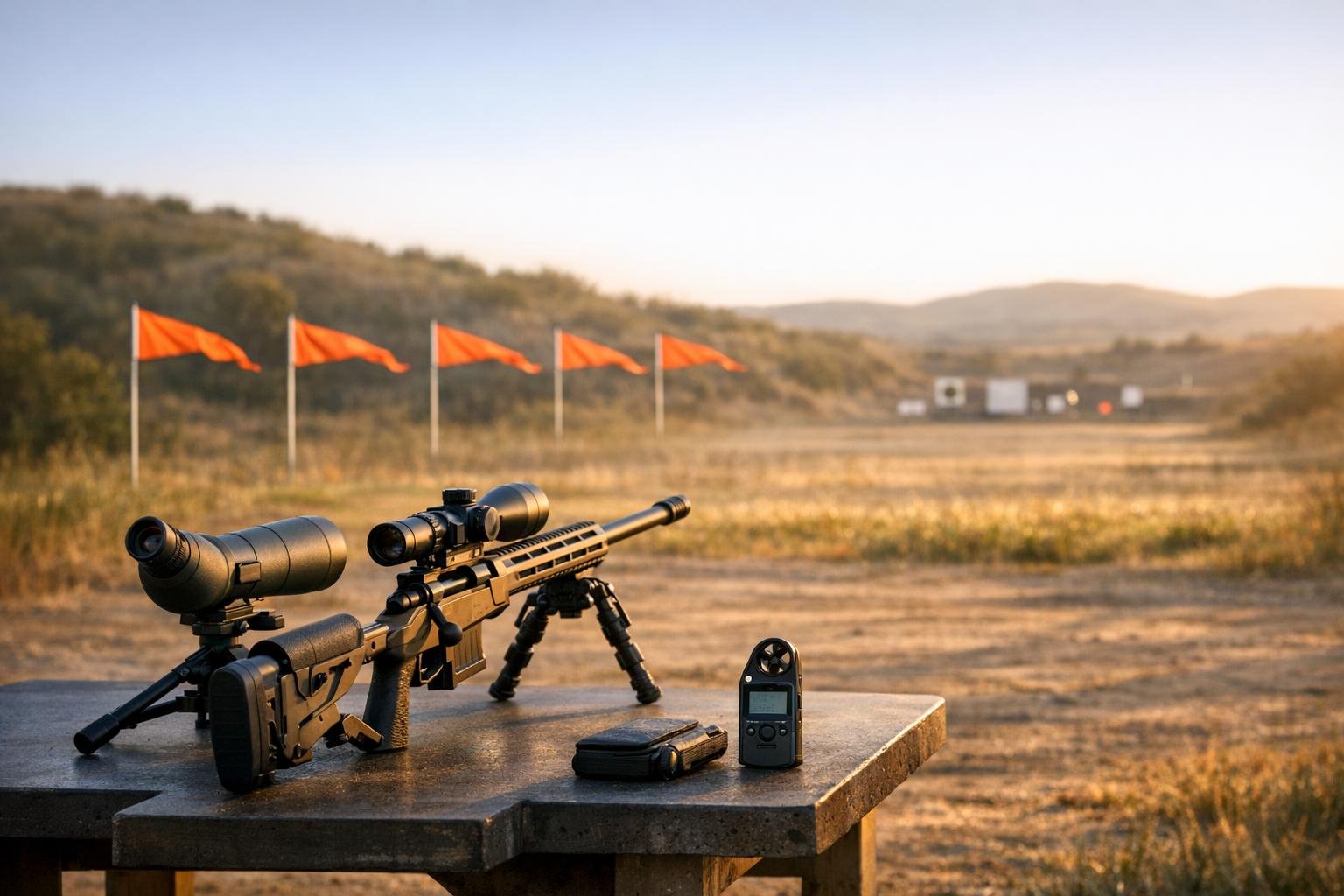
Wind can drastically alter your bullet’s trajectory, making it harder to zero a rifle accurately. Even small errors at close range can result in significant misses over long distances. For example, a 15 mph crosswind can push a .308 bullet 17 inches off course at 328 yards.
Key takeaways:
- Wind is unpredictable: It changes speed and direction, unlike gravity, which is constant.
- Full-value winds (90°) cause maximum drift, while partial-value winds (angled) have a reduced effect.
- Heavier bullets with higher ballistic coefficients resist wind better than lighter ones.
- Mirage and natural indicators like grass and tree movement are essential for reading wind speed and direction.
- Zero in calm conditions whenever possible; if not, use shorter distances (e.g., 25 yards) to minimize wind impact.
Accurate wind reading and the right tools – like high-performance scopes, wind meters, and ballistic systems – are crucial for maintaining precision. Waiting for consistent wind patterns before shooting can also improve results.
What Shooters Don’t Know About WIND Reading!!
sbb-itb-31b92c7
How Wind Changes Bullet Path
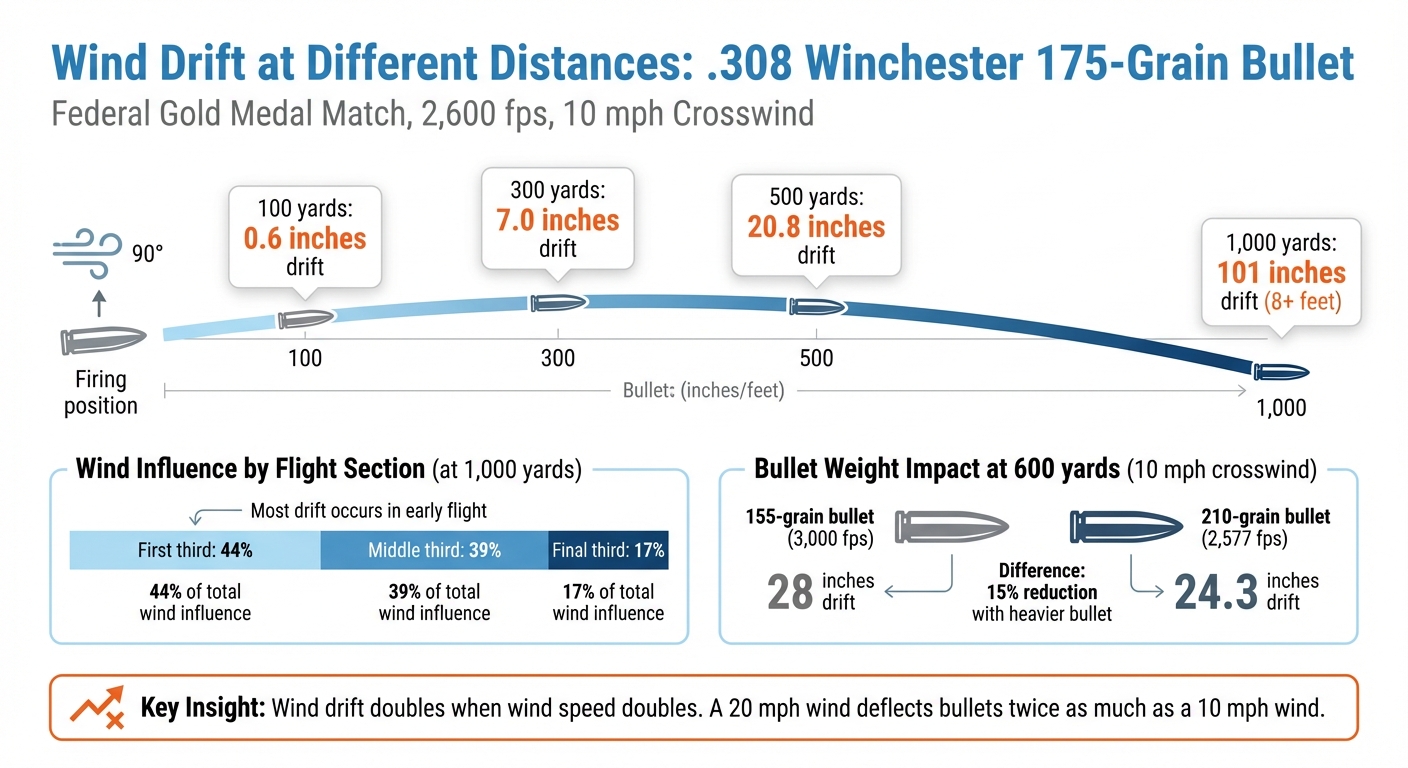
Wind Drift Impact on .308 Bullets at Different Distances
Wind doesn’t just nudge a bullet sideways – it’s a lot more complicated than that. A spin-stabilized bullet acts like a gyroscope, naturally aligning its axis with the airflow it encounters. When a crosswind hits the bullet, it tilts slightly into the wind, which shifts the aerodynamic drag force and creates a lateral pull in the downwind direction. Bryan Litz, Chief Ballistician at Berger Bullets, breaks it down:
"It’s that lateral component of aerodynamic drag that causes wind deflection during long distance shooting."
This deflection is tied to "lag time", which is the extra flight time caused by air resistance compared to a vacuum. Wind drift is directly proportional to wind speed. For instance, a 20 mph wind will deflect a bullet twice as much as a 10 mph wind. This makes drift calculations directly tied to wind speed. Let’s dive into how wind direction impacts this phenomenon.
Full-Value vs. Partial-Value Winds
The direction of the wind plays a huge role in how much it affects a bullet’s path. Full-value winds blow at a 90-degree angle to your line of sight. Picture aiming at 12 o’clock while the wind blows from 3 or 9 o’clock. These winds create the maximum amount of drift.
Partial-value winds, however, come from angles like 1, 2, 4, 5, 7, 8, 10, or 11 o’clock. These are often treated as "half-value" winds, meaning they cause about 50% of the drift compared to a full-value wind of the same speed. For example, using a .223 Remington 55-grain bullet at 230 yards, a 10 mph full-value wind causes about 6.2 inches of drift. But if the wind comes at a 22.5° angle, the drift drops to around 2.4 inches.
No-value winds blow directly from 12 o’clock (headwind) or 6 o’clock (tailwind). While these winds can alter a bullet’s vertical trajectory by changing drag, they don’t cause any sideways deflection. Generally, any wind within 22.5° of a direct headwind or tailwind won’t affect a typical hunting shot enough to matter.
Wind Drift at Different Distances
Understanding how wind affects bullets at various ranges is crucial for accurate shooting, especially with high-caliber rifles. Wind drift increases significantly as the distance grows. For example, take a Federal Gold Medal Match .308 Winchester with a 175-grain bullet traveling at 2,600 fps. A 10 mph crosswind produces about 0.6 inches of drift at 100 yards, roughly 7.0 inches at 300 yards, and around 20.8 inches at 500 yards. By the time you reach 1,000 yards, that same wind can push the bullet about 101 inches – over 8 feet.
The longer a bullet is in the air, the more time the wind has to act on it. As drag slows the bullet, it becomes even more susceptible to deflection. For instance, a mild 2.24 mph wind can cause about 4 inches of drift at 400 yards for a .308 175-grain bullet, but at 1,000 yards, that drift jumps to over 32 inches.
Interestingly, the first part of the bullet’s flight is where wind has the greatest impact. At 1,000 yards, the first third of the flight path accounts for about 44% of the total wind influence, the middle third for about 39%, and the final stretch near the target only about 17%. This is why seasoned shooters focus their wind-reading efforts on the area roughly two-thirds to three-quarters of the way to the target.
Here’s an interesting twist: heavier bullets with higher Ballistic Coefficients (BC) tend to resist wind better than lighter, faster bullets. At 600 yards with a 10 mph crosswind, a 155-grain .308 bullet traveling at 3,000 fps might drift around 28 inches. Meanwhile, a slower but heavier 210-grain bullet at 2,577 fps could drift only about 24.3 inches – a 15% reduction. This showcases the advantage of using heavier bullets for long-range precision.
Reading Wind Conditions in the Field
Understanding how wind affects a bullet’s trajectory is only part of the equation. To make precise adjustments, you need to accurately read wind conditions in real-world settings. While this can be challenging, there are practical techniques that don’t require high-tech gear.
Using Mirage to Measure Wind Speed and Direction
Mirage – those heat waves created by air at varying temperatures – offers a visual way to gauge wind movement. To use mirage effectively, adjust your spotting scope to focus about halfway to three-quarters of the distance to your target. A magnification of around 25× works best for clarity, as higher magnifications can make the image harder to interpret.
One of the benefits of mirage is its sensitivity to wind changes. As Ernest J. Vande Zande, a Smallbore Rifle Prone Champion, explains:
"Because air weighs so little, the mirage will change before the wind flags move."
When the mirage rises straight up – referred to as a "boil" – it indicates no wind or wind blowing directly toward or away from you. By rotating your spotting scope until you see a boil, you can determine the wind’s exact direction based on the scope’s angle. According to Glen Zediker, an NRA High Master, a boil often precedes a shift in wind direction.
Mirage patterns also help estimate wind speed. At about 3 mph, the waves appear flat. As wind increases to 4–15 mph, the waves compress and move faster. Beyond 12–15 mph, the mirage becomes unreadable.
| Mirage Pattern | Movement Angle | Estimated Wind Speed |
|---|---|---|
| Boiling | Vertical (Upward) | 0 mph (or direct head/tail wind) |
| Slow | 30° (7 to 1 or 5 to 11 o’clock) | 1–3 mph |
| Medium | 60° (8 to 2 or 4 to 10 o’clock) | 4–7 mph |
| Fast | 90° (Horizontal, 9 to 3) | 8–12 mph |
When mirage is unavailable or unclear, natural elements can offer alternative ways to read the wind.
Natural Wind Indicators
If you can’t rely on mirage or don’t have a spotting scope, turn to the environment around you. Watch how grass bends, tree branches sway, or how dust and smoke move. Water surfaces can also reveal wind direction and strength.
Rain is another helpful clue. As Ernest J. Vande Zande notes:
"One advantage of rain is that it is a good indicator of wind direction and velocity."
To refine your wind-reading skills, practice with wind flags and tools like a Kestrel. Observing how flags behave at different wind speeds can train your eye to recognize subtle changes. Keep in mind that wet flags are heavier, requiring stronger winds to move.
Focus your attention on the area two-thirds to three-quarters of the way to your target. This is where the wind has the greatest influence on your bullet’s path, making it the most critical zone for adjustments.
Zeroing Methods for Windy Days
When it comes to adjusting your zero in windy conditions, having a solid strategy is key. Wind can be unpredictable, so the approach you choose should align with the prevailing conditions to maintain accuracy.
Chasing the Shot and Shooting a Condition
One of the most reliable methods for zeroing in the wind is shooting a condition. This involves identifying a consistent wind pattern – both in speed and direction – and only firing when that specific condition reappears. Ernest J. Vande Zande, a World Record Holder and National Champion, sums it up perfectly:
"The most desirable method is… picking a condition. This method has the fewest number of variables since you only shoot when all conditions are exactly the same as the one you picked."
To implement this method, spend 10–15 minutes observing the wind behavior on the field. Look for repeating patterns and wait for your chosen condition before taking each shot. Patience is critical here.
On the other hand, chasing the shot – where you adjust your sights based solely on the last round’s impact – is far less reliable. Vande Zande warns against this approach:
"Chasing the shot… is a plan of desperation and normally used when you are running out of time and making sight adjustments based only upon the print of the last shot."
For a more balanced approach, consider bracketing. This involves observing the full range of wind values during your session and only shooting when the wind falls within the middle third of that range. As Sgt. 1st Class Walter Craig, former AMU Service Rifle Team Head Coach, explains:
"I typically stay in the middle third of an established bracket. When the lower and upper thirds come around, I’ve found it’s best to wait it out."
These techniques emphasize the importance of stable conditions when zeroing, underscoring why a true zero remains a foundational requirement.
Zeroing in Calm vs. Windy Weather
Having a true zero established in calm conditions is non-negotiable – it provides the baseline for all wind adjustments. If possible, zero your rifle in calm weather to ensure accuracy. As Vande Zande advises:
"Always work from true zero."
If calm conditions aren’t an option, a practical workaround is to zero at 25 yards. At this distance, the wind’s impact on the bullet is minimal due to its high velocity. Once you’ve achieved a rough alignment, fine-tune your zero when the wind dies down. For perspective, a 5 mph wind might cause about 1 MOA of drift at 200 yards, but its effect at 25 yards is negligible.
Finally, make sure to record your true zero settings by noting the exact turret positions under calm conditions. This ensures you always have a reliable reference point, regardless of the weather.
Gear for Better Zeroing in Wind
Dealing with wind while zeroing requires more than just skill – it demands the right tools. The proper gear can make environmental analysis more precise and help you adjust your point of impact with greater confidence. Here’s how specific equipment can improve your accuracy in windy conditions.
High-Performance Scopes and Wind-Resistant Optics
When it comes to scopes, First Focal Plane (FFP) reticles are a game-changer. They allow for consistent holdovers at any magnification. For instance, a 2-MIL hold will remain accurate whether you’re zoomed in at 5x or fully extended to 25x power. Horizontal subtensions on these scopes are especially useful – they let you hold into the wind rather than constantly adjusting the windage turret as conditions shift.
Clarity is critical for reading environmental cues like mirages. High-definition optics make it easier to detect subtle mirage movements, which can reveal wind direction and speed. Features like side parallax adjustment are also essential. They help eliminate "reticle float", ensuring your crosshairs stay locked on target even if your eye position changes slightly – something that’s crucial for long-distance precision.
Another helpful feature is an internal bubble level, which prevents canting – a common issue that can mimic wind drift. Some advanced scopes even have wind-enabled turrets with custom wind hold values that increase with distance, allowing you to adjust for yardage and wind simultaneously.
Thermal Scopes and Rangefinders
Thermal scopes bring unique advantages to the table. Models with a one-shot freeze function can capture a stable frame, making quick adjustments easier. Additionally, multiple zero profiles let you save settings for different ammunition types or weather conditions, sparing you from re-zeroing every time the environment changes.
For rangefinding, advanced models integrate environmental sensors to provide real-time shooting solutions. A standout example is the Kestrel 5700 Elite, which combines Applied Ballistics software with atmospheric monitoring. However, as competitive shooter Erik Cortina points out:
The Kestrel only tells you what the wind is doing where it stands… It can’t tell you what’s happening 400 yards out, above the tree line, or along a ridgeline mid-flight.
For those tackling extreme long-range challenges, the Wind Zero System ($2,815.00) goes a step further. This system uses up to eight ultrasonic meters placed downrange to measure wind at multiple points along the bullet’s flight path – such as at 300, 600, and 900 yards. This approach addresses the limitations of single-point wind measurements, offering a more comprehensive solution.
Gear Comparison Table
Here’s a quick comparison of gear setups based on their ability to handle wind, read mirage, and perform at long distances:
| Gear Level | Wind Deflection Handling | Mirage Reading Capability | Long-Range Performance |
|---|---|---|---|
| Basic Gear (Standard Scope + Basic Rangefinder) | Relies on manual holdovers from visual cues | Limited to high-contrast conditions | Effective up to 300-400 yards |
| Advanced Gear (Thermal Scope + Sensor Rangefinder) | Offers digital zero profiles for varied conditions | Moderate; depends on thermal contrast | Suitable for mid-range tactical use |
| Expert Gear (Integrated Ballistic Systems + One-Shot Freeze Thermal) | Provides real-time firing solutions | High; specialized optics detect subtle mirage shifts | Delivers precision at 1,000+ yards |
The right combination of tools can make all the difference when navigating the complexities of wind and distance.
Conclusion
Zeroing a rifle in windy conditions requires a solid grasp of how air movement impacts bullet trajectory. As champion shooter Nancy Tompkins-Gallagher highlights:
One of the most important aspects of shooting in the wind is to know what the no-wind zero is on your rear sight.
This "True Zero" serves as the foundation for making accurate adjustments in the field.
For instance, a 10 mph crosswind can push a .308 bullet off course by 82 inches over 1,000 yards. Add to that the Bernoulli Effect, which introduces a slight vertical shift, and the importance of precise wind assessment becomes clear. Understanding wind value is key – whether it’s a full crosswind from 3 o’clock or a partial-effect wind from 1 o’clock, which typically exerts only 25% of the full impact. These nuances highlight why reading wind conditions is just as critical as calculating adjustments.
Observing mirage patterns is often more reliable than relying solely on flags, as mirages respond more quickly to shifting air masses. Sgt. 1st Class Walter Craig, a former AMU Service Rifle Team Head Coach, explains:
I personally do not think anyone has the ‘magic eye.’ I believe we all see the same indicators, what varies is how people interpret, analyze and make decisions.
High-quality gear plays a pivotal role in managing wind effectively. Tools like premium scopes and wind meters, such as the Kestrel, provide the precise data needed for accurate corrections. Advanced systems that measure wind at multiple downrange points further reduce uncertainty, especially for long-range shots. For expert insights into selecting the right optics and accessories for windy conditions, check out Scope It Outdoors.
FAQs
Should I dial windage or hold for wind when zeroing?
When zeroing, it’s usually best to dial windage because it’s quicker and reduces the chances of mistakes. On the other hand, holding for wind works better in dynamic shooting scenarios where you need to make rapid adjustments. Dialing allows for more precise corrections, especially when you have the time to fine-tune your settings.
How can I tell wind speed without a wind meter?
You can gauge wind speed by observing your surroundings and referencing the Beaufort Scale. For instance, when winds are calm (less than 1 mph), smoke rises straight up. Light air causes smoke to drift slightly. A moderate breeze, around 13–18 mph, can move small branches. If you notice small trees swaying or flags fully extending, you’re likely dealing with stronger winds. These visual clues are handy for estimating wind strength and direction.
Does bullet weight or ballistic coefficient matter more in wind?
Ballistic coefficient (BC) plays a bigger role than bullet weight when it comes to handling wind. BC measures how well a bullet resists wind drift by efficiently slicing through the air. On the other hand, bullet weight primarily affects impact energy and recoil. If you’re aiming for better performance in windy conditions, prioritize bullets with a high BC.