
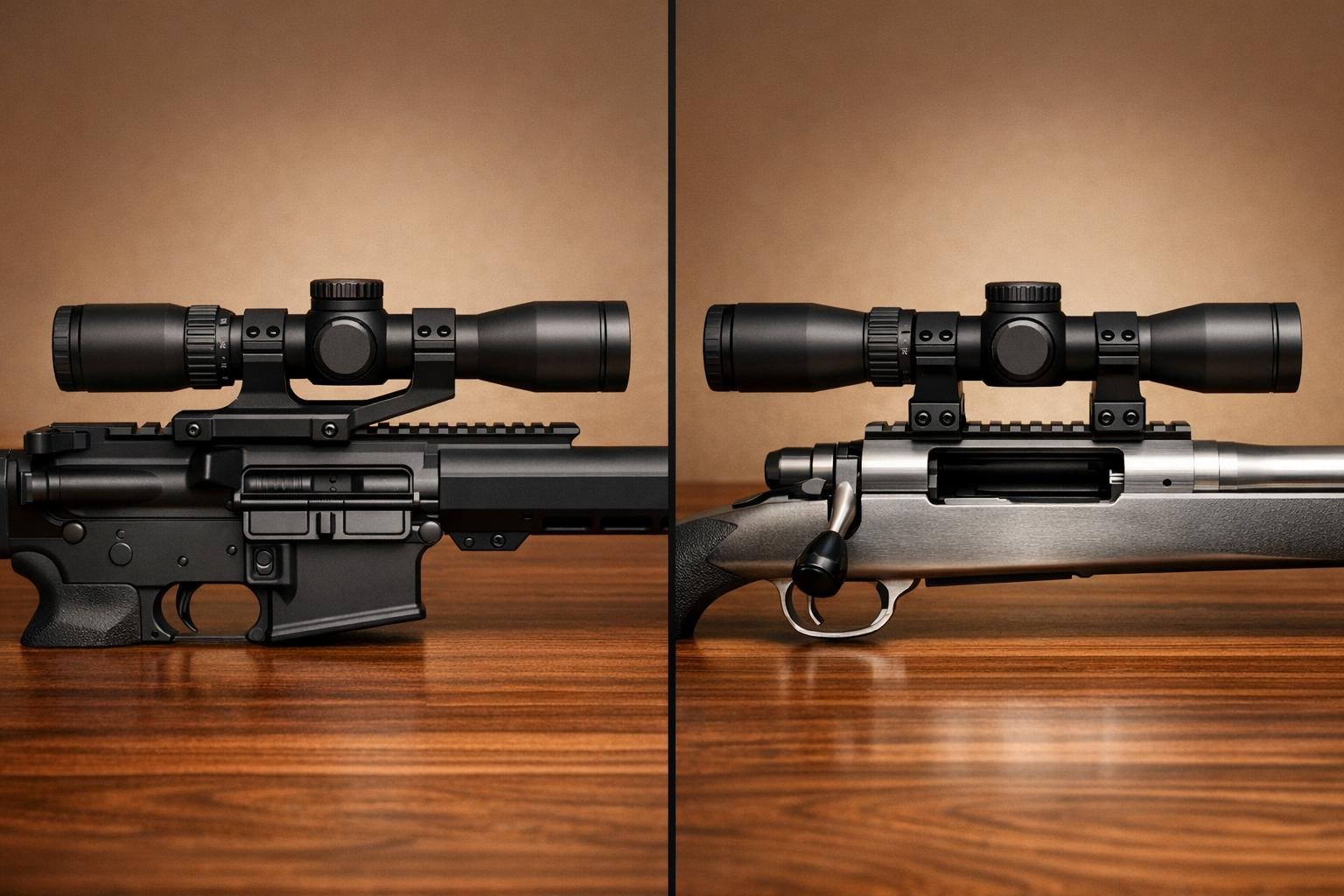
When choosing between one-piece and two-piece scope mounts, it’s all about your rifle, shooting style, and priorities like stability, weight, and cost. Here’s a quick breakdown:
- One-piece mounts: Strong, rigid, and ideal for high-recoil rifles or precision shooting. They maintain alignment better and often include features like cantilever designs for AR platforms. Downsides? Heavier, pricier, and may block breech access on bolt-action rifles.
- Two-piece mounts: Lightweight, affordable, and better for bolt-action rifles where breech access is important. However, they can be less stable and require careful alignment during installation.
Quick Comparison
| Feature | One-Piece Mounts | Two-Piece Mounts |
|---|---|---|
| Stability | Excellent (rigid, single-piece design) | Moderate (separate rings) |
| Weight | Heavier | Lighter |
| Cost | Higher ($150+) | Lower (often under $100) |
| Installation | Easier (pre-aligned) | More complex (requires alignment) |
| Breech Access | May obstruct | Open design for easy access |
| Best For | AR platforms, high-recoil rifles | Bolt-action, lightweight builds |
Pick one-piece mounts for precision and durability, especially with ARs or magnum calibers. Go with two-piece mounts for hunting rifles where weight and breech access matter most.
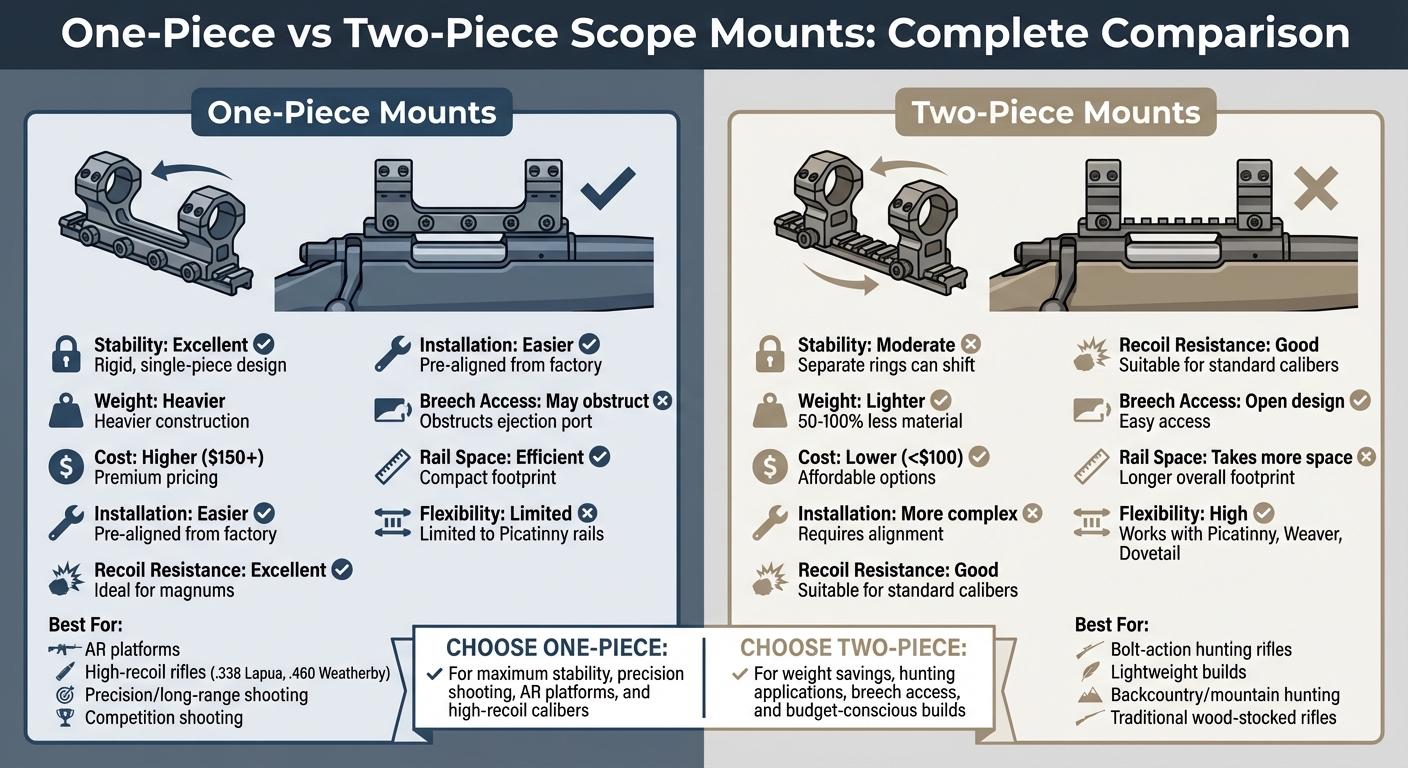
One-Piece vs Two-Piece Scope Mounts Comparison Chart
Bases, rings, mounts and cantilevers. Which one is right for you and your application?
sbb-itb-31b92c7
What Are One-Piece Scope Mounts?
A one-piece scope mount is a single, solid unit that combines two rings on a shared base, typically crafted from aluminum, steel, or titanium. This design creates a sturdy link between your rifle and optic. Unlike two-piece systems, where each ring is mounted separately, the rings in a one-piece mount are permanently connected by a single mounting plate.
Because these mounts are machined as a single unit – often using CNC technology – they come perfectly aligned from the factory. This eliminates the need for lapping, a process used to align separate rings by grinding them down.
One-piece mounts attach to rifles via standardized rail systems, most commonly Picatinny rails (MIL-STD-1913). These rails feature slots that are 0.206 inches wide with a 0.394-inch center-to-center spacing. The mount is secured to the rail using three to four screws over a span of 4–5 inches, providing a much stronger hold compared to two-piece bases, which typically use only two screws over a shorter span. As Pdvdh from Long Range Hunting explains:
"A one-piece base is a more rugged support system than the two-piece bases. 4 screws holding one piece securely over a span of 4–5 inches of separation, compared to 2 screws holding two separate pieces with the screws separated over a span of only 1 inch"
- Pdvdh, Long Range Hunting
For AR-15 platforms, one-piece mounts often feature a cantilevered design, which positions the scope further forward than the rail allows. This design is crucial for achieving proper eye relief while keeping the mount firmly attached to the upper receiver. These thoughtful design elements contribute to the mount’s superior performance in terms of precision and recoil management.
Key Features of One-Piece Scope Mounts
One-piece mounts are built to deliver exceptional rigidity and resist recoil effectively. Their monolithic construction ensures the rings remain perfectly aligned, even under heavy recoil, creating what shooters call a "single centerline." This consistent alignment is critical for maintaining accuracy, even if the rifle’s receiver has slight imperfections.
The mounting surface of a one-piece mount is larger than that of two-piece systems. High-performance models, like the Leupold Mark AR, can feature up to five screws to secure the base to the rail. Manufacturers often recommend torque values of 65 inch-pounds for base screws and 28 inch-pounds for ring screws. This larger contact area and multiple attachment points enhance stability and precision – an essential factor for long-range shooting.
One-piece mounts come in two primary attachment styles: screw mounts and quick-release (QD) levers. Screw mounts provide consistent clamping force and a low-profile design, ideal for precision shooting. On the other hand, QD mounts allow for tool-free removal but tend to have a bulkier design. Premium models, such as the $330 Area 419 Tactical mount, incorporate features like internal steel guide pins to prevent scope rotation during installation.
These mounts are also compatible with various rail systems beyond Picatinny. They can work with Weaver rails, which have narrower slots (0.14–0.16 inches), and 3/8-inch dovetail systems commonly found on rimfire rifles. Some models are even designed to screw directly into factory-drilled holes on a rifle’s receiver, eliminating the need for a separate rail.
Advantages of One-Piece Scope Mounts
The factory alignment of one-piece mounts is a standout advantage. This alignment prevents uneven stress on the scope tube, which could damage the optic’s internal components. Installation is straightforward, with no need to adjust individual rings or worry about spacing. Once installed, the mount ensures reliable performance, even if you need to remove and reinstall it.
Their structural strength is another major benefit. As Travis Olander from AllOutdoor points out:
"Since they’re machined from a single piece of aluminum, monolithic mounts are stiffer and stronger overall than individual scope rings"
This stiffness makes one-piece mounts particularly well-suited for high-recoil rifles and long-range precision shooting.
Drawbacks of One-Piece Scope Mounts
The additional material in a one-piece design makes these mounts heavier than two-piece systems. For hunters who prioritize weight savings on a mountain rifle, this could be a drawback.
Cost is another consideration. Quality one-piece mounts start at around $119.99, with more advanced models or those featuring quick-release mechanisms ranging from $150 to $400. High-end options with QD features often exceed $150.
One-piece mounts can also obstruct access to the breech on bolt-action rifles, making tasks like top-loading or clearing jams more difficult. This is less of an issue with two-piece rings, which leave the ejection port clear. If breech access is important, it’s worth verifying compatibility before purchasing.
Finally, one-piece mounts offer limited flexibility in mounting configurations. They are primarily designed for Picatinny rails and require a continuous mounting surface. In contrast, two-piece rings can work with a broader range of older actions and mounting systems, such as dovetail or Weaver setups. Additionally, the fixed spacing between rings on a one-piece mount may not accommodate certain scope lengths, though this is rarely an issue with modern optics.
What Are Two-Piece Scope Mounts?
Two-piece scope mounts are all about flexibility, lighter weight, and better clearance – key attributes that set them apart from one-piece mounts.
These mounts consist of two separate rings that attach independently to the rifle’s receiver. Unlike one-piece mounts, which are a single, continuous structure, two-piece mounts leave a gap between the front and rear rings. This design allows one ring to sit in front of the ejection port and the other behind it, offering greater adjustability for scope positioning.
This setup creates what shooters call "two center-lines", as opposed to the single centerline found in one-piece mounts. Mike from CSTactical breaks it down:
"A 2 piece base will have TWO center-lines and a 1 piece base will have ONE center-line even if you put it on a rifle that is not trued."
However, because these rings attach separately, they rely on the rifle’s factory-drilled screw holes, which can sometimes lead to alignment issues.
Two-piece mounts are especially popular with bolt-action rifles since they don’t cover the action. This open design makes it easier to manually load rounds, clear malfunctions, or perform maintenance. Warne Scope Mounts highlights this benefit:
"The disadvantage of the one-piece scope bases is some rifles have either a ‘Blind Mag’ or a ‘Hinge Floor Plate’ which require you to load your rifles from the breech. A one-piece scope base can sometimes get in the way of speed loading."
These mounts also work with a variety of attachment systems – Picatinny, Weaver, and even older Dovetail setups – making them more versatile than one-piece mounts, which are typically designed for Picatinny rails.
Key Features of Two-Piece Scope Mounts
The modular design of two-piece mounts delivers a combination of adjustability and weight savings that appeals to many shooters.
- Adjustability: Since the rings are not connected, they can be repositioned along the rail or receiver to fit different scope tube lengths. This flexibility is especially helpful for compact scopes that might not align properly with the fixed spacing of one-piece mounts.
- Lightweight: Using less material than one-piece mounts, these are significantly lighter. For hunters navigating rugged terrain, every saved ounce matters.
- Clearance: Their open design ensures better access around the ejection port, making them ideal for rifles requiring top-loading or frequent chamber access. As Travis Pike, a former Marine machine gunner, explains:
"The issue here is that a single piece scope mount has to go above the action of the rifle. This lowers clearance and makes it harder to load bolt actions, as well as unload and clear potential malfunctions."
This design also accommodates scopes with larger center turret saddles, which could otherwise interfere with one-piece mounts.
Advantages of Two-Piece Scope Mounts
Two-piece mounts come with several perks, starting with their affordability. Their simpler design and reduced material needs make them a budget-friendly option. While premium one-piece mounts can cost over $150, you can find quality two-piece rings at a fraction of the price. Travis Pike sums it up:
"Two-piece rings are light and handy, and best of all very affordable."
Other benefits include:
- Weight Reduction: Perfect for lightweight rifle builds, they help reduce fatigue during long treks.
- Breech Access: The open space between the rings makes top-loading bolt-action rifles or clearing jams much easier.
- Modular Replacement: If one ring gets damaged, you can replace it without swapping out the entire mount.
- Classic Look: Many shooters prefer the traditional aesthetic of separate rings, especially on wood-stocked rifles, over the tactical appearance of one-piece mounts.
Drawbacks of Two-Piece Scope Mounts
Despite their advantages, two-piece mounts come with a few challenges.
- Alignment Issues: Because the rings mount independently, they are more likely to follow any imperfections in the rifle’s factory-drilled screw holes. This can lead to misalignment that stresses the scope tube. As gunbugs from Alaska Outdoors Forums explains:
"Two piece bases can, and will follow the screw holes more easily, and if the factory doesn’t drill them all in a straight line, then two piece bases won’t be in a straight line either."
Proper alignment often requires specialized tools and lapping, which can make installation more complex.
- Reduced Stability: Without the rigidity of a single-piece design, these mounts may shift under heavy recoil or impact. However, proper installation and torque settings can usually minimize this risk.
- Limited Eye Relief: While the rings can be adjusted, they are still constrained by the positions of the receiver’s mounting holes. This limitation can make achieving optimal eye relief trickier compared to the broader range offered by one-piece Picatinny rails.
- Time-Consuming Installation: Each ring must be individually aligned, which can be a more tedious process compared to installing a one-piece mount.
One-Piece vs Two-Piece Scope Mounts: Direct Comparison
Let’s break down how one-piece and two-piece scope mounts stack up in the areas that matter most to shooters.
Stability is a standout feature for one-piece mounts. Their single-piece construction ensures maximum rigidity, making them less likely to shift under heavy impact. Two-piece rings, on the other hand, rely on separate attachment points, which can lead to alignment issues. As Greyfox, a Long Range Hunting Supporter, shared:
"I have had alloy two piece mounts get knocked out of alignment with hard contact to the scope."
Weight and cost are areas where two-piece mounts shine. They use less material, often weighing 50% to 100% less than their one-piece counterparts. Additionally, two-piece mounts are more budget-friendly. While premium one-piece mounts with features like quick-release mechanisms can exceed $150, quality two-piece sets are available at a fraction of the price.
Installation and alignment are more straightforward with one-piece mounts. Their factory pre-alignment eliminates much of the guesswork. In contrast, two-piece rings require careful setup, as they depend on the rifle’s factory-drilled holes, which might not always be perfectly aligned. These considerations highlight the importance of choosing the right mount based on your specific needs.
Comparison Table: Pros and Cons
Here’s a quick overview of the key differences between the two mount types.
| Feature | One-Piece Mounts | Two-Piece Rings |
|---|---|---|
| Stability | Superior – monolithic design ensures rigidity | Moderate – independent pieces can shift under impact |
| Recoil Resistance | Excellent – ideal for magnums and high-recoil calibers | Good – suitable for standard hunting calibers |
| Weight | Heavier due to additional material | Lightweight – great for precision builds |
| Cost | Higher – $150+ for premium models | Lower – more affordable option |
| Installation | Easy – factory pre-aligned | More complex – requires precise alignment |
| Flexibility | Limited to Picatinny rails; great eye relief adjustment | High – compatible with various mounting systems |
| Rail Space Usage | Efficient – compact footprint leaves room for accessories | Takes up more space with separate mounts |
| Breech Access | May obstruct ejection port on bolt-action rifles | Open design allows easy access |
| Best For | AR platforms, precision rifles, high-recoil systems | Bolt-action hunting rifles, lightweight builds |
This breakdown provides a clear picture of the strengths and weaknesses of each type, helping you zero in on the best option for your shooting setup.
How to Choose the Right Scope Mount
Selecting the right scope mount is crucial for ensuring your rifle performs as intended. A poor choice can lead to issues like a shifted zero, damaged optics, or an overall frustrating experience at the range.
Rifle Type and Recoil
The type of rifle you use and its recoil level are key factors in picking a scope mount. For rifles chambered in high-recoil calibers like the .338 Lapua Magnum, one-piece mounts are ideal. Their solid, monolithic design helps prevent the scope from shifting under heavy recoil. As Travis Pike, a former Marine Machine Gunner, explains:
"One-piece mounts are perfect for high recoiling systems".
For AR-platform rifles, one-piece cantilever mounts are the go-to option. These mounts push the scope forward, providing proper eye relief while avoiding the common mistake of "bridging" the gap between the receiver and handguard. Since handguards can flex, bridging can lead to a lost zero. On the other hand, bolt-action rifles often benefit from two-piece rings, which leave the breech area clear for top-loading.
Shooting Style and Use Case
Your shooting style and intended use also play a big role. Precision shooters often opt for one-piece mounts because their rigid, single-piece construction ensures perfect alignment and maintains zero even under the recoil of long-range calibers. For hunters navigating rugged terrain, two-piece mounts are a lighter option, which can be a big deal when every ounce counts. If you’re building a tactical AR setup, one-piece mounts with integrated Picatinny rails offer additional versatility. They allow you to attach secondary accessories like lasers or night vision without needing extra clamps.
Budget and Accessory Compatibility
Budget is another important consideration. Two-piece rings are usually the most affordable, with quality sets starting around $100. One-piece mounts, however, tend to start at $150 and can go beyond $400 for premium, competition-grade options. Despite the higher cost, one-piece mounts often include extra features like a 20 MOA cant for long-range shooting or built-in bubble levels, which would otherwise need to be purchased separately.
For AR platforms, one-piece cantilever mounts maximize rail space, leaving room for flip-up iron sights, night vision, or lasers. Meanwhile, two-piece rings provide flexibility and are easier to replace if damaged. They’re also a practical choice for rifles with blind magazines or hinge floor plates, as they leave enough space to load rounds directly into the breech.
Best Use Cases for Each Mount Type
One-Piece Scope Mounts for Precision and High-Recoil Rifles
If you’re working with AR-style rifles or tackling high-recoil calibers like .338 Lapua, .338 RUM, or .460 Weatherby Magnum, one-piece mounts are your go-to option. These mounts are specifically designed to provide the height and forward cantilever positioning needed for proper eye relief, while also clearing the handguard and maintaining a consistent centerline through the optic. Their single-block construction ensures stability, making them incredibly resistant to zero shift – even under punishing recoil.
As Travis Pike, a former Marine Machine Gunner, explains:
"One-piece scope mounts are incredibly rigid and durable. One-piece mounts are perfect for high recoiling systems. Long-range rounds are typically very powerful rounds and are capable of some brutal recoil."
These mounts are a favorite in F-Class and extreme distance shooting competitions. Most come with built-in elevation (commonly 20 MOA), which helps shooters zero their rifles at long distances without maxing out their scope’s internal adjustments. They’re also a smart choice for mass-produced rifles with less precise receiver tolerances, as they provide a consistent centerline that two-piece mounts might struggle to achieve. For anyone dealing with high-recoil calibers or long-range precision shooting, one-piece mounts offer the alignment and durability you need to perform reliably.
Two-Piece Scope Mounts for Hunting and Versatility
On the other hand, two-piece mounts shine in hunting scenarios, particularly with traditional bolt-action rifles. Their design leaves the ejection port completely open, which is a huge advantage for top-loading cartridges or clearing malfunctions in the field – especially for rifles with blind magazines or hinge floor plates.
Weighing 50% to 100% less than one-piece mounts, two-piece mounts are a lifesaver for backcountry or mountain hunters where every ounce matters. They also offer a sleek, classic look that pairs beautifully with wood-stocked rifles. Thanks to their compatibility with various action lengths – short, long, or magnum – they provide flexibility without requiring a specific rail length. For standard hunting calibers with moderate recoil, these mounts deliver dependable performance at a lower cost and lighter weight.
If you’re after a lightweight, functional, and traditional solution for your hunting rifle, two-piece mounts are an excellent choice, balancing practicality and aesthetics for the field.
Conclusion: Choosing the Right Mount for Your Needs
Deciding between a one-piece and two-piece scope mount comes down to your rifle, shooting preferences, and intended use. One-piece mounts are a top choice for AR-platform rifles and high-recoil calibers, offering excellent rigidity and alignment since they’re crafted from a single block of material. On the other hand, two-piece rings are often favored for bolt-action hunting rifles, where lighter weight and easy access to the ejection port are key advantages.
Selecting the right mount is essential for maintaining accuracy and performance. Be mindful of practical considerations, like ensuring your mount doesn’t obstruct loading or unloading – this is especially critical for bolt-action rifles with blind magazines or hinged floor plates.
Budget is another factor to weigh. Premium one-piece mounts can run upwards of $150, while two-piece rings are a more affordable option that still performs well for most hunting setups.
For detailed compatibility checks and performance reviews tailored to your firearm and optic, visit Scope It Outdoors. Their expert guides can help you find the perfect mount to maximize your shooting experience.
FAQs
Do I need to lap two-piece rings?
Lapping two-piece rings isn’t something you always need to do, but it’s often a smart move to handle potential misalignment or uneven contact surfaces. Even with modern machining tolerances, small gaps in alignment can occur, and lapping helps smooth things out while reducing stress on the scope tube. While some high-quality mounts might not need it, lapping can enhance the fit, improve accuracy, and extend the life of your scope – especially if you spot alignment issues during the mounting process.
Will a one-piece mount block my bolt-action breech?
A one-piece mount is designed to avoid obstructing the bolt-action breech, making it a reliable choice for many rifles. Its sturdy construction provides solid support, which can improve accuracy and withstand heavy use. That said, it’s crucial to double-check that the mount is compatible with your specific rifle model to prevent any fitting problems.
How do I choose the right mount height and eye relief?
When selecting a mount height, aim for one that allows your scope to align naturally with your eye. This ensures both comfort and precision. The ideal height depends on your shooting posture and the size of your scope’s objective lens. Keep in mind that terms like low, medium, and high rings can vary between manufacturers, so always check the specific measurements for your setup.
To achieve proper eye relief, adjust the scope within the rings until you can see a clear, unobstructed image without straining your eyes. This setup helps you acquire targets quickly and maintain consistent accuracy.