
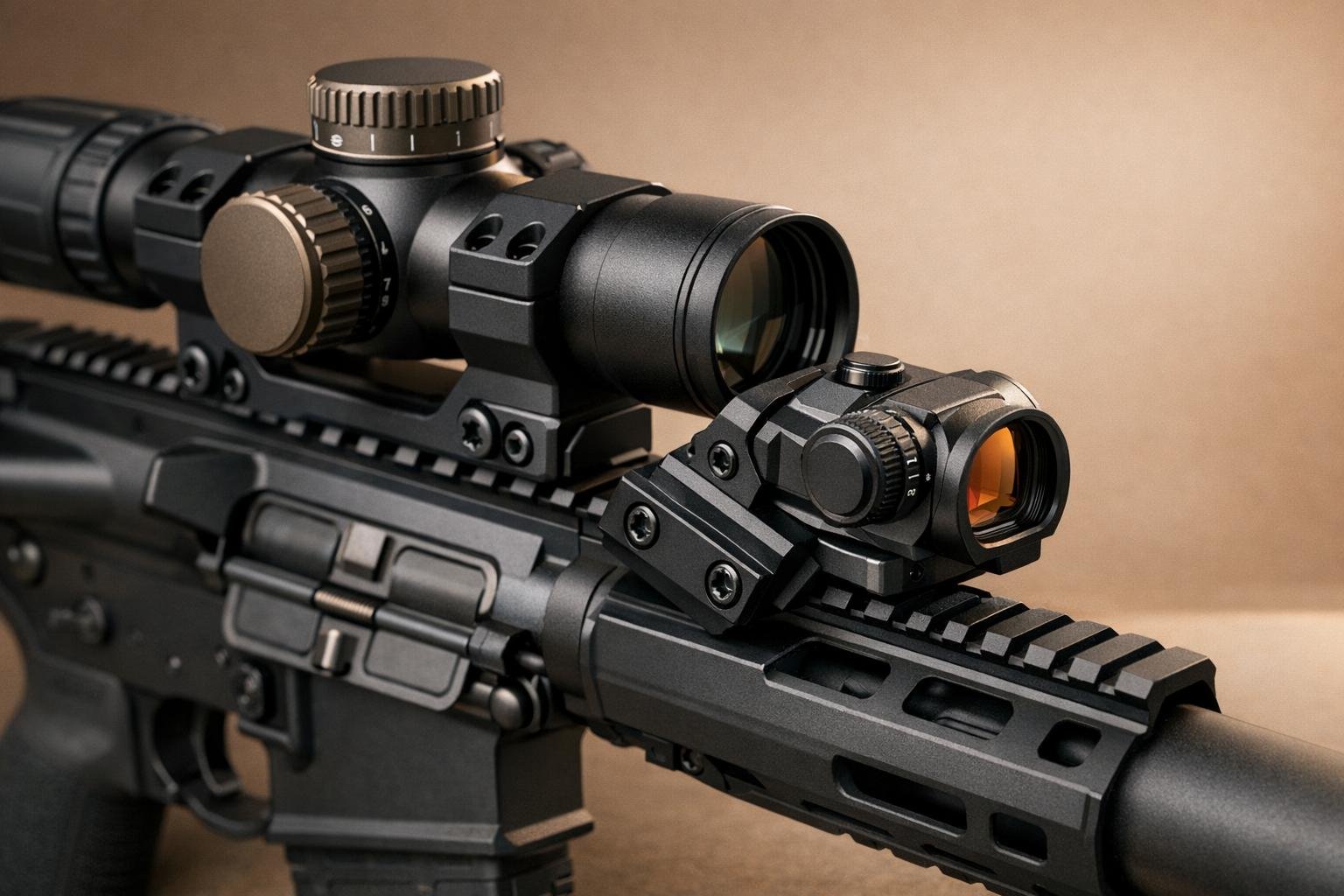
Offset scope mounts allow you to attach a secondary red dot sight at a 35°–45° angle alongside your primary optic. This setup is popular among tactical shooters, hunters, and competitors for its ability to improve speed, comfort, and performance in various shooting scenarios.
Here’s a quick breakdown of the key advantages:
- Faster Close-Range Targeting: Switch to a red dot instantly by tilting the rifle, maintaining stability and natural posture.
- Dual Range Capability: Engage targets at both long and short distances without adjusting magnification.
- Improved Ergonomics: Maintain a stable cheek weld and reduce strain on your neck during extended use.
- Reliable Optical Performance: High-quality mounts hold zero under recoil and work well with lightweight reflex sights.
- Practical for Competition and Self-Defense: Quick transitions save time in high-pressure situations, and the red dot serves as a reliable backup.
Offset mounts are ideal for shooters looking to enhance speed and precision across varied distances. While they add some weight and require practice to master, their benefits outweigh these minor challenges for most users.
Why You Should Run an Offset Red Dot ft. Jerry Miculek | Vortex Selects

sbb-itb-31b92c7
1. Faster Target Acquisition at Close Range
In close-range situations, speed can make all the difference. Offset mounts allow you to transition to a red dot sight without adjusting your scope or moving your support hand. By simply rolling your rifle inward at a 35–45° angle, the offset red dot aligns with your line of sight almost instantly. This smooth, natural motion minimizes delays, ensuring you’re ready to engage close-range targets without hesitation.
One of the key advantages of offset mounts is that they maintain a stable cheek weld throughout the transition. Unlike piggyback mounts, which require an awkward chin weld, offset mounts let you keep a natural shooting posture. As Infitac USA explains:
"The offset mount is generally faster. Switching to the red dot requires a simple and natural roll of the rifle, a motion that becomes fluid with practice."
The transition relies on rotating your arms and torso, not isolated head movements, which makes it faster and easier for experienced shooters. In fact, Primary Arms highlights how seamless this can be:
"Transitioning between optics takes only milliseconds for an experienced marksman. No manual dexterity required."
Another benefit of offset mounts is their position closer to the bore, which provides more predictable holdovers at close range. L.P. Brezny, a ballistics expert at Riflegearlab, explains:
"When the need comes to hit those close-up targets, all you’ll need to do is tilt your AR15, acquire the targets through the offset red dot, and fire away."
These ergonomic improvements make target acquisition faster and more reliable when it matters most.
To fully take advantage of this speed, practice the rolling motion until it becomes second nature. Zero your offset red dot at 10–25 yards for optimal performance in close-range scenarios. Additionally, lightweight micro reflex sights work best for offset mounts, as they maintain your rifle’s balance and reduce fatigue during extended use.
2. Multiple Engagement Distances
Offset mounts provide two magnification options, making it easier to handle targets at varying distances without needing to adjust your scope manually. Instead of fiddling with a magnification ring while trying to stay on target, you can simply tilt your firearm 35 to 45 degrees to bring the offset red dot into view. This allows you to keep both hands firmly on the weapon, ensuring full control during quick transitions. This setup makes it possible to engage effectively at both long and short ranges.
This approach is particularly helpful when dealing with targets at mixed distances. Your primary scope can stay optimized for long-range precision, while the offset red dot takes care of close-range targets instantly. As Primary Arms notes:
"With practice, anyone can transition from scope to offset and back in fractions of a second. No other optic setup will give you a faster engagement speed when shifting magnification power."
Each optic serves a specific purpose: a 2.5–10× scope for long-range accuracy and an offset red dot for immediate 1× targeting.
For hunters navigating varied terrain, this adaptability is a game-changer. For instance, you might spot a target far away in an open field, only to have another appear suddenly at close range in dense cover – just 30 to 40 feet away.
To maximize this setup, zero your primary scope at 100 yards and your offset red dot at 25 to 50 yards. Keep the primary optic at higher magnification for distant targets, while relying on the offset dot for nearby engagements. If your scope has large windage turrets, a 45° mount is a better choice than a 30° mount to avoid blocking the red dot’s sight picture.
3. Better Ergonomics and Shooting Comfort
Offset mounts are designed to maintain your natural head alignment during shooting sessions, offering a more comfortable and efficient experience. Unlike top-mounted optics that force you to lift your head, offset mounts allow you to keep a consistent cheek weld on the stock. This stable contact point not only reduces strain but also improves shooting accuracy, as highlighted in the comparison below.
The transition to an offset optic involves a smooth, natural rotation of your torso and arms, rather than straining your neck. As Infitacusa puts it:
"The movement is rotational, involving the arms and torso rather than an independent motion of the head".
This rotational movement minimizes repetitive neck strain, making long shooting sessions less fatiguing. Plus, maintaining a stable cheek weld throughout ensures better precision.
Another advantage of offset systems is their ability to promote a heads-up posture, which helps keep your spine in a neutral position. Milspec Retail emphasizes this point:
"A heads-up posture also helps users maintain a neutral spine position. This makes for much more comfort while wearing helmets, plate carriers, and other heavy gear".
This feature is particularly beneficial for hunters carrying heavy packs or tactical shooters wearing protective gear. Together, these ergonomic benefits reduce overall fatigue and enhance performance, complementing the faster target acquisition and adaptability already discussed.
Offset Mounts vs. Piggyback Mounts: Ergonomic Comparison
| Feature | Offset Mount | Piggyback Mount |
|---|---|---|
| Head Position | Consistent cheek weld | Elevated "chin weld" |
| Transition Motion | Rotational (arms/torso) | Vertical (neck/head) |
| Spine Alignment | Neutral/Heads-up | Variable/Lifted |
| Stability | High (stable contact point) | Lower (less stock contact) |
Offset mounts also cater to shooters using bifocal or progressive lenses. By keeping your eye in the same focal zone when switching between the primary scope and red dot, they eliminate the disorienting shift that can occur with other mounting systems. If you need to fine-tune the angle for better compatibility with your shooting style, adjustable mounts – typically set at 35° or 45° – are a great option.
4. Maintained Optical Performance
Offset mounts aren’t just about comfort or ease of use – they’re also built to deliver reliable optical performance, which is crucial for consistent accuracy.
One major concern when adding a secondary optic is whether it can hold zero under recoil. High-quality mounts address this by being machined from a single piece of aircraft-grade aluminum, such as 6061-T6 or 7075-T6. This one-piece design provides far greater rigidity compared to multi-piece alternatives, ensuring stability under stress.
Top-tier offset mounts are crafted with machining tolerances as tight as 3 microns. When installed to the proper specifications – 20–30 in-lbs for rings and 65 in-lbs for cross bolts – they maintain zero even during heavy use. This level of precision makes them reliable in both competitive and tactical shooting, where performance cannot falter.
Another advantage of offset mounts is the ability to independently zero each optic. Your primary scope can stay dialed in for long-range shots, while the offset red dot can be zeroed for closer distances, typically 25–50 yards. Because each optic attaches directly to the receiver, adjusting one won’t impact the other. However, it’s worth noting that zeroing an offset sight involves windage and elevation adjustments on a canted axis, meaning the "up" and "down" directions won’t align the same way as they do with a standard mount.
The offset angle – either 35° or 45° – is designed to avoid interference with larger turrets, ensuring a clear view. As Arisaka Defense explains:
"The Arisaka Offset Optic Mount… allows the user to select a 35 or 45 degree offset position… the 35-degree position brings the red dot sight up closer to slimmer, smaller scopes, while the 45-degree position provides additional clearance around wider turrets".
For added reliability, competition shooters recommend marking your mounting screws with a paint pen after torquing them to spec. This simple step makes it easy to spot any loosening over time. Offset mounts typically cost between $100 and $400, with complete setups averaging around $250. Investing in a well-engineered mount ensures dependable performance, even in high-pressure situations.
These design details and precision engineering make offset mounts a reliable choice for diverse shooting needs.
5. Practical Use in Competition and Self-Defense
Offset mounts shine in fast-paced competitions like 3-Gun and IPSC, where targets can range from close quarters to distances of 200 yards. Adjusting a variable optic manually in these scenarios wastes precious seconds. With an offset mount, you can instantly switch between optics under pressure, giving you a decisive edge. As IPSC shooter Richard van der Wel explains:
"Speed, accuracy, and reliability are the three pillars of a successful IPSC performance".
In self-defense situations, the benefits are just as clear. If your primary scope becomes damaged, obstructed, or fails entirely, the offset red dot acts as a reliable backup. By simply tilting the rifle, you can stay engaged without skipping a beat. This quick adaptability underscores the system’s practical value.
Offset mounts also enhance tactical positioning. By canting the rifle, you can engage targets while keeping more of your body protected behind cover compared to using a standard top-mounted sight. This configuration allows for a stable cheek weld, enabling accurate and rapid fire. For close-quarters encounters, zeroing your offset red dot at 25 yards helps address height-over-bore issues, ensuring your point of aim matches your point of impact.
Another advantage is weight reduction. A micro reflex sight weighs just 2.5 oz, significantly lighter than a full-sized hooded red dot at 10.3 oz. Combined with the ability to transition quickly between optics, this lighter setup improves overall maneuverability. Complete offset setups typically cost between $250 and $1,000, depending on your choice of optics.
Comparison Table
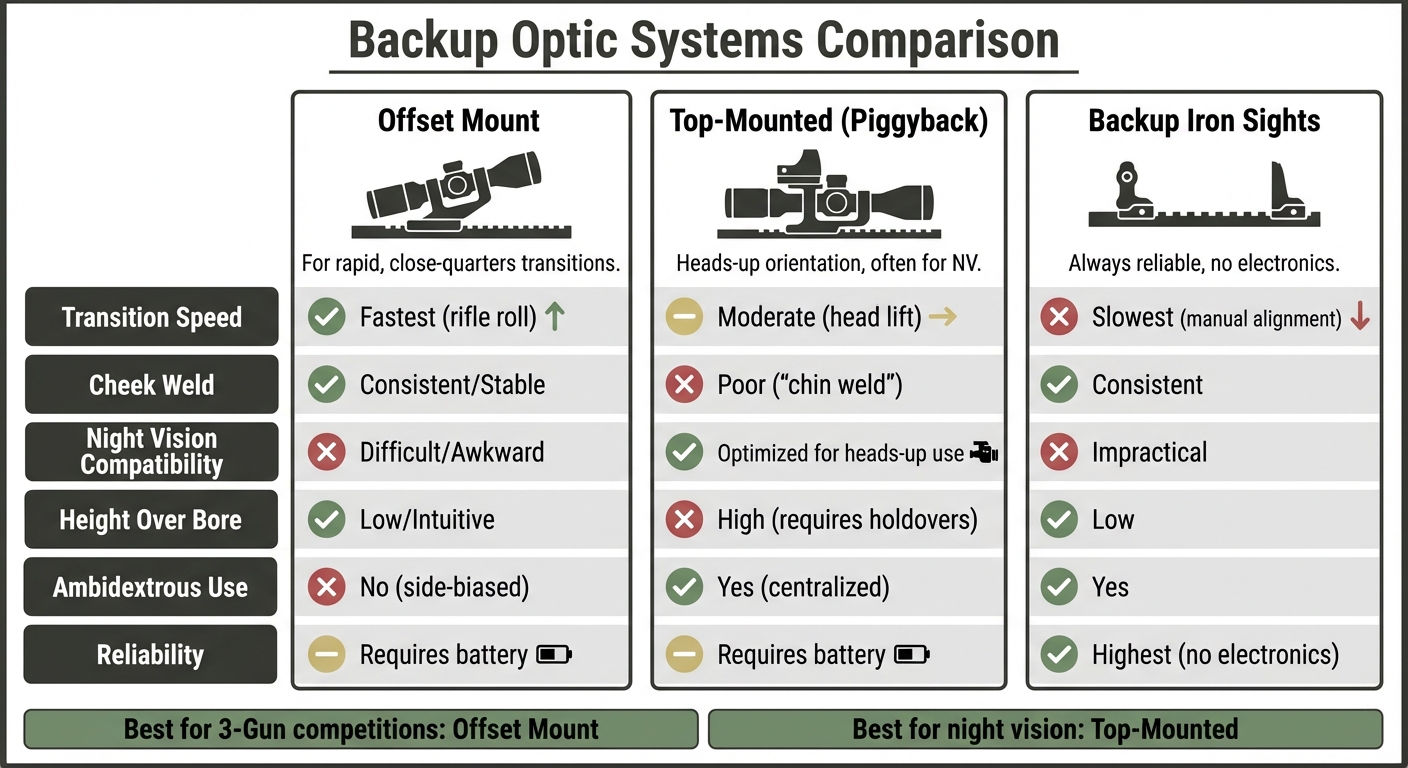
Offset vs Top-Mounted vs Backup Iron Sights Comparison Chart
Choosing the right backup system comes down to your specific tactical needs. Here, we break down the differences between offset mounts, top-mounted optics, and backup iron sights based on their performance traits.
Top-mounted (or "piggyback") optics require you to lift your head into a "heads-up" position. While this is slower for target acquisition, it works well with night vision equipment. On the other hand, backup iron sights are the most reliable option since they don’t rely on batteries, but they tend to be the slowest for quick target engagement.
Height-over-bore is another key factor. Offset mounts sit lower, making close-range holdovers more natural and predictable. In contrast, top-mounted optics have a higher height-over-bore, which demands significant practice to adjust for close-range aiming. These factors highlight why offset mounts are often favored for their versatility and speed, especially in dynamic shooting scenarios. Below is a table summarizing the key differences:
| Feature | Offset Mount | Top-Mounted (Piggyback) | Backup Iron Sights |
|---|---|---|---|
| Transition Speed | Fastest (rifle roll) | Moderate (head lift) | Slowest (manual alignment) |
| Cheek Weld | Consistent/Stable | Poor ("chin weld") | Consistent |
| Night Vision | Difficult/Awkward | Optimized for heads-up use | Impractical |
| Height Over Bore | Low/Intuitive | High (requires holdovers) | Low |
| Ambidextrous | No (side-biased) | Yes (centralized) | Yes |
| Reliability | Requires battery | Requires battery | Highest (no electronics) |
For events like 3-Gun competitions, where speed is everything, offset mounts are the clear winner. However, if you rely on night vision goggles or need clearance for gas masks, top-mounted optics are the better choice due to their design.
Conclusion
Offset scope mounts offer a practical solution for shooters needing rapid target acquisition and versatility. They allow seamless transitions between a magnified primary optic and a close-range red dot, giving you the advantages of both setups. Plus, their design supports consistent cheek weld and ergonomic stability, making them a strong choice for competitive and tactical shooting situations.
That said, they’re not without drawbacks. Offset mounts add extra weight to your setup, increase the horizontal profile – which can snag on brush or tight spaces – and demand careful zeroing to manage point-of-impact shifts at different ranges.
To get the most out of an offset mount, training is key. Building muscle memory ensures you can fully capitalize on the speed these mounts are designed to provide. Additionally, investing in high-quality materials, like aircraft-grade aluminum or hardened steel, ensures durability and performance. As Primary Arms puts it:
"The most obvious benefit is speed"
But that speed only comes to life with practice and preparation.
FAQs
Do offset mounts work for left-handed shooters?
Yes, offset mounts work well for left-handed shooters. Many are built to cater to various eye dominance and shooting styles, making them adaptable for both right- and left-handed users. Just make sure to select a mount that suits your individual preferences to achieve the best results.
Will an offset red dot snag on gear or brush?
Offset red dots, positioned beside the primary optic, can sometimes catch on gear or brush, making them more susceptible to snagging. That said, with thoughtful mounting and careful placement, you can minimize this issue and enjoy smoother, hassle-free handling during field use.
What red dot size is best for an offset mount?
A red dot with a size of 3 MOA works well for offset mounts. It offers a clear aiming point that strikes a good balance between accuracy and fast target acquisition. This size is neither too large nor too distracting, making it suitable for different shooting situations.