
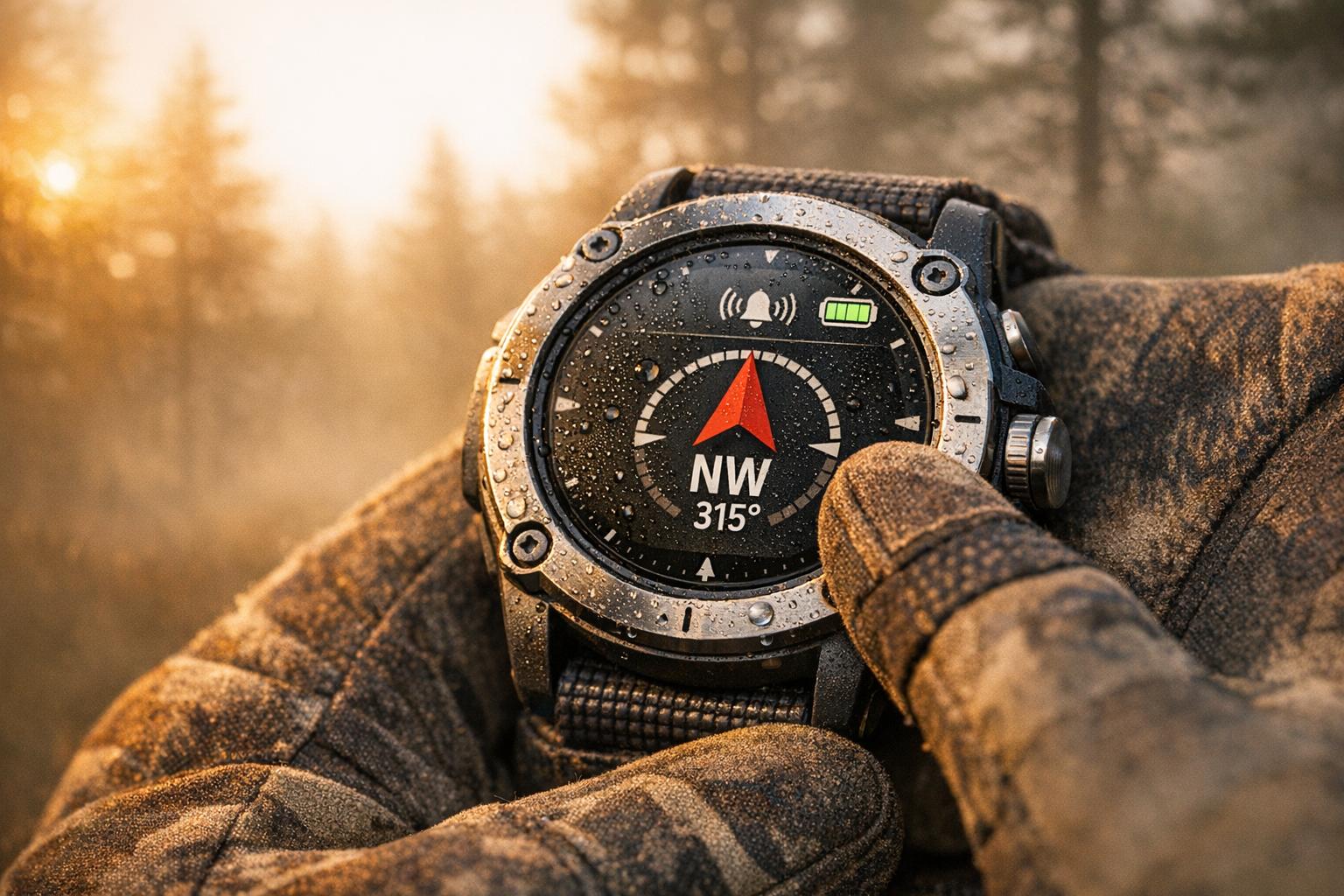
When selecting a hunting watch, focus on these key factors to make the best choice for your needs:
- Durability: Look for water resistance (100m minimum), shock resistance (MIL-STD-810 compliance), and tough materials like titanium or sapphire crystal.
- Battery Life: Choose between solar-powered models for extended trips or quartz watches for longer-lasting, simpler power options.
- Alarms: Silent vibration alerts are ideal for stealth. Multiple alarms and storm warnings can help you stay organized and safe.
- Navigation Tools: GPS, compass, and ABC sensors (altimeter, barometer, compass) are useful for tracking location and weather changes.
- Comfort & Build: Lightweight designs (under 3.5 oz) and durable straps (silicone, resin, or nylon) ensure all-day wearability.
Investing in the right features ensures your watch is reliable in challenging conditions, helping you stay prepared and focused in the field.
Casio‘s Vibration Alarm Watches – W735H, W736H, TRT110H, and GD350

Durability and Build Quality
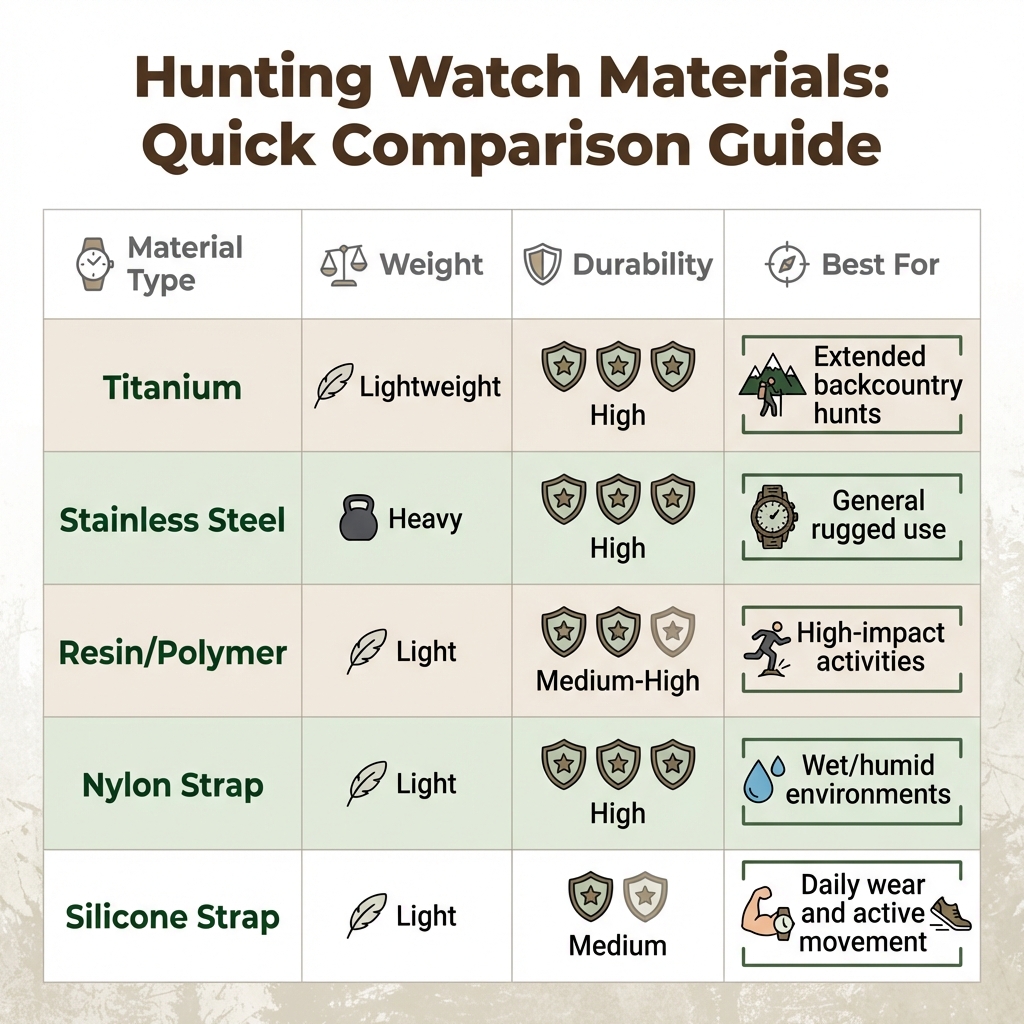
Hunting Watch Materials Comparison: Weight, Durability and Best Use Cases
When you’re out in the wild, your hunting watch needs to handle tough conditions without breaking a sweat. The right durability features can mean the difference between a dependable tool and one that lets you down when you need it most.
Water Resistance
A good hunting watch should have a minimum water resistance rating of 100 meters (330 feet). This ensures it can handle river crossings, heavy downpours, and even brief submersion without compromising its internal components. Watches with lower ratings, like 30 to 50 meters, may survive light rain but aren’t reliable for snorkeling, deep wading, or extended exposure to water. If you’re planning to tackle extreme environments – like wetlands or muddy trails – opt for models with 200-meter (660 feet) resistance, often designed with mud-resistant seals for extra protection.
For budget-conscious buyers, the Timex Expedition Scout offers 160 feet (approximately 50 meters) of water resistance for just $32. On the other hand, premium options like the Garmin Instinct 2 ($349) deliver 100-meter resistance and advanced features. Pair water resistance with rubber, silicone, or water-resistant nylon straps to ensure your watch stays functional in wet conditions. But water isn’t the only challenge – your watch also needs to withstand hard impacts.
Shock Resistance
A hunting watch will take its fair share of abuse, from firearm recoil to accidental drops. Look for MIL-STD-810 compliance, which certifies that the watch meets military-grade standards for shock, thermal, and water resistance in extreme conditions. Watches with this certification use internal bumpers and shock-absorbing systems to protect their delicate components. Additional features like button guards help prevent accidental damage to pushers during high-impact activities.
Nate Granzow, Editor-in-Chief of The Ultimate Predator, highlights the importance of lens durability:
"Sapphire crystal… resists shattering and scratches better than any other material on the market".
This is crucial when you’re navigating dense brush or climbing into a tree stand. Premium models like the Garmin fēnix 7 Sapphire Solar Edition ($800) and the G-SHOCK Master of G Mudmaster ($800) combine sapphire crystal lenses with rugged, shock-resistant builds for maximum toughness. Beyond shock resistance, the materials and strap options you choose also play a big role in your watch’s overall durability.
Materials and Strap Options
The case material of your watch can make or break its performance in harsh conditions. Titanium and stainless steel are excellent choices, offering strength and durability. Titanium, in particular, stands out for being just as strong as steel but much lighter, minimizing wrist fatigue during long treks. For even lighter options, reinforced fiber polymers and carbon-compound cases, commonly found in G-Shock models, provide excellent impact absorption without adding bulk.
Choosing the right materials ensures your watch can handle the challenges of hunting. Here’s a quick comparison of popular materials and their strengths:
| Material Type | Weight | Durability | Best For |
|---|---|---|---|
| Titanium | Lightweight | High | Extended backcountry hunts |
| Stainless Steel | Heavy | High | General rugged use |
| Resin/Polymer | Light | Medium-High | High-impact activities |
| Nylon Strap | Light | High | Wet/humid environments |
| Silicone Strap | Light | Medium | Daily wear and active movement |
Battery Life and Power Source
When you’re out in the field, having reliable power for your watch is just as important as its ruggedness. Whether you’re on a week-long hunt or a quick trip, the right power system can make all the difference. Your choice will largely depend on how long you’ll be out and the features you need most.
Solar Power vs. Quartz Watches
Solar-powered watches are a great option for longer hunts. Take the Garmin Instinct 3 Solar (50 mm), for example – it can run indefinitely in smartwatch mode with just 3 hours of sunlight at 50,000 lux per day. Even in GPS-only mode, it offers between 40 to 130 hours of battery life with enough exposure. Another standout is the Garmin Enduro 3, which costs around $900 and can last up to 36 days in smartwatch mode, extending to 90 days with sufficient sunlight.
On the other hand, traditional quartz watches offer simplicity and long-lasting power without the need for sunlight. These models typically run for one to four years on a single battery. For instance, the Suunto Core, priced at about $200, can operate for roughly a year on a user-replaceable battery, although it lacks GPS or smart features. If you’re hunting closer to home and don’t need advanced features, options like the Timex Expedition Scout 40 (around $32) are reliable and don’t require sunlight for power. Military-grade quartz watches, such as the CWC G10, have also proven dependable, with over 200,000 units produced for military use.
For those who need advanced features, rechargeable USB-powered watches are another option. These models, like the Garmin Instinct 2 Solar, can be fully charged in about 1.5 hours. If you’re heading out for a multi-day hunt, a 10,000 mAh portable power bank can recharge a high-end GPS watch like the Enduro 3 up to 10 times in the field.
Low-Battery Warnings and Power-Saving Features
A clear battery indicator is essential to avoid unexpected shutdowns. Many hunting watches now come with visual battery status displays and power-saving modes that deactivate non-essential functions to extend battery life. For example, Garmin Instinct models include features that save tracking data before the battery is completely drained.
However, extreme conditions like cold weather (below 20°F) can reduce battery performance, even in rugged watches like the G-Shock. Some watches also offer "Power Save" modes, which turn off the display overnight to conserve energy – a handy feature for winter hunts.
Alarms and Battery Management
Most modern hunting watches, such as the Garmin Instinct and Suunto Traverse, use a single lithium-polymer battery to power all functions, including alarms. This means high-drain features like vibration alerts can significantly impact battery life. For example, the Garmin Instinct 3 Solar’s battery life in smartwatch mode ranges from 40 to 130 hours when GPS is active.
If alarms are a must-have, solar-powered models can help offset battery drain. The Casio Pro Trek PRG-270-1 (around $129) is a solid choice, offering unlimited battery life with adequate light exposure. To conserve power, use vibration alerts sparingly and switch to silent or visual alerts when the battery is low.
Alarm Features and Customization
Multiple Alarm Functions
Hunting watches come equipped with multiple alarms to help you stay on top of your schedule and adapt to changing conditions. For instance, models like the G-Shock GD-120CM and Casio SGW 1000 offer up to five daily alarms, making it easy to manage early starts, meetups, or track weather updates. If you’re looking for a more budget-friendly option, the Timex Expedition Digital provides three daily alarms and is priced at around $57.
In addition to standard alarms, some watches include specialized features tailored for hunters. The Suunto Core stands out with its storm alarm, which monitors barometric pressure and warns you of severe weather. It also provides sunrise and sunset alerts for over 400 locations, helping you plan legal shooting times and ensuring you return to camp safely before dark. High-end models like the Suunto Traverse Alpha take it a step further with shot detection technology, which automatically records the GPS location and time of fired shots. These customizable alarms not only help you stay on schedule but also improve your efficiency in the field.
Silent Alert Options
Stealth is just as important as staying organized. Audible alarms can easily give away your position, which can be a critical mistake during a hunt. As an expert from WristwatchPro put it:
"Accidental alarms can alert your prey instantly." – WristwatchPro
To avoid this, many tactical watches include vibration alerts, which keep you informed without making a sound. Models like the Garmin Instinct and Suunto Traverse Alpha offer vibration notifications for silent operation. For hunters using night vision gear, the Garmin Tactix Bravo features a backlight designed to work seamlessly with night vision goggles. Similarly, the Suunto Traverse Alpha includes a red LED backlight that preserves your visibility while keeping your position concealed. Before heading out, it’s always a good idea to test your alarm settings to ensure they’re configured for silent operation.
Adjustable Volume and Duration
Customization is key when it comes to alarms, and some watches go above and beyond in this department. For example, Garmin Fenix models allow you to fine-tune vibration patterns and notifications using dedicated apps. On the other hand, digital watches often have fixed alarm settings but still offer practical features. If you need an audible alarm, look for models that let you switch between silent and audible modes depending on the situation.
The Casio SGW 1000 includes a snooze function, perfect for early mornings. Additionally, most hunting watches come with countdown timers, which are great for tracking time spent at a stand or managing intervals between calls. These features ensure your watch adapts to the demands of different hunting scenarios, keeping you prepared and focused on your goals in the field.
sbb-itb-31b92c7
Timekeeping Accuracy and Display Features
Precise timekeeping and clear displays are essential for staying on schedule and maintaining control during a hunt.
Atomic or GPS Synchronization
Accurate timekeeping plays a key role in adhering to legal shooting times and coordinating with your team. GPS-enabled watches like the Garmin Fenix 7 and Suunto Traverse Alpha use satellite systems such as GPS, GLONASS, and GALILEO to offer pinpoint accuracy for both positioning and timekeeping. The Fenix 7 Sapphire Solar steps it up with multi-band GPS technology, providing quicker and more precise navigation.
For those seeking maintenance-free precision and better battery efficiency, watches with atomic synchronization are a solid choice. Many Casio Pro Trek and G-Shock models feature "Multiband 6" technology, which syncs with atomic time radio signals worldwide. As watch researcher Carl Pender explains:
"The Pro Trek piece is dead-accurate due to Multiband 6 technology that ensures atomic time basically everywhere you’re located".
In areas with radio signal coverage, these watches deliver reliable accuracy without the need for manual adjustments. Even standard quartz watches, like the Casio Pro Trek PRG-270, maintain a respectable accuracy of about 15 seconds per month. This level of precision ensures the display information remains both clear and dependable.
Display Readability
A watch’s display must remain easy to read, no matter the lighting conditions. For low-light environments, features like LED backlighting, luminous dials, or high-contrast OLED screens are invaluable. For instance, the Casio Pro Trek PRW-3510Y uses a Super-Twisted Nematic (STN) display, which not only conserves power but also enhances readability in extreme lighting compared to standard LCDs. Analog watches with luminous hands are another excellent option for conserving battery life during extended hunts.
Bright sunlight can also make it difficult to read a display. To counter this, premium models often include anti-glare coatings or durable sapphire crystals to minimize reflections. If you’re using night vision gear, the Garmin Tactix Bravo is equipped with a backlight compatible with night vision goggles, ensuring it doesn’t interfere with their functionality. For stealth-focused hunting, the Suunto Alpha’s red LED backlight preserves your natural night vision while remaining less visible to game. Meanwhile, Luminox watches use tritium illumination, providing a constant glow for up to 25 years without needing a light source or battery charge.
Hunting-Specific Displays
Modern hunting watches often go beyond basic timekeeping by offering features tailored to outdoor adventures. Many include ABC sensors (Altimeter, Barometer, Compass) to monitor elevation, weather, and direction. GPS-enabled models like the Garmin Instinct 2 and Garmin Tactix Delta take this further by adding advanced mapping and path-tracking capabilities, making it easier to navigate back to your starting point. The Garmin Tactix Delta Solar Edition even incorporates a ballistics calculator for precise long-range shooting, though this premium feature comes with a hefty price tag of around $1,300.
Some watches also track moon phases, which can be particularly helpful for hunters targeting game that moves based on lunar cycles. As mountain hunter and TV host Remi Warren shares:
"I quickly realized the benefit. I could record my days, track my path, look at a map, check my ballistics, and have an alarm clock with plenty of battery to spare".
When deciding between GPS and non-GPS ABC watches, keep in mind that GPS models offer active path recording and satellite mapping, while standard ABC watches focus on providing real-time environmental data without draining the battery as quickly.
Ease of Use and Additional Features
A hunting watch needs to perform reliably in cold, wet, or gloved conditions, all while staying lightweight enough for those long days in the field.
User-Friendly Button Layout
When it comes to outdoor functionality, physical buttons are a clear winner over touchscreens. Why? Touchscreens can fail when wet and are nearly impossible to use with gloves on. Take the Coros Pace 2, for instance – it features a straightforward two-button design that reviewers praise for being easy to operate, even when your dexterity is limited. Similarly, the Casio Pro Trek offers a three-button side arrangement, making it simple to access sensors and alarms, even with thick hunting gloves on.
This kind of intuitive design gives you quick access to essential features when you need them most.
Hunting-Specific Tools
A good hunting watch goes beyond just telling time. Look for tools like ABC sensors (altimeter, barometer, and compass) to help with navigation and weather tracking on the go. Some models take it a step further: the Suunto Traverse Alpha includes shot detection, which records the time and location of your shot based on recoil. Meanwhile, the Suunto Core offers preset sunrise and sunset times for over 400 locations, helping you stick to legal shooting hours and stay safe after dark. Features like storm alarms, which activate when the barometric pressure drops rapidly, can also give you a heads-up about incoming bad weather.
These hunting-specific tools are designed to keep you prepared and informed in the field.
Lightweight and Comfortable Design
Weight matters – especially when you’re wearing a watch all day. Aim for something under 3.5 ounces (100 g) to avoid wrist fatigue. Many top-rated hunting watches fall well below this mark. For example, the Garmin Instinct 2 weighs just 1.83 ounces, the Suunto Core comes in at 2.26 ounces, and the ultra-light Coros Pace 2 is a mere 1.02 ounces. On the other hand, watches over 5 ounces can feel cumbersome during extended trips.
Strap material is just as important. Silicone, resin, or nylon straps are durable, easy to clean, and comfortable in harsh conditions. For the case, fiber-reinforced polymer or carbon-compound materials provide military-grade toughness without the added heft of steel.
With lightweight construction and durable materials, these watches are built for long-term comfort and rugged use.
Conclusion
When selecting a hunting watch, focus on what you truly need in the field. A sturdy, weather-resistant design is non-negotiable – after all, even the most advanced features are useless if your watch can’t withstand harsh conditions.
Another key factor is the power source. For extended hunts, battery life is crucial. Solar-powered models can last up to 70 days with solar-assisted charging, while traditional quartz watches can provide years of dependable use.
Alarm functionality is also worth considering. Choose alarms that suit your hunting style. Features like multiple alarm settings can help you stay organized, and silent or vibrating alerts are perfect for maintaining stealth when noise could scare off game. As Max DesMarais, Founder of MyOutdoorBasecamp, advises:
"The ideal hiking watch should be relatively intuitive to use, and shouldn’t require more than a few practice sessions to learn inside and out".
This advice applies just as well to hunting watches, where ease of use is critical. A confusing interface can waste precious time when you need quick access to features.
Finally, prioritize practical design elements like glove-friendly buttons, high-contrast displays, and a lightweight build (under 3.5 ounces). ABC sensors – altimeter, barometer, and compass – are invaluable for navigation and tracking weather changes, especially when you want to conserve battery life by avoiding GPS usage.
FAQs
What makes a solar-powered hunting watch a better choice than a quartz one?
A solar-powered hunting watch is a smart pick for anyone heading into the wild. Why? It charges itself using sunlight or even artificial light, so you won’t have to stress about replacing batteries mid-adventure. This makes it a reliable companion for extended trips where access to spare batteries might be limited.
On the other hand, quartz watches rely on replaceable batteries that usually last only 2–3 years. If the battery dies while you’re out on a hunt, it can be a frustrating inconvenience.
Another big plus for solar-powered watches is their long-term practicality. They’re easier on the environment and your wallet since they cut down on disposable battery use. With their durability and low-maintenance design, they’re an excellent choice for outdoor enthusiasts who need gear they can trust.
What makes MIL-STD-810 compliance important for a hunting watch’s durability?
MIL-STD-810 certification guarantees that a hunting watch is tough enough to withstand harsh outdoor conditions. This military-grade testing evaluates the watch’s resilience to challenges like shock, vibration, extreme temperatures, humidity, and altitude changes.
For hunters, this translates to peace of mind knowing your watch is built to perform in rugged environments. Whether you’re navigating rough trails, braving unpredictable weather, or dealing with unexpected impacts, this durability ensures your gear won’t let you down when it matters most.
Why are vibration alerts important for hunting watches?
Hunters rely on vibration alerts in their watches to stay informed without drawing attention. These silent notifications ensure that crucial updates, like alarms or timers, are received without startling nearby game or breaking focus. Unlike traditional audible alarms, vibrations keep you discreet and undetected, which is essential for maintaining your position and increasing your chances of a successful hunt.