
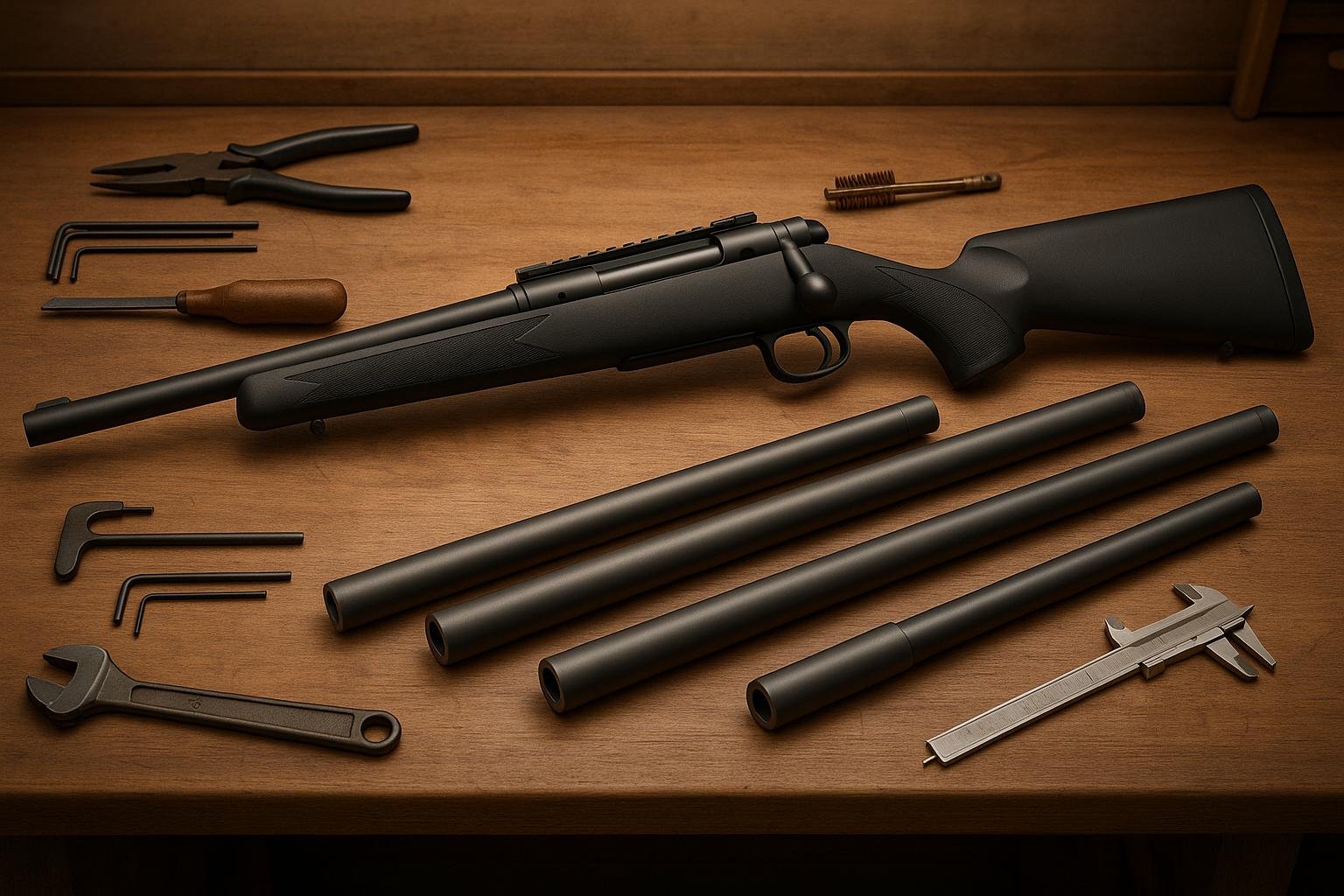
When selecting a rifle, barrel length directly impacts performance in three key areas: muzzle velocity, accuracy, and effective range. Here’s what you need to know:
- Barrel Length Basics: Measured from the bolt face to the muzzle crown, typical hunting rifles range from 16 to 26 inches. Short barrels (16–20 inches) are compact and maneuverable, while longer barrels (24–26 inches) maximize velocity and range.
- Velocity Impact: Longer barrels allow gases to push the bullet further, increasing velocity. Gains vary by cartridge – e.g., a 5.56 NATO sees up to 80 fps per inch, while a 6.5 Creedmoor gains about 25 fps per inch.
- Accuracy and Range: Higher velocity from longer barrels results in flatter trajectories, reduced bullet drop, and more consistent long-range accuracy. However, shorter barrels are easier to handle in tight spaces.
- Practical Use: Short barrels excel in close-quarters or dense terrain, while longer barrels suit open fields and long-distance shots. Magnum cartridges benefit most from longer barrels due to their slower-burning powders.
Key Takeaway: Match barrel length to your needs – shorter for portability, longer for velocity and range. Combine this with the right cartridge, optics, and shooting conditions for optimal results.
How Barrel Length Affects Velocity: 223/5.56, 308, & 9.3×62 Velocity Test
How Barrel Length Affects Velocity
When it comes to firearms, barrel length plays a major role in determining muzzle velocity. The longer the barrel, the more time expanding gases have to accelerate the bullet, which generally results in higher velocities. This section breaks down how barrel length influences velocity and highlights key examples.
Velocity Changes with Barrel Length
On average, every additional inch of barrel length can increase muzzle velocity by 25 to 50 fps, though this depends heavily on the cartridge and its powder type. Cartridges with fast-burning powders show smaller gains, while those using slow-burning powders, especially in magnum cartridges, see more noticeable improvements with longer barrels.
Take the 5.56 NATO cartridge as an example. A 55-grain bullet fired from a 14.5-inch barrel typically achieves about 2,750 fps. However, in a 20-inch barrel, the same bullet reaches approximately 3,200 fps – an increase of 80 fps per inch. This is higher than the average due to the powder’s burn characteristics.
The 6.5 Creedmoor offers a different story. A 140-grain bullet fired from an 18-inch barrel travels at around 2,550 fps. Extend the barrel to 24 inches, and the velocity increases to 2,700 fps. That’s a steady 25 fps per inch, reflecting the efficient burn rate of the powder used in this cartridge.
Magnum cartridges, like the .300 Winchester Magnum, benefit the most from longer barrels. With their large powder charges, they require more time and space for complete combustion. Velocity gains can range from 40 to 60 fps per inch when transitioning from shorter to longer barrels, especially in the 20- to 26-inch range.
Understanding Diminishing Returns
While longer barrels generally mean higher velocities, the gains aren’t infinite. Every cartridge has an optimal barrel length, where velocity increases start to taper off. In some cases, adding extra length can even reduce velocity due to friction.
This happens because powder burn rates dictate the ideal barrel length. Cartridges with fast-burning powders, such as pistol rounds or some rifle cartridges, burn all their powder quickly. Once the powder is fully burned, the gases cool and lose pressure, and barrel friction begins to slow the bullet.
For most hunting cartridges, the sweet spot lies between 20 and 24 inches. Beyond 26 inches, velocity gains typically drop to just 10–15 fps per inch. Some cartridges, particularly those with fast-burning powders, may even lose velocity in barrels longer than 28–30 inches.
Take the .223 Remington as an example. While velocity continues to increase up to 24 inches, the rate of gain slows significantly after 20 inches. A 26-inch barrel might only add 50–75 fps compared to a 24-inch barrel, making the extra length less practical for most uses.
On the other hand, cartridges with slow-burning powders, such as the .300 Winchester Magnum or 7mm Remington Magnum, can effectively utilize barrels as long as 26–28 inches. Their powder charges continue burning further down the barrel, maintaining consistent velocity gains.
Velocity Comparison Table
The table below compares typical velocity ranges for popular hunting cartridges across various barrel lengths, using standard factory ammunition:
| Cartridge | 16" Barrel | 20" Barrel | 24" Barrel | 26" Barrel |
|---|---|---|---|---|
| .223 Remington (55gr) | 2,850 fps | 3,100 fps | 3,200 fps | 3,220 fps |
| .308 Winchester (150gr) | 2,650 fps | 2,800 fps | 2,900 fps | 2,920 fps |
| 6.5 Creedmoor (140gr) | 2,450 fps | 2,600 fps | 2,700 fps | 2,730 fps |
| .30-06 Springfield (165gr) | 2,550 fps | 2,700 fps | 2,800 fps | 2,820 fps |
| .300 Win Mag (180gr) | 2,750 fps | 2,950 fps | 3,100 fps | 3,150 fps |
| 7mm Rem Mag (160gr) | 2,800 fps | 3,000 fps | 3,150 fps | 3,200 fps |
These figures represent typical performance with factory ammunition. Results can vary based on specific loads, powder types, and individual firearm characteristics.
Notice how the velocity gains diminish as barrel length increases, especially in cartridges like the .223 Remington and .308 Winchester. In contrast, magnum cartridges maintain more consistent gains across longer barrels, making them a better choice for hunters who prioritize long-range performance or need the extra power for large game.
Barrel Length and Accuracy
Barrel length plays a role in accuracy by influencing velocity, which in turn affects trajectory and practical shooting performance. While the barrel length doesn’t directly impact a rifle’s mechanical precision, it has a noticeable effect on how the bullet behaves in real-world conditions, especially at longer distances. Let’s break down how barrel length contributes to accuracy.
Trajectory and Bullet Drop
A longer barrel increases muzzle velocity, which results in a flatter trajectory and less bullet drop – key factors when shooting at extended ranges. For instance, with a cartridge like the .308 Winchester, rifles equipped with longer barrels typically experience reduced bullet drop compared to shorter-barreled counterparts. This can make a significant difference when aiming at vital zones on game or distant targets.
At greater distances, the benefits of a flatter trajectory become even more apparent. With higher velocity, the bullet spends less time in the air, making it less susceptible to crosswind effects. This helps ensure more consistent and predictable performance, even in challenging wind conditions. Additionally, a flatter trajectory reduces the margin of error for range estimation or holdover adjustments, which can be critical during long-range engagements.
Mechanical Accuracy vs. Practical Accuracy
Mechanical accuracy refers to the rifle’s precision under ideal, controlled conditions. From this perspective, barrels of varying lengths – if made with equal craftsmanship – can deliver similar results.
Practical accuracy, however, considers real-world factors like bullet drop, wind drift, and small velocity variations. Longer barrels, with their velocity advantages, improve practical accuracy by offering more consistent performance. The increased velocity and flatter trajectory help offset minor errors in range estimation, making long-distance shots more reliable.
For shooters using iron sights, the extended sight radius of a longer barrel can also aid in better alignment. However, this benefit is less relevant when optics are mounted, as they eliminate sight radius as a factor.
Another key advantage of longer barrels is their ability to provide greater shot-to-shot consistency. This consistency matters significantly in long-range shooting, where even slight variations in velocity can shift the point of impact.
Point of Impact at Extended Ranges
At long distances, the combination of flatter trajectory, higher velocity, and sustained energy from a longer barrel reduces the need for holdover adjustments. This not only simplifies aiming but also ensures that the bullet retains enough energy to be effective upon reaching the target. These factors collectively extend the rifle’s effective range, making longer barrels a preferred choice for precision shooting at distance.
sbb-itb-31b92c7
Barrel Length Effects on Range and Terminal Ballistics
Barrel length plays a crucial role in a rifle’s overall performance, influencing not just accuracy but also effective range and terminal energy. These factors are key in determining how well a rifle performs in various applications. By understanding how barrel length impacts these elements, shooters can make smarter decisions based on their specific needs.
Effective Range and Energy
A rifle’s effective range is the farthest distance it can deliver enough energy to achieve its purpose, whether for hunting or self-defense. Shorter barrels often result in lower muzzle velocities, which means the bullet loses energy more quickly as it travels. In contrast, longer barrels can help maintain terminal energy over greater distances, making them a better choice when long-range performance is critical. This energy retention can be the deciding factor when choosing a rifle for open-field hunting or other scenarios requiring extended reach.
Short vs. Long Barrel Applications
The choice of barrel length often depends on the situation and the balance between performance and practicality.
For home defense, shorter barrels are a popular choice because they are easier to handle in tight spaces. For example, a 16-inch barrel allows for quick target acquisition and smooth maneuverability, which is ideal in confined environments.
In hunting, the terrain and typical shooting distances influence barrel selection. In dense woods, a shorter, more compact rifle is better suited for quick shots. On the other hand, hunting in open areas often benefits from the increased velocity and extended effective range provided by a longer barrel.
Tactical and law enforcement users also select barrel lengths based on their operational needs. Shorter barrels are advantageous for vehicle operations and urban settings, where agility is key. However, when precision at long distances is required, longer barrels are often the better option. Tactical rifles commonly feature barrels in the 18- to 20-inch range, striking a balance between portability and performance.
While longer barrels can improve stability for supported shooting positions, they may feel less agile during offhand shooting due to their forward weight distribution.
Pros and Cons: Short vs. Long Barrels
Here’s a side-by-side comparison to highlight the differences between short and long barrels:
| Aspect | Short Barrels (16–18 inches) | Long Barrels (22–26 inches) |
|---|---|---|
| Velocity | Lower muzzle velocity | Higher muzzle velocity |
| Effective Range | Better for shorter distances | Superior performance at longer ranges |
| Maneuverability | Excellent for close-quarters handling | Can be cumbersome in tight spaces |
| Weight | Lighter and easier to handle | Heavier, with a forward-weighted feel |
| Suppressor Use | Retains good balance with a suppressor | May feel excessively long with a suppressor |
| Vehicle Use | Ideal for confined spaces | Less practical in tight quarters |
| Accuracy Potential | Mechanically accurate | Excels in long-range shooting |
| Noise Level | Louder muzzle blast | Quieter, with less forceful blast |
Ultimately, the right barrel length depends on the rifle’s intended use. If portability and close-range performance are priorities, shorter barrels are the way to go. For those who need extended range and higher energy output, longer barrels make more sense. Whether for home defense, hunting, or tactical operations, the barrel length should match the rifle’s primary purpose to deliver the best results.
Selecting the Right Barrel Length
When it comes to picking the right barrel length, it’s all about matching your choice to your shooting needs. While performance stats are important, practical considerations often play a bigger role in making the right decision.
Key Factors to Consider
Barrel length isn’t just about ballistics – it’s about how you plan to use your rifle.
Intended use should be your first priority. Think about what you’ll be doing with your rifle:
- For home defense, shorter barrels (16–18 inches) are easier to handle in tight spaces.
- Hunting in dense woods? A 16–20-inch barrel works well for maneuverability.
- Open-country hunting? Opt for a longer barrel (22–24 inches) to maximize range and precision.
Typical engagement distances are another big factor. If you’re regularly shooting targets beyond 300 yards, a longer barrel can give you the velocity and energy retention you need. On the other hand, if most of your shots are within 200 yards, a shorter barrel can be more practical without sacrificing much in terms of performance.
Legal considerations are also critical. Federal law mandates a minimum barrel length of 16 inches for rifles, but some states have additional rules about overall rifle length or specific configurations. Hunters need to check local regulations, as certain areas might have restrictions on barrel lengths or setups during hunting seasons.
Physical considerations shouldn’t be overlooked. Longer barrels can make the rifle feel heavier and more front-heavy, which might be challenging for smaller shooters or those with less upper body strength. This balance shift can also affect comfort during extended use or when carrying the rifle in the field.
Suppressor compatibility is increasingly important as suppressor use becomes legal in more states. Adding a suppressor to a long barrel can make the rifle cumbersome. Shorter barrels are often a better choice for suppressed setups, offering a good balance between practicality and performance.
Matching Barrel Length with Cartridge and Optics
The cartridge you’re using plays a big role in how barrel length affects performance. For example, cartridges like the .223 Remington with fast-burning powders reach peak velocity in shorter barrels. Meanwhile, magnum cartridges with slower-burning powders benefit from longer barrels, where they can fully utilize their powder charge for maximum velocity.
When it comes to optics, shorter barrels pair well with low-power variable scopes for versatility, while longer barrels are better suited to high-magnification scopes that need more mounting space. This pairing ensures your rifle is set up to perform well in the field, no matter the conditions.
How Scope It Outdoors Can Help

Scope It Outdoors offers expert advice, detailed reviews, and real-world testing to help you choose the perfect barrel length. They go beyond just specs, providing insights into how different barrel lengths, cartridges, and optics combinations perform in practical scenarios. Whether you’re a hunter, target shooter, or home defender, their guidance makes it easier to find the setup that works best for you.
Conclusion
Grasping the role barrel length plays in ballistics is crucial for anyone looking to optimize shooting performance. It’s not just about chasing higher velocity – it’s about striking a balance where your rifle offers the right mix of speed, accuracy, and handling to suit your specific needs. Longer barrels can boost velocity, while shorter ones provide better maneuverability, so understanding these trade-offs is key.
While barrel length does influence accuracy to some extent, it’s far from the only factor. Components like quality optics, reliable ammunition, and solid shooting techniques often have a bigger impact. That said, longer barrels do come with perks, such as an extended sight radius and reduced muzzle blast, though the precision differences between barrel lengths are often negligible for most shooting scenarios.
Practical use should guide your choice. For example, shorter barrels shine in home defense or close-quarters situations where agility matters most. On the other hand, a longer barrel is ideal for long-range shooting, offering better velocity and energy retention. Hunters should consider their environment – shorter barrels are easier to handle in dense woods, while longer barrels excel in open terrain.
It’s also worth noting that barrel length is just one piece of the puzzle. Cartridge selection, optics, and shooting fundamentals all play a significant role in overall performance. By focusing on a setup tailored to your specific needs, you’ll be better equipped to achieve reliable and effective results in the field. Choosing the right barrel length is important, but it’s the combination of all these elements that truly drives success.
FAQs
How does barrel length impact a rifle’s balance and handling in various shooting situations?
Barrel length is a crucial factor in determining a rifle’s balance, weight distribution, and overall handling. Longer barrels generally provide greater stability and higher bullet velocity, making them ideal for precision shooting and long-range accuracy. That said, they can feel bulkier and less nimble, especially in tight spaces or fast-moving situations. On the flip side, shorter barrels are lighter and easier to maneuver, which makes them a great fit for close-quarters or dynamic shooting. However, this comes at the cost of reduced velocity and less precision at longer distances.
The choice between a long or short barrel ultimately comes down to your specific shooting requirements. If long-range accuracy is your priority, a longer barrel may suit you best. But if portability and quick handling are more important, a shorter barrel could be the way to go.
What are the pros and cons of using a short barrel versus a long barrel for hunting in different terrains?
Short barrels, typically ranging from 16 to 20 inches, are lightweight and easy to handle, making them perfect for navigating dense environments like forests or thick brush. Their compact design minimizes the chance of snagging on obstacles and allows for quicker, more agile movement. On the flip side, shorter barrels often produce lower bullet velocities, which can impact accuracy and performance at longer distances.
Long barrels, which can measure up to 24 inches, shine in open landscapes such as plains or mountainous regions where long-range shots are more common. They provide higher bullet velocities, greater stability, and improved accuracy over extended distances. However, the added length and weight can make them harder to maneuver, especially in tight or heavily wooded spaces.
When deciding on a barrel length, think about where you’ll be hunting and the distances you’ll be shooting. Balancing portability with performance is key to finding the right fit for your needs.
How does barrel length affect muzzle velocity and accuracy for different cartridges?
Barrel length is a crucial factor in how cartridges perform, particularly when it comes to muzzle velocity and accuracy. A longer barrel gives the powder more time to burn completely, generating higher pressure and pushing the bullet faster. This often translates to better accuracy, especially over long distances.
However, the effect of barrel length isn’t uniform across all cartridges. High-pressure cartridges or those with larger powder charges tend to gain more from extended barrels. On the other hand, smaller or low-pressure cartridges might show only minor improvements. Choosing the right barrel length comes down to the cartridge you’re using and your specific needs, whether that’s maximizing velocity, achieving precision, or ensuring ease of handling.