
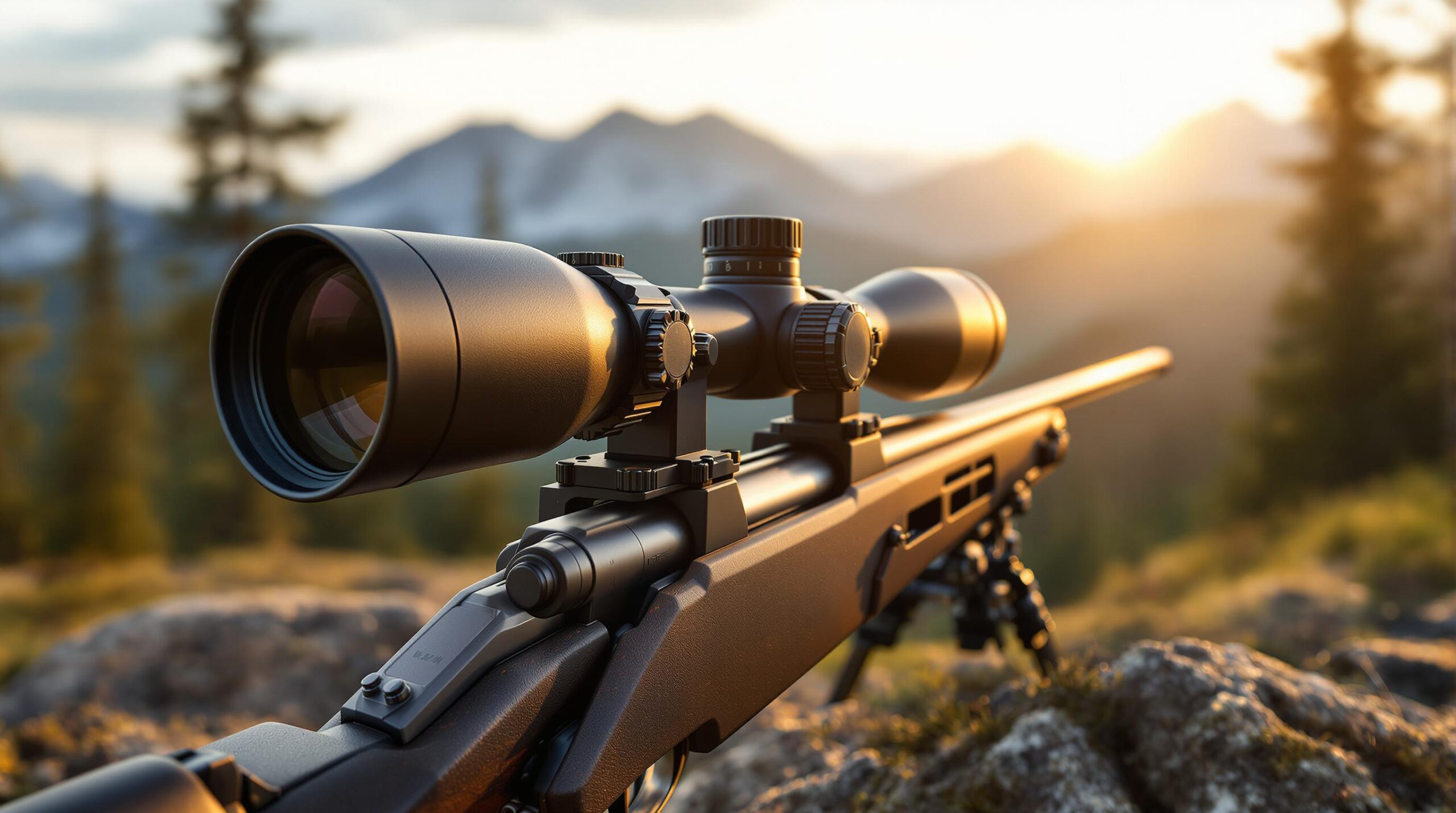
A good hunting scope can improve your accuracy, help in low-light conditions, and handle tough weather. Here’s a quick overview of the 10 must-have features you should look for:
- Zoom Power Range: Match magnification to your hunting terrain (e.g., 3–9x for forests, 4–16x for open fields).
- Front Lens Size: Larger lenses (50mm+) gather more light but add weight; a 40–44mm lens is a good all-around choice.
- Crosshair Types: Choose reticles like Duplex for simplicity or BDC for long-range shooting.
- Build Quality: Look for waterproof, fogproof, and shockproof materials like aircraft-grade aluminum.
- Lens Coating: Fully multi-coated lenses improve light transmission and clarity.
- Dawn/Dusk Performance: Scopes with 90%+ light transmission and illuminated reticles work best in low light.
- Adjustment Controls: Capped turrets for protection or exposed turrets for precise, long-range adjustments.
- Eye Relief: Ensure 3.5–4+ inches to avoid scope bite, especially with high-recoil rifles.
- Field of View (FOV): Wide FOV for dense woods; narrow FOV for long-range precision.
- Parallax Adjustment: Fixed for general use or adjustable for long-range accuracy.
Quick Comparison Table
| Feature | Best Use Case | Key Considerations |
|---|---|---|
| Zoom Power Range | Close or long-range hunting | Match magnification to terrain |
| Lens Size | Low-light or general hunting | Balance light-gathering and weight |
| Reticle | Dense woods or open fields | Simplicity vs. advanced features |
| Build Quality | Harsh weather or rugged use | Waterproof, fogproof, shockproof |
| Lens Coating | Low-light clarity | Fully multi-coated for best results |
| Dawn/Dusk | Low-light hunting | High light transmission, illumination |
| Turrets | Dense woods or open fields | Capped for protection, exposed for precision |
| Eye Relief | High-recoil rifles | 3.5–4+ inches for safety |
| FOV | Dense woods vs. open fields | Wide for tracking, narrow for precision |
| Parallax | General vs. long-range hunting | Fixed for simplicity, adjustable for precision |
These features ensure your scope performs well in any hunting environment. Keep reading for detailed explanations and tips to choose the right scope for your needs.
Understanding Your Optics: Rifle Scopes
1. Zoom Power Range
Choosing the right magnification is crucial for a successful hunt. Your ideal zoom level depends on the terrain and the typical distance of your shots. Since magnification directly impacts both accuracy and target acquisition, it’s essential to match it to your hunting environment. For example, in the Midwest, where most shots are within 200 yards, a 3–9x or 2.5–10x scope usually works well.
Here’s a quick guide to help you pick the right magnification based on your hunting scenario:
| Hunting Environment | Recommended Magnification | Typical Range (Yards) |
|---|---|---|
| Dense Forest/Timber | 1–4x or 2–7x | 50–150 |
| Mixed Terrain | 3–9x or 2.5–10x | 100–250 |
| Open Country/Western | 4–16x or 6–24x | 250+ |
In dense woods, lower magnification (up to 6x) offers a wider field of view, making it easier to spot and track targets quickly. For instance, at 3x magnification, your field of view is about 34 feet, but it narrows to just 8 feet at 10x magnification.
When hunting in open country, flexibility is key. Vortex Optics emphasizes:
"Get the magnification that fits the application for the riflescope 80-90% of the time."
A good rule of thumb is to use about 1x magnification per 100 feet for an accurate shot. However, don’t overdo it – too much zoom reduces your field of view and magnifies any shaking.
For dangerous game like leopards or cape buffalo, lower magnification (1–5x or 2–8x) is ideal. It ensures faster follow-up shots and better situational awareness. While high magnification might seem appealing, it compromises stability, light transmission, and your ability to react quickly. In fact, many hunters successfully hit deer-sized targets at 200 yards with just 3x or 4x magnification, proving that more zoom isn’t always better.
2. Front Lens Size
Once you’ve set your zoom power range, it’s time to focus on the size of the objective lens. This is a critical factor in how much light your scope can transmit, directly affecting its performance. The diameter of the objective lens is measured in millimeters and plays a big role in determining how well the scope works in different lighting conditions.
Here’s a quick guide to help you choose:
| Objective Size | Weight Range | Best Use Case | Typical Mount Height |
|---|---|---|---|
| Small (28–32 mm) | 10–13 oz | Dense forest, brush hunting | Low |
| Medium (40–44 mm) | 12–15 oz | All-purpose hunting | Medium |
| Large (50 mm+) | 16–21+ oz | Low-light, long-range | High |
Larger lenses gather more light, which is great for low-light conditions, but they also add extra weight and require taller mounting rings. Keep in mind, however, that the human eye has its limits. For example, hunters over 40 may find their pupils only dilate to 5–6 mm, which can limit how much brightness they perceive, even with a larger lens.
A few key factors to consider:
- Mounting height: Bigger lenses need taller rings, which can affect your cheek weld and overall comfort.
- Weight distribution: A standard 40mm lens adds about 12–15 oz to your rifle, while a 50mm+ lens can add 16–21+ oz.
- Field of view: Pairing a large objective lens with high magnification can reduce the "eye box", making it harder to quickly acquire targets.
- Light transmission: A high-quality 40mm scope can often deliver better brightness than a lower-quality 50mm scope.
For most hunting situations, a 40–44mm objective lens strikes a great balance. It gathers enough light while keeping the weight manageable, ensuring your scope works well in the field without compromising comfort or performance.
3. Crosshair Types
Choosing the right reticle design can fine-tune your aiming system and improve accuracy by matching your scope to the environment. This complements earlier discussions on magnification and lens choices, ensuring your setup is tailored to your hunting needs.
| Reticle Type | Best For | Key Benefits |
|---|---|---|
| Duplex | Big game, general use | Simple design for quick target acquisition |
| BDC (Bullet Drop Compensator) | Open fields, medium range | Helps account for bullet drop over distance |
| V-Plex | Dense timber, brush | Clean sight picture for fast targeting |
| German # | Dawn/dusk hunting | Thick posts improve visibility in low light |
| Christmas Tree | Long-range shooting | Assists with wind drift and elevation holds |
For dense woodlands, simpler reticles like the V-Plex offer a clear aiming point, making it easier to quickly lock onto targets in fast-moving situations.
Low-light conditions call for illuminated reticles. As one expert puts it:
"I have been increasingly reluctant to recommend any scopes that do not have illumination. With modern technology, more or less any scope above $1k should have it as far as I am concerned."
When deciding on a reticle, keep these factors in mind:
- Environment Fit: Use simple designs like the V-Plex for wooded or close-range settings. Opt for options like BDC for open fields or longer distances.
- Lighting Conditions: Illuminated reticles provide better contrast in low light without affecting night vision.
- Battery Considerations: Non-illuminated reticles are always ready, while illuminated ones require regular battery checks.
- Color Choice: Red illumination helps preserve night vision, while green is more effective in daylight.
4. Build Quality and Protection
When it comes to hunting, durability and protection are just as important as optical performance. Your scope needs to handle tough conditions without compromising its functionality. Here’s a closer look at the materials and protective features that help ensure long-lasting performance.
Top-quality scopes are typically crafted from aircraft-grade aluminum and impact-resistant polymers, providing the strength needed to withstand recoil and harsh conditions.
| Protection Rating | What It Means | Recommended For |
|---|---|---|
| IPX7 | Waterproof up to 1 meter for 30 minutes | Hunting in all weather conditions |
| 1000-2000g | Shockproof for recoil resistance | High-caliber rifles |
| -40°F to 122°F | Handles extreme temperatures | Harsh weather environments |
These ratings give you a clear picture of how well a scope can endure demanding field conditions.
Weather Protection Features
- Nitrogen Purging: Removes moisture and prevents fogging inside the scope.
- O-ring Seals: Ensures a watertight barrier for added protection.
- Temperature Resistance: Keeps the scope functional during sudden temperature shifts.
"Whether you’re a tactical operator, a competitive shooter, or an avid hunter, the reliability of your rifle scope is paramount, especially when you’re depending on it in demanding environments." – CVLIFE
For example, ZEISS puts its scopes through rigorous temperature shock tests in under 5 minutes, proving their reliability in rapidly changing conditions.
Maintenance Tips
To keep your scope in top shape:
- Store it in a cool, dry place.
- Use scope covers to shield it from direct sunlight.
- Regularly check O-rings for wear and tear.
- Always clean lenses with a microfiber cloth.
When choosing a scope, opt for models with solid weatherproofing and shock resistance. These features ensure your scope performs reliably, no matter the challenges you face during your hunting trips.
5. Lens Coating Quality
The quality of lens coatings plays a crucial role in improving light transmission and image clarity. Advances in coating technology have significantly boosted scope performance, with top-tier coatings allowing up to 99.9% of available light to pass through a single lens.
Understanding Coating Types
Here’s a breakdown of the most common coating levels and their features:
| Coating Level | Description | Light Transmission |
|---|---|---|
| Coated | A single anti-reflective layer on one or more lens surfaces | – |
| Fully Coated | A single anti-reflective layer on all lens-to-air surfaces | – |
| Multi-Coated | Multiple layers on some lens surfaces | >75% |
| Fully Multi-Coated | Multiple layers on all lens-to-air surfaces | >85% |
Without proper coatings, lenses can lose up to 50% of the light. High-end scopes now include up to 40 layers of specialized coatings, which not only improve performance but also add durability.
Performance Benefits
- Better Light Transmission: Achieve over 95% light transmission.
- Accurate Colors: Maintain true-to-life color for precise target identification.
- Lens Protection: Prevent scratches and other damage.
- Weather Resistance: Keep moisture off lenses, avoiding water spots.
Thanks to modern coatings, the emphasis has shifted from simply choosing scopes with larger objective lenses. Often, investing in better coatings and high-quality optical glass provides a noticeable performance boost.
For the best low-light performance and long-term durability, opt for fully multi-coated scopes, even if they come with a higher price tag.
sbb-itb-31b92c7
6. Dawn and Dusk Performance
Twilight hours call for scopes that excel in low-light conditions.
The best scopes offer over 90% light transmission by focusing on key features:
| Feature | Optimal Specifications | Performance Impact |
|---|---|---|
| Objective Lens | 44–56 mm | Gathers more light without adding unnecessary weight |
| Magnification | 2.5–15× or 3–12× | Maintains light transmission effectively at mid-ranges |
| Light Transmission | Over 95% | Provides clear images even in dim lighting |
High-quality coatings and sturdy construction are essential for sharp imaging during dawn and dusk. These enhancements lead to several important design elements:
- Illuminated Reticle: Adjustable brightness ensures visibility as light changes.
- Weather Protection: Waterproof and fogproof designs handle early morning moisture with ease.
- Glass Quality: Fully multi-coated lenses minimize light loss for better clarity.
- Light Management: Models like the Leupold VX-5HD 3–15×44 and Bushnell Banner Dusk & Dawn 3–9×40 use advanced coatings and systems to boost light transmission and maintain contrast.
The Kahles K525i is a great example of how premium glass paired with advanced coatings can deliver outstanding clarity, even as daylight fades.
7. Adjustment Controls
Adjustment controls are essential for accurate shooting. Elevation and windage turrets help hunters fine-tune their aim, compensating for bullet drop and wind drift to ensure the point of aim matches the point of impact.
| Turret Type | Ideal Use Case | Benefits |
|---|---|---|
| Capped | Dense forest hunting | Shields the scope’s zero from accidental shifts |
| Exposed | Long-range shooting | Enables fast, precise adjustments in the field |
| Locking Exposed | Mixed terrain | Combines quick changes with secure settings |
Each turret click generally adjusts 1/4 inch at 100 yards, providing consistent and precise control. Many high-end scopes, like those with RevStop® Zero systems, allow a quick return-to-zero after making elevation adjustments.
Key adjustments include:
- Elevation Control: Adjusts for bullet drop over distance.
- Windage Adjustment: Corrects for horizontal drift caused by wind.
- Parallax Setting: Keeps the reticle and target on the same focal plane for a sharp image.
For hunting in dense terrain or mountainous areas, capped turrets are ideal to protect your zero. If you’re focusing on long-range shots, exposed turrets offer the flexibility needed for quick, precise changes.
To maintain accuracy, regularly inspect mounts and rings, confirm zero settings before each trip, make small adjustments when sighting in, keep adjustment mechanisms clean, and note successful settings for future reference.
Smooth, precise adjustments with clear tactile feedback are key features of a quality scope. These controls allow hunters to make quick, reliable corrections, even in tough conditions, ensuring dependable performance in the field.
8. Eye Distance Safety
Eye relief refers to the distance between your eye and the scope’s ocular lens. It’s an important safety feature that protects you from "scope bite", which happens when recoil causes the scope to hit your face. High-quality hunting scopes are designed to provide enough eye relief to avoid this issue. The table below breaks down the basics:
| Eye Relief Type | Distance | Best For | Key Features |
|---|---|---|---|
| Standard | 3.5–4 inches | Medium caliber rifles | Better magnification for long-range shots |
| Long | 4.5+ inches | High caliber rifles | Wider field of view and safer for recoil |
These distances help ensure your scope works well with different calibers and recoil levels.
"For most hunting rifles, you want 3.5-4 inches minimum between your eye and the scope. Some rifles and calibers need more breathing room. It’s usually 6+ inches to keep your eyebrow intact during recoil. I’ve tested dozens of scopes and anything less than 3.5 inches is asking for trouble, especially on harder-recoiling rifles."
In rugged areas like mountains, eye relief can naturally shorten due to the shooting angles. Scopes like the Leupold VX-Freedom, which offers 9.2–12 inches of eye relief, are great for such conditions.
Key safety tips:
- Use longer eye relief for firearms with heavy recoil.
- Always check the eye relief before using your scope.
- Keep your head in the correct position to avoid injury.
- Factor in terrain-specific needs when choosing a scope.
If you notice a black ring in your sight picture, it’s a sign of insufficient eye relief. This not only limits your view but also increases your risk of injury from recoil. Always prioritize proper eye relief – it’s better to have a little extra space than to risk a painful scope bite.
9. Viewing Area Width
The field of view (FOV) in a hunting scope determines how much of the area you can see at a specific distance, usually measured in feet at 100 yards. A broad FOV helps you spot targets faster and improves awareness of your surroundings. This is especially useful when tracking moving targets or scanning challenging terrain.
As you adjust your scope, it’s important to understand how FOV impacts target tracking. When magnification increases, FOV decreases. In dense forests, a wide FOV makes it easier to follow game, while in open landscapes, a narrower FOV with higher magnification is better for identifying targets at long range.
For fast-moving targets, a wide FOV is especially helpful. Low Variable Power Optics (LVPO) scopes, like 1-4x or 1-6x, are a great choice for close-range hunting since they offer a balance of wide FOV and sufficient magnification.
When choosing a scope, think about where you usually hunt. In wooded areas, a wider FOV helps you spot sudden movements. For long-distance hunting, you might prioritize higher magnification, even if it means sacrificing some FOV.
In short, using the right FOV for your environment can speed up target acquisition and improve awareness in different terrains.
10. Range Focus Settings
Range focus settings, often called parallax adjustment, play a key role in maintaining shooting accuracy. Just like elevation and windage controls, getting the parallax adjustment right ensures a clear and dependable sight picture.
Most basic hunting scopes come with a fixed parallax, usually set at 150 yards for centerfire rifles or 50 yards for rimfire rifles. While this is fine for most hunting situations, an adjustable parallax becomes crucial for precision shooting, especially at distances beyond 600 yards.
Parallax adjustment fine-tunes your sight alignment, complementing turret adjustments. As Richard Mann puts it:
"The parallax adjustment on a riflescope simply positions the reticle focus and the image focus at the same spot".
How to Adjust Parallax:
- Start by focusing the reticle using the diopter adjustment while looking at a plain background.
- Set the parallax dial to match your target’s distance.
- Slightly move your head to check if the reticle stays fixed on the target.
- Make minor adjustments if needed.
Here’s a quick look at the differences between fixed and adjustable parallax scopes:
| Feature | Fixed Parallax | Adjustable Parallax |
|---|---|---|
| Depth of Focus | Deeper | Narrower |
| Best Use Case | General hunting under 600 yards | Long-range precision shooting |
| Ease of Use | Simple, no adjustment needed | Requires manual adjustment |
| Typical Applications | Big game hunting | Target shooting, tactical uses |
For long-range shooting, an adjustable parallax scope allows for precise fine-tuning, helping to eliminate potential errors. If your reticle shifts when you move your head, here’s what to do:
- If the reticle moves left, increase the parallax distance setting.
- If it moves right, lower the distance setting until the reticle stays steady.
This extra adjustment step can make all the difference when accuracy is on the line.
Conclusion
Research highlights that quality optics play a key role in improving accuracy and hunting success. A 3–9×40 mm scope is a reliable choice for most big game hunters, offering the right mix of magnification for both close-range shots in dense forests and medium-range targeting in open fields. However, your specific needs will depend on the environment and conditions.
Here’s a quick guide to match scope features with your hunting environment:
| Hunting Environment | Recommended Configuration | Key Features to Focus On |
|---|---|---|
| Dense Forest | 3–9×40 mm | Lower magnification, wide field of view |
| Open Prairie | 4–12×50 mm | Higher magnification, larger objective lens |
| Mixed Terrain | 3–9×40 mm | Versatile zoom range, BDC reticle |
| Dawn/Dusk Hunting | 3–9×50 mm | Larger objective lens, illuminated reticle |
When working within a budget, prioritize optical quality and durability over additional features. Remember, even advanced features like turret adjustments and proper eye relief won’t matter much without practice.
Key trade-offs to keep in mind:
- A 50 mm objective lens improves light gathering but adds extra weight.
- Higher magnification enhances precision but limits your field of view and reduces brightness.
- Complex reticles can be helpful but may require extra training to use effectively.
Ultimately, scope selection is just the first step. Regular practice is what truly makes a difference. Even a basic scope can outperform a pricey one if you’ve put in the time to master it.
For beginners, a 3–9×40 mm scope with a BDC reticle is a solid, user-friendly option. Invest time in learning your scope, and you’ll increase your chances of a successful hunt every time.